Lecture Notes 22: Practice Reductions
Outline
This class we’ll discuss:
- Recap: Enumeration and Recognizers
- Mapping reducibility
A Slideshow:
GUIDED NOTES (Optional)
More Reductions: The EMPTY Language
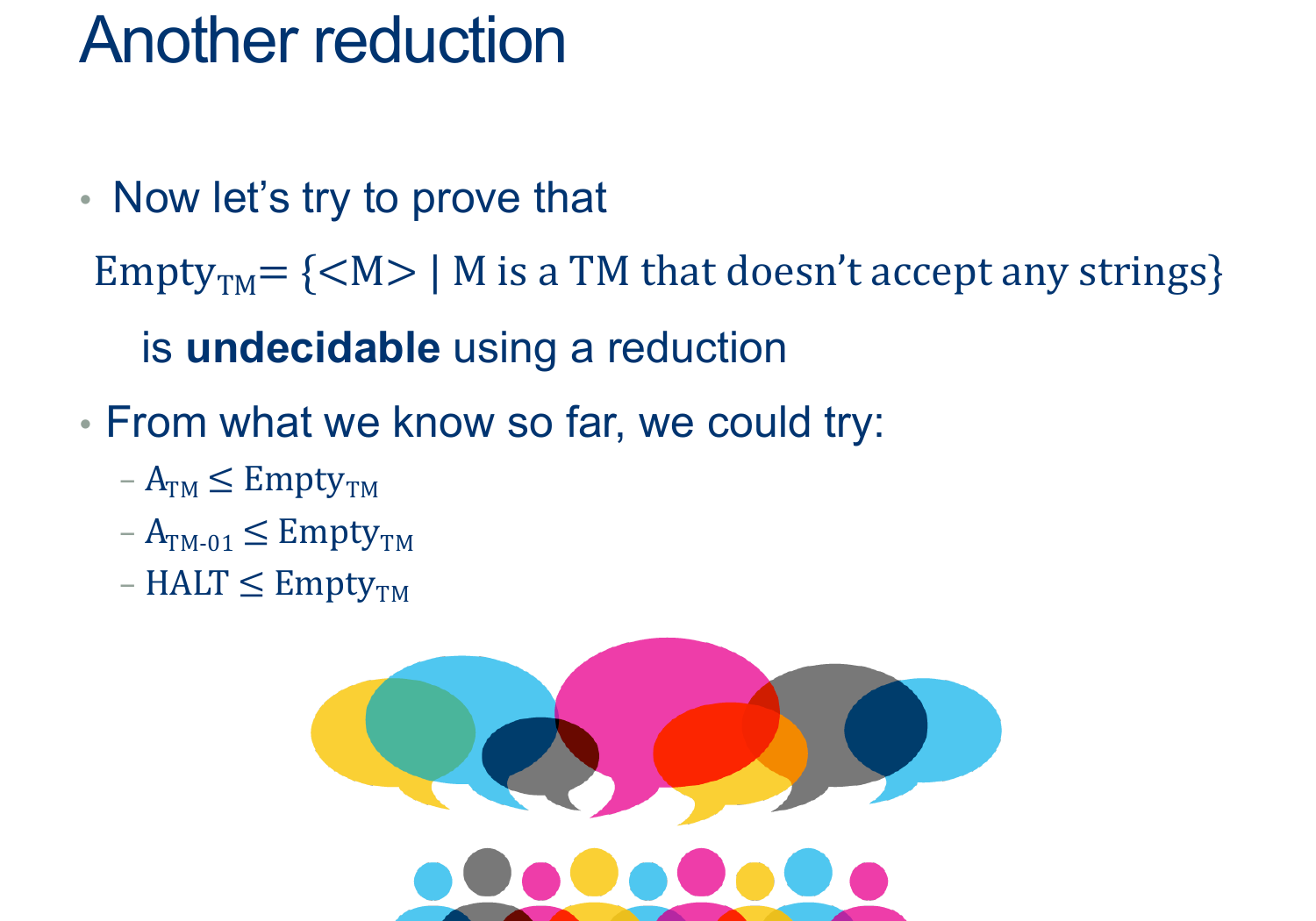
Let’s go together
Let’s use, in addition to $D_{EMPTY} $, an extra HELPER machine to help us extend the usefulness of $D_{EMPTY} $.
(Wait; then Click)
Assume that Empty_TM is decidable, and so there exists some $D_{EMPTY}$ that decides for any input $< M >$ whether $M$’s language is empty. We'll design the Machine $ D_{ATM} $ as follows: $$ \begin{align*} & D_{ATM}:\\ & \text{ On input $ < M, w > $ }:\\ & \text{ 1. build a HELPER machine (but don't run it yet) $Helper_{M,w}$ that is shown below: }\\ & \; \\ & \qquad Helper_{M,w}:\\ & \qquad \text{ On input $ x $ }: \quad \color{gray}{\text{# x: Anything! we don't care} }\\ & \qquad \text{ Ignore $ x $ and run $M$ on $w$ ADWID} \quad \color{gray}{\text{# We hardcode what $Helper_{M,w}$ does} }\\ & \; \\ & \text{ 2. Simulate $D_{EMPTY}$ on $Helper_{M,w}$ }\\ & \qquad \text{ If it accepts, REJECT (if the language of $Helper_{M,w}$ is empty, $M$ doesn’t accept $w$)}\\ & \qquad \text{ If it rejects, ACCEPT (the only way $Helper_{M,w}$ accepts anything is if $M$ accepts $w$)}\\ \end{align*} $$ Analysis of cases What is going on?:
- Inside our $D_{ATM} $ machine, we use $D_{EMPTY} $ to ask if its input TM $M$'s' language is empty ... But in order to do it ... it is forced to simulate the input machine $M$ ... instead of running $D_{EMPTY} $ on $M$, we can have $D_{EMPTY} $ run on a Trojan-Horse Machine whose only job is to check if $M$ accepts $w$!
- $Helper_{M,w}$ is a TM built solely to check if the $M$ actually accepts the $w$ from the input to $D_{ATM} $ ($ < M, w >$ ).
- When $D_{EMPTY} $ runs on $Helper_{M,w}$, it simlates $Helper_{M,w}$ (on some unimportant input); $Helper_{M,w}$ IGNORES the input and just runs $M$ on $w$ It will actually answer if $M$ accepts $w$ rather than if the input $Helper_{M,w}$ has an empty language.
- If $D_{EMPTY}$ returns ACCEPT, then $Helper_{M,w}$ rejects all words (because $M$ rejects $w$), so return REJECT
- If If $D_{EMPTY}$ returns REJECT it was because $Helper_{M,w}$ accepted, which means $M$ accepted $w$;so return ACCEPT
- The output of $D_{EMPTY} $ is NOT actually answering if its input has an empty language... it is secretly answering the question : "Does $M$ accept $w$?"
More Reductions: The $\overline{EMPTY}$ Language
Is $\overline{EMPTY}$ Decidable?
$\overline{EMPTY}$ is the complement language of $EMPTY$.
Its definition, should be:
\(\overline{EMPTY} = \{ < M > | \text{TM $M$ accepts at least one string} \}\)
There is a first simple step: We can say, for sure that $\overline{EMPTY}$ must be undecidable… Why?
Can we come up with a simple Recognizer?
(Wait; then Click)
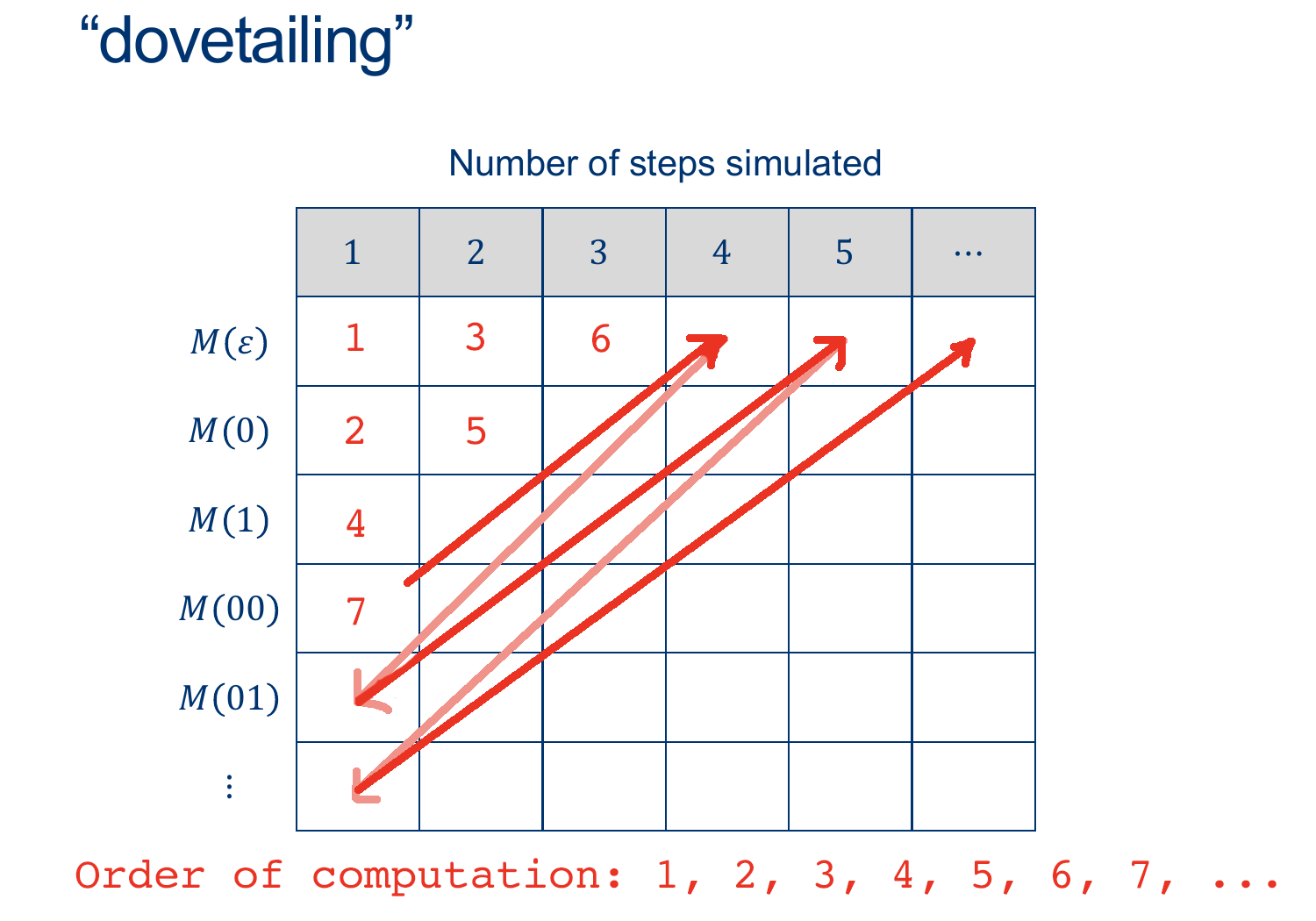
Recognizer by construction: $$ \begin{align*} &R_{\overline{EMPTY}}:\\ & \text{ On input $ < M > $ }:\\ & \text{ Simulate M on all possible w's one at a time}\\ & \text{ If any accepts, accept. }\\ \end{align*} $$ Is there a problem here?
(Wait; then Click)
The computation is FINITE!
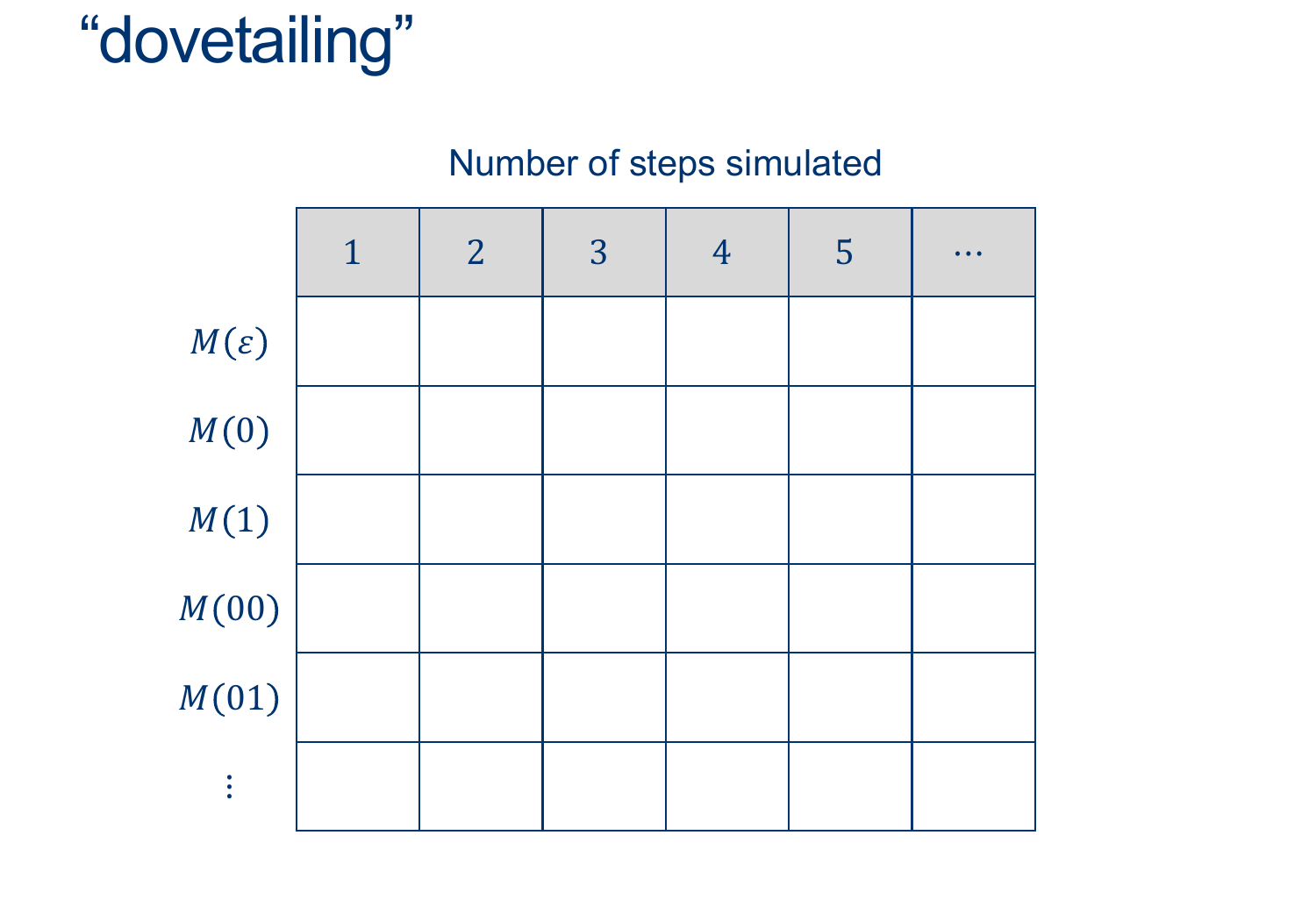
Attempt 2 at a Recognizer for $\overline{EMPTY}$
(Wait; then Click)
Recognizer by construction: $$ \begin{align*} &R_{\overline{EMPTY}}:\\ & \text{ On input $ < M > $ }:\\ & \text{ Simulate M on all possible w's DOVETAILED}\\ & \text{ If any accepts, accept. }\\ \end{align*} $$
More Reductions: The $\overline{EQ}$ Language
A proof:
(Wait; then Click)
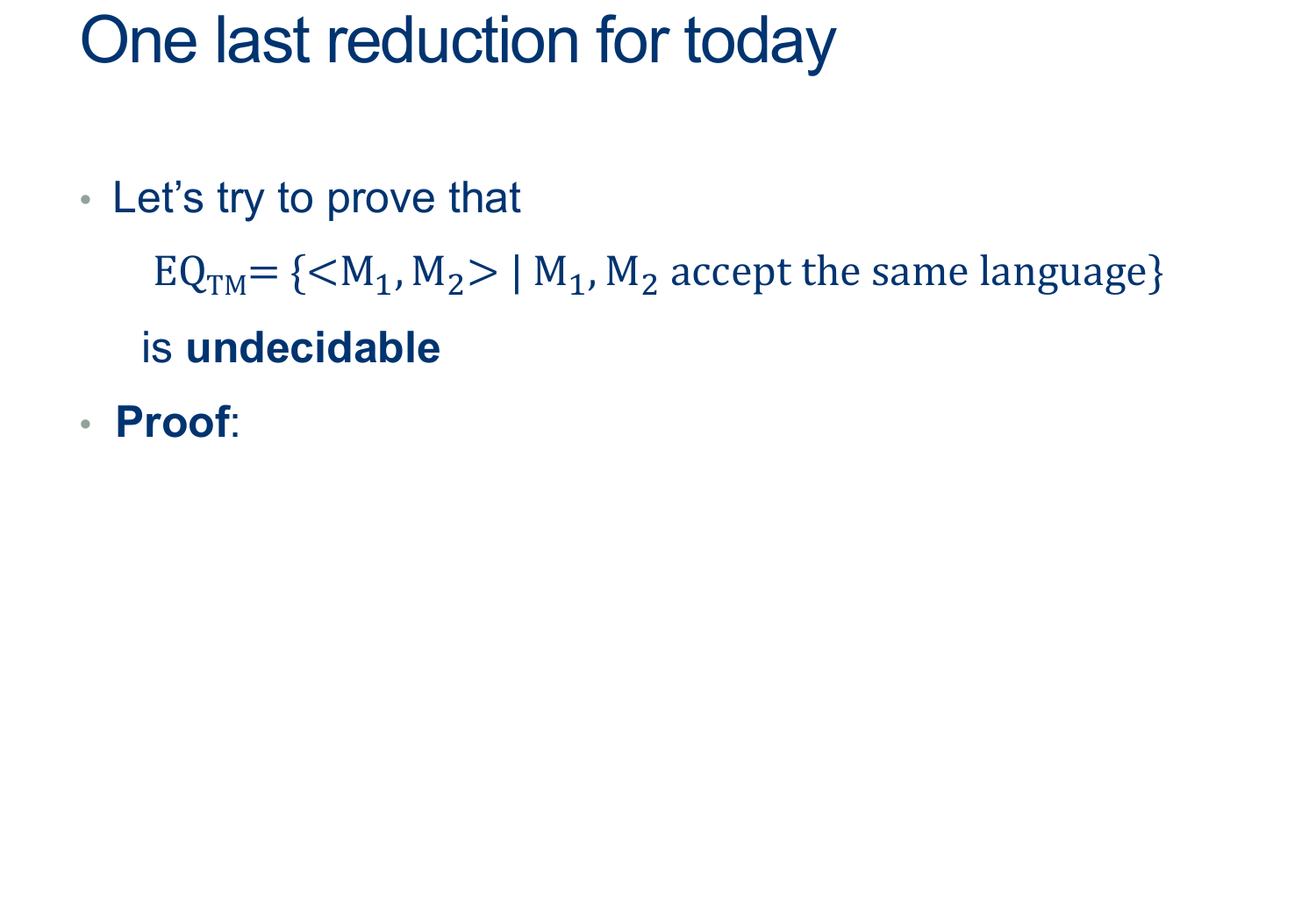
Reducing EMPTY to EQ. $$ \begin{align*} &D_{EMPTY}:\\ & \text{ On input $ < M > $ }:\\ & \text{ Build a helper $TM_{\emptyset}$ such that $L(TM_{\emptyset}) = \emptyset$ }:\\ & \text{ Run $D_{EQ}$ on input $ < M, TM_{\emptyset} >$ ADWID}\\ \end{align*} $$ Note that $D_{EQ}$ tells whether $\; < M, TM_{\emptyset} > \; \in \; EQ \;$ , that is, whether $L(M) = L(TM_{\emptyset}) = \emptyset$... Which is the question that $D_{EMPTY}$ is supposed to answer.