Lecture Notes 05: Finite Automata
Outline
This class we’ll discuss:
- RE power
- Algorithms: Code, RegExes, and Diagrams
- Intro to Finite Automatons
A Slideshow:
GUIDED NOTES (Optional)
Recap: RegExes, how powerful are they?
For the the Machine Abstraction of Regular Expressions, we can ask:
what problems can they solve?
In other words: Which Language sets can they generate/accept?
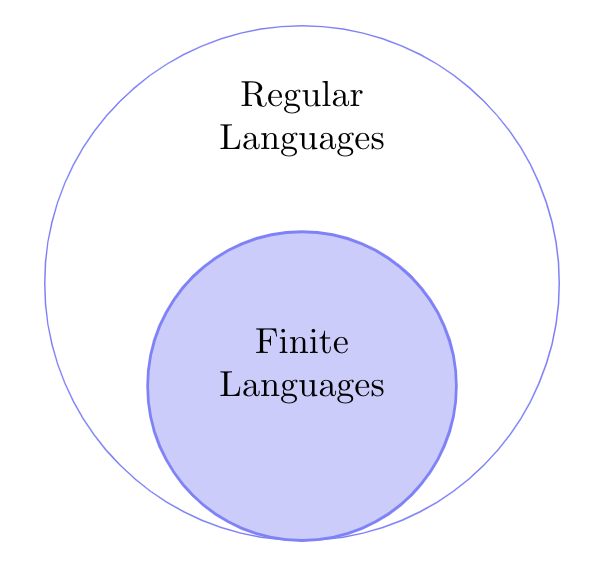
Regular Languages are more powerful than Finite Languages (can encompass more)
Still confused about RExs? Go to Office Hours with Winnie!! (and with me)
Algorithms: Code, RegExes, and Diagrams
As we saw above, an algorithm can be encoded as:
- RegEx
- (pseudo) Code
But we know that a piece of code can also be drawn using things like a “Flow Diagram”!
In this section, we’ll use a special type of diagram called a State Diagram.
State Diagram
A State diagram looks like this:
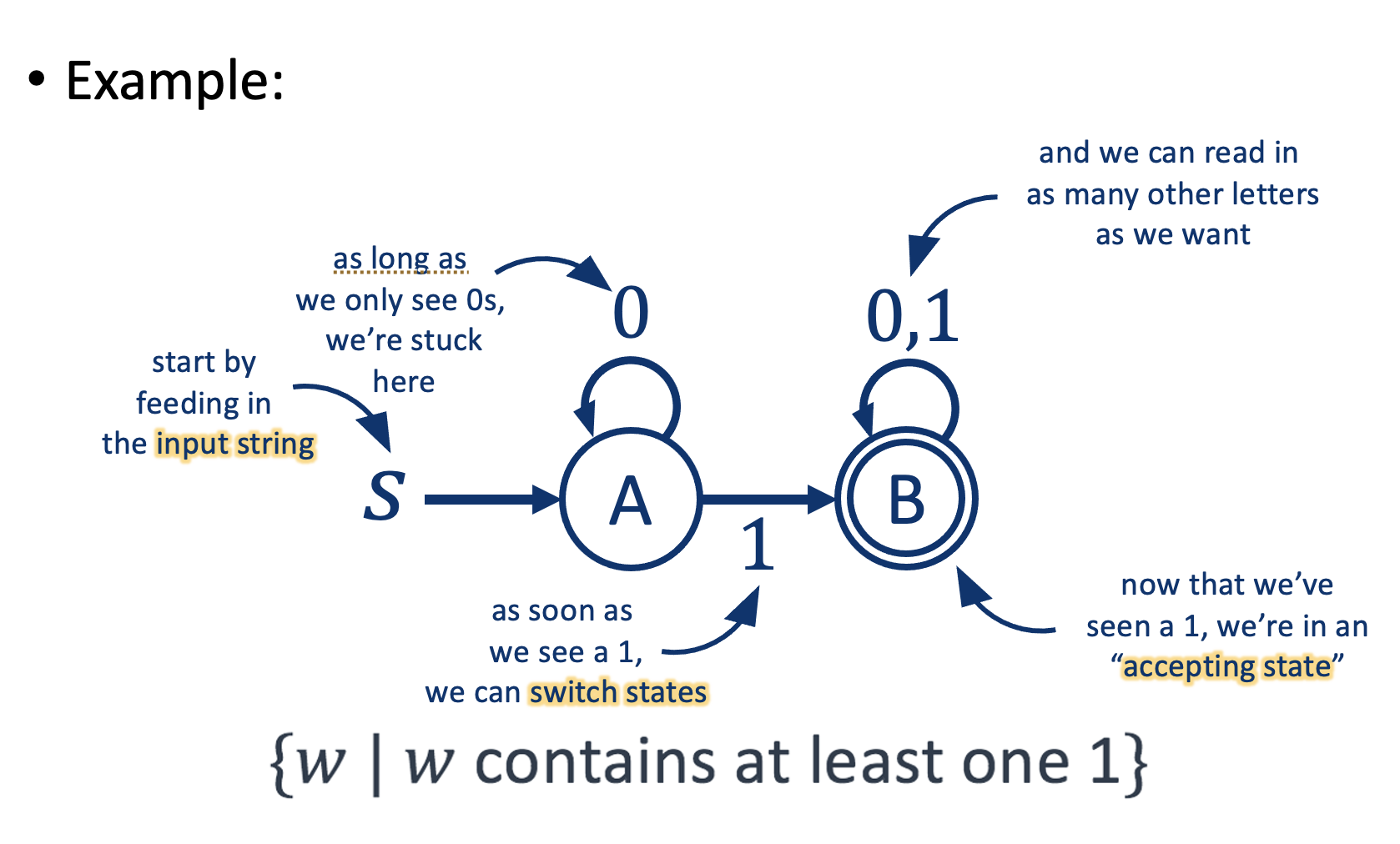
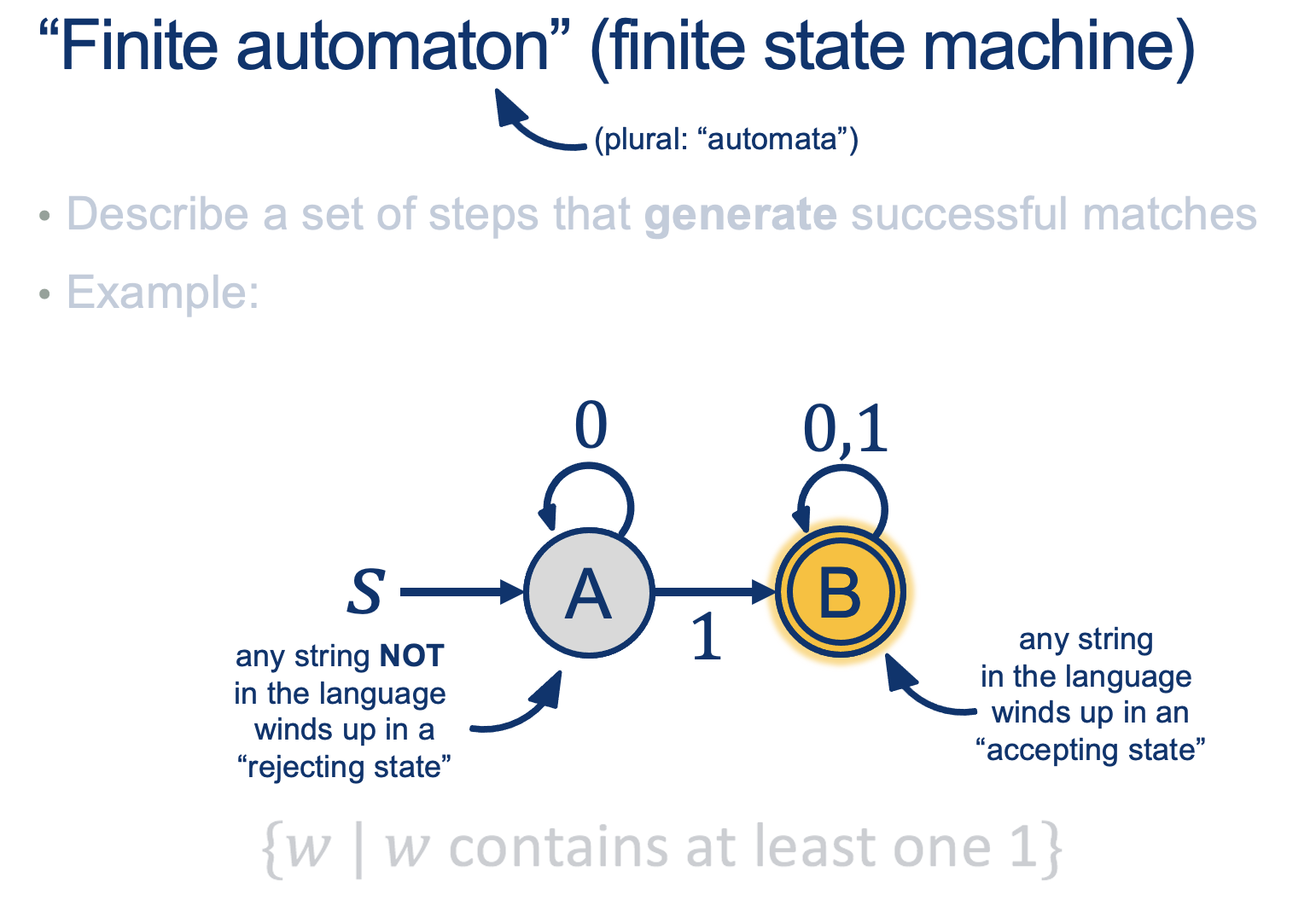
Finite Automaton AKA: Finite State Machine (FSM)
- Finite number of states
- Follows Rules that have been programmed beforehand
Operation Examples
Example 01: Processing a String
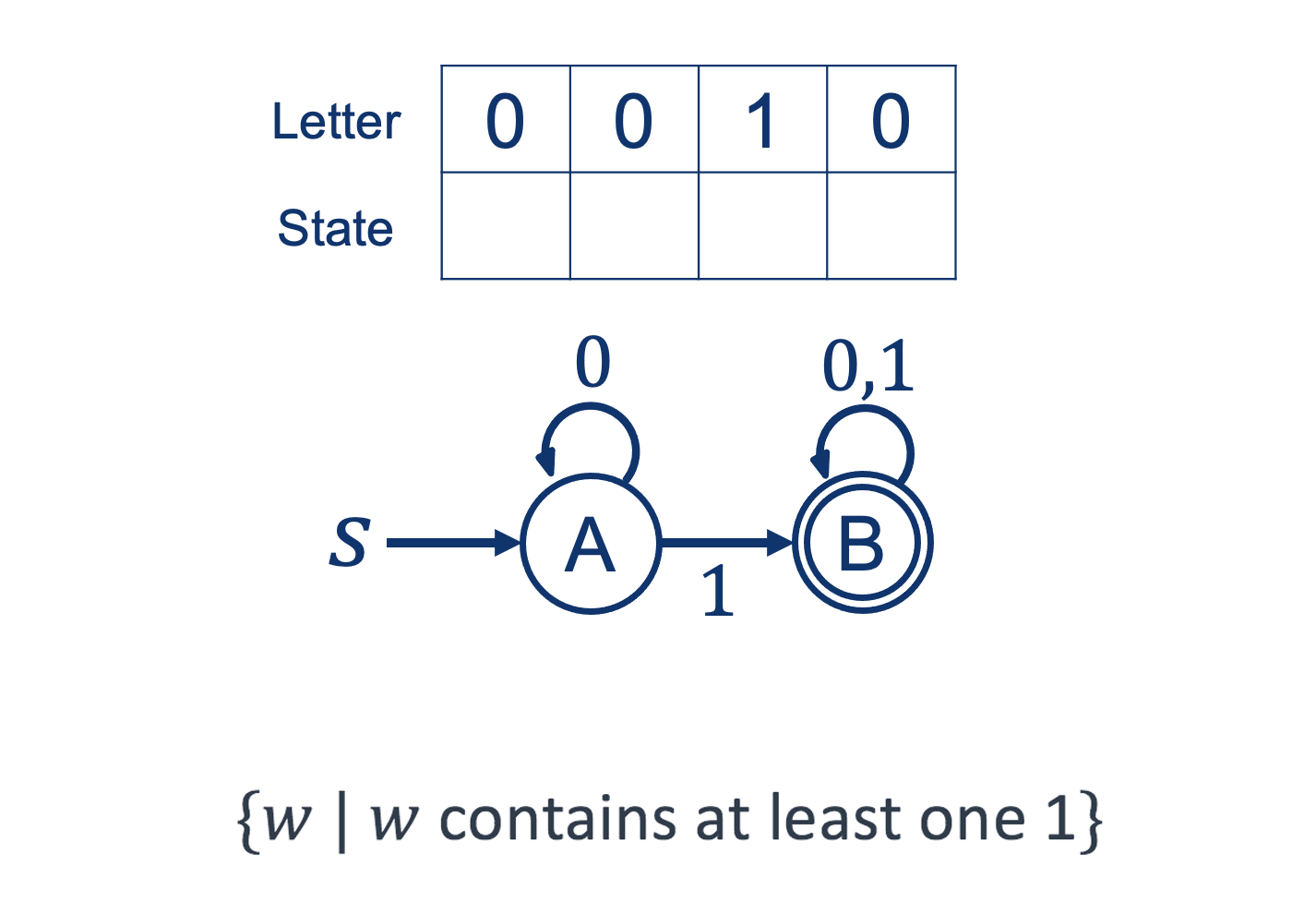
Example 02: Processing a String
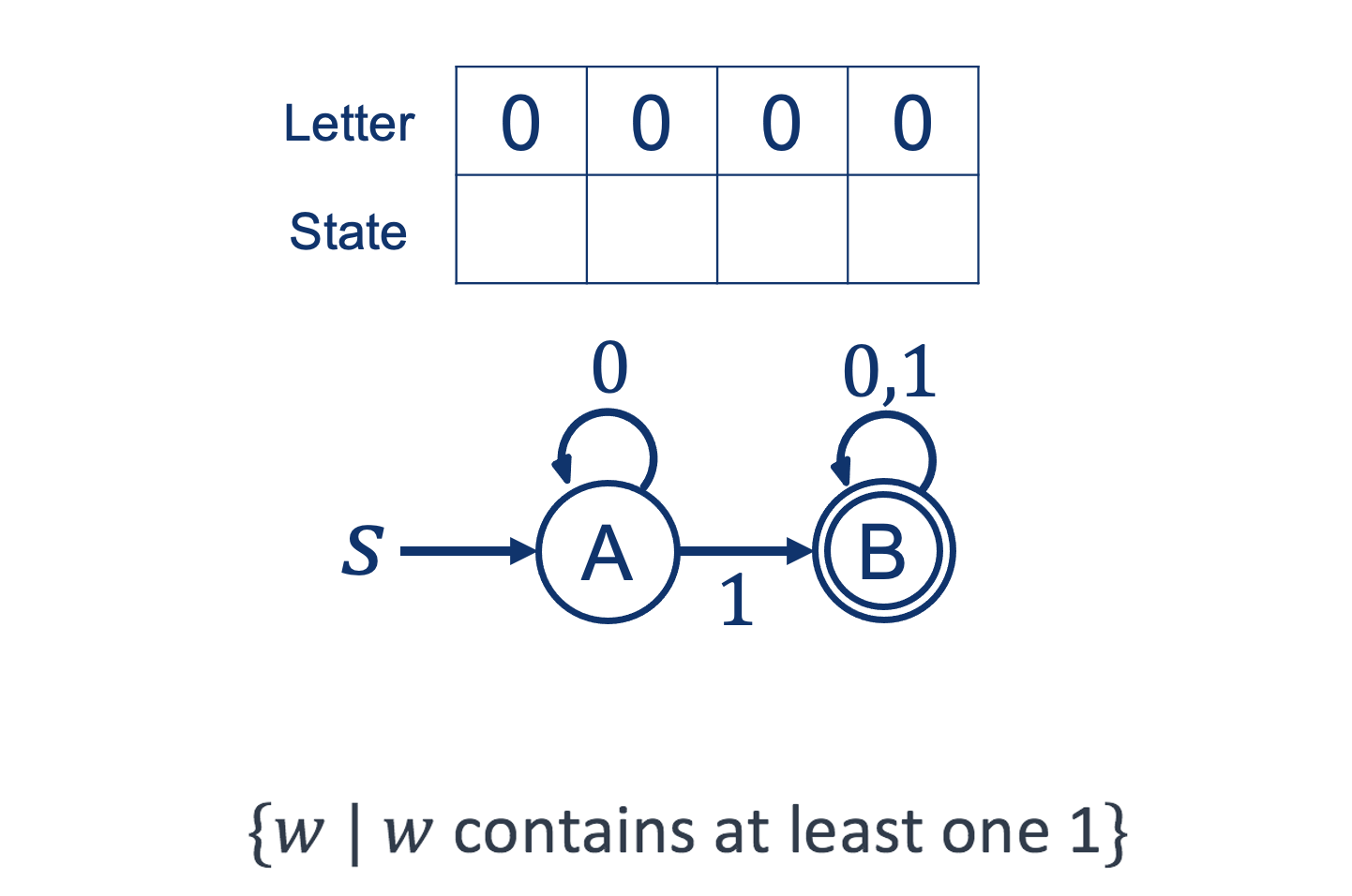
Example 03: Processing a String
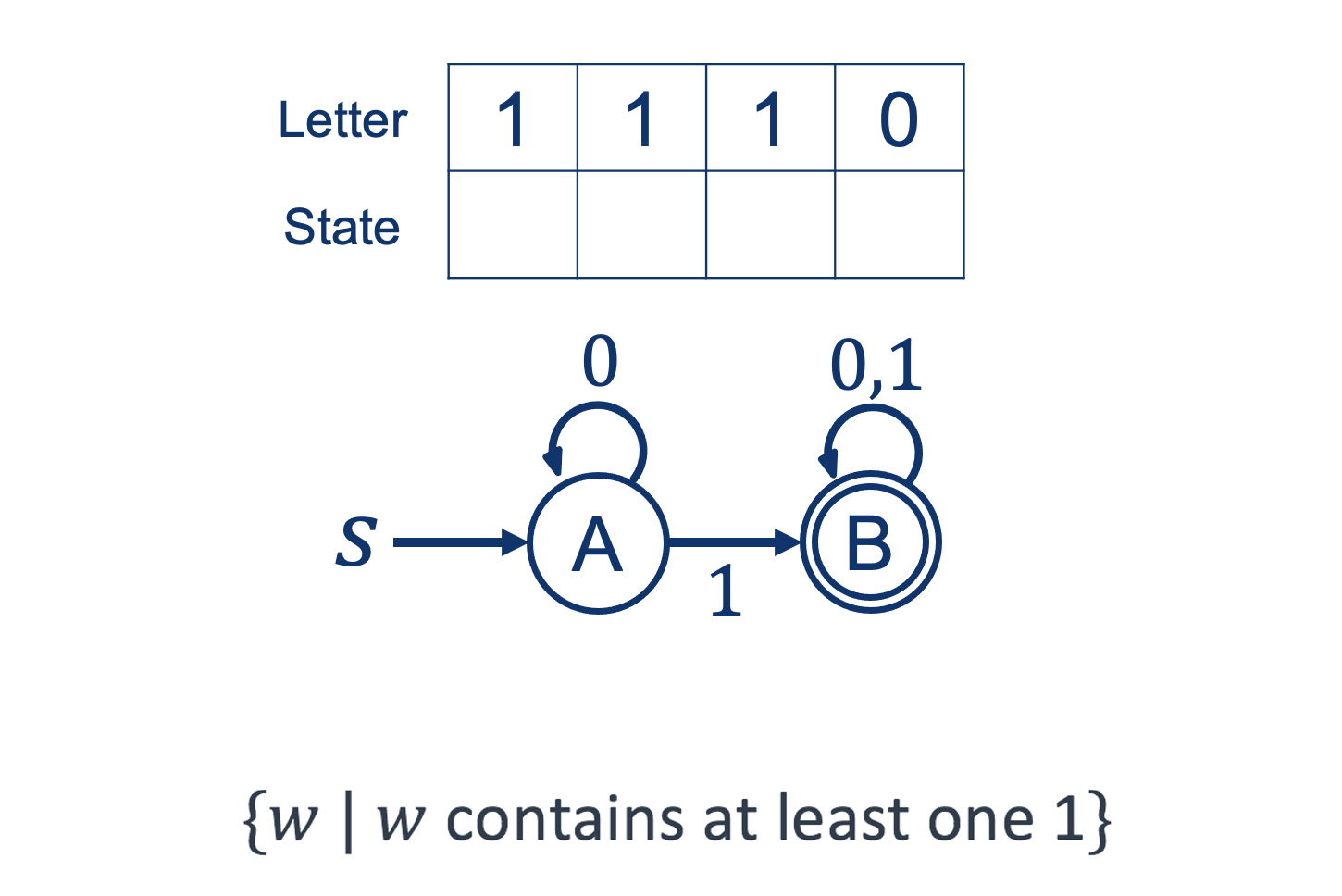
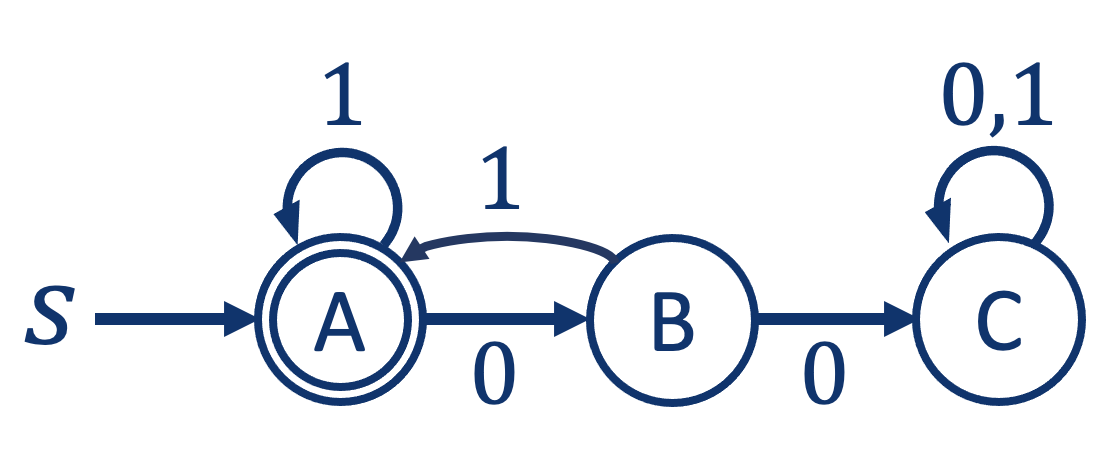
Activity 1 [2 minutes]:
Try to build your own machine. One that “Accepts” this set:

(Wait; then Click)
Alphabets and languages
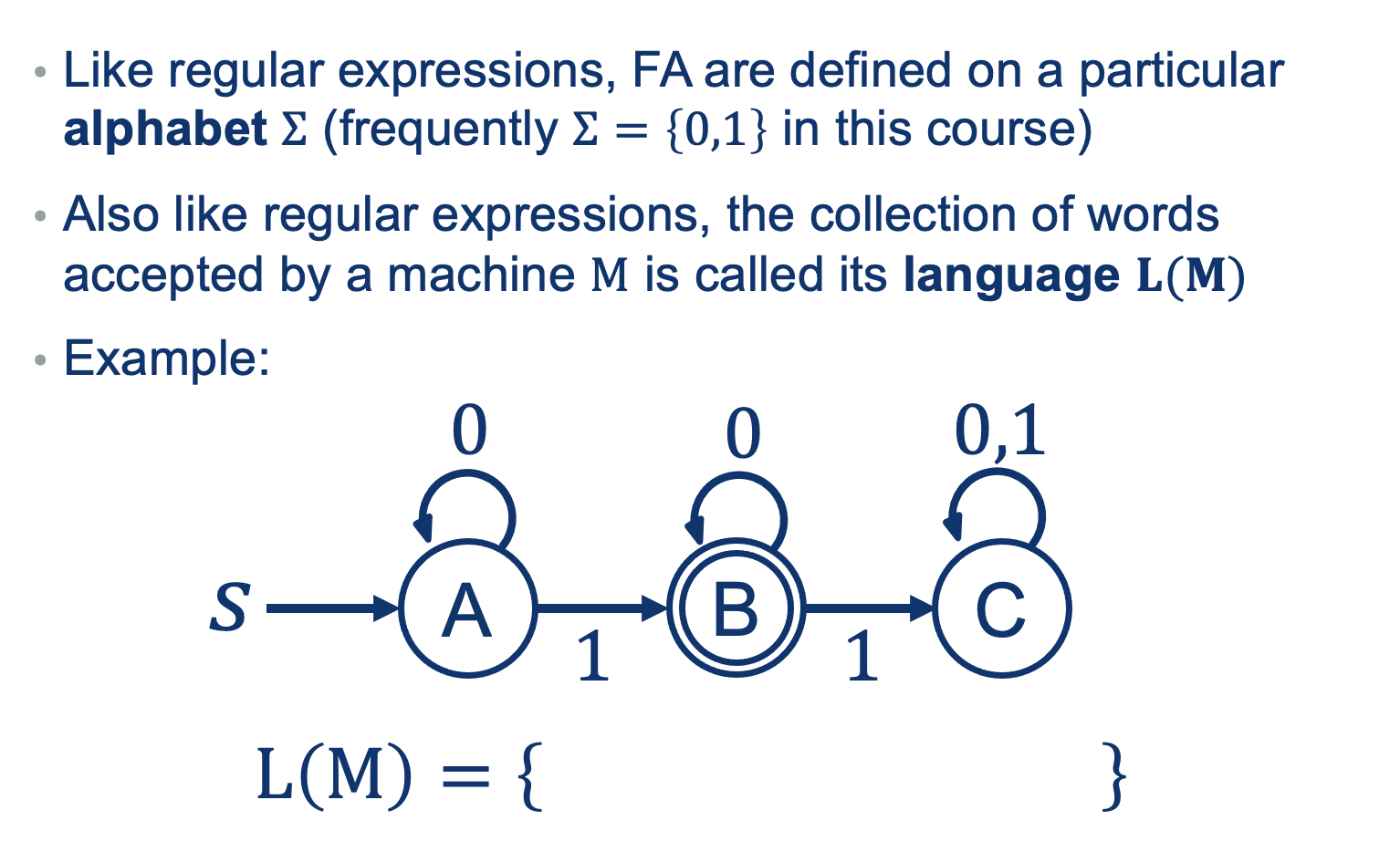
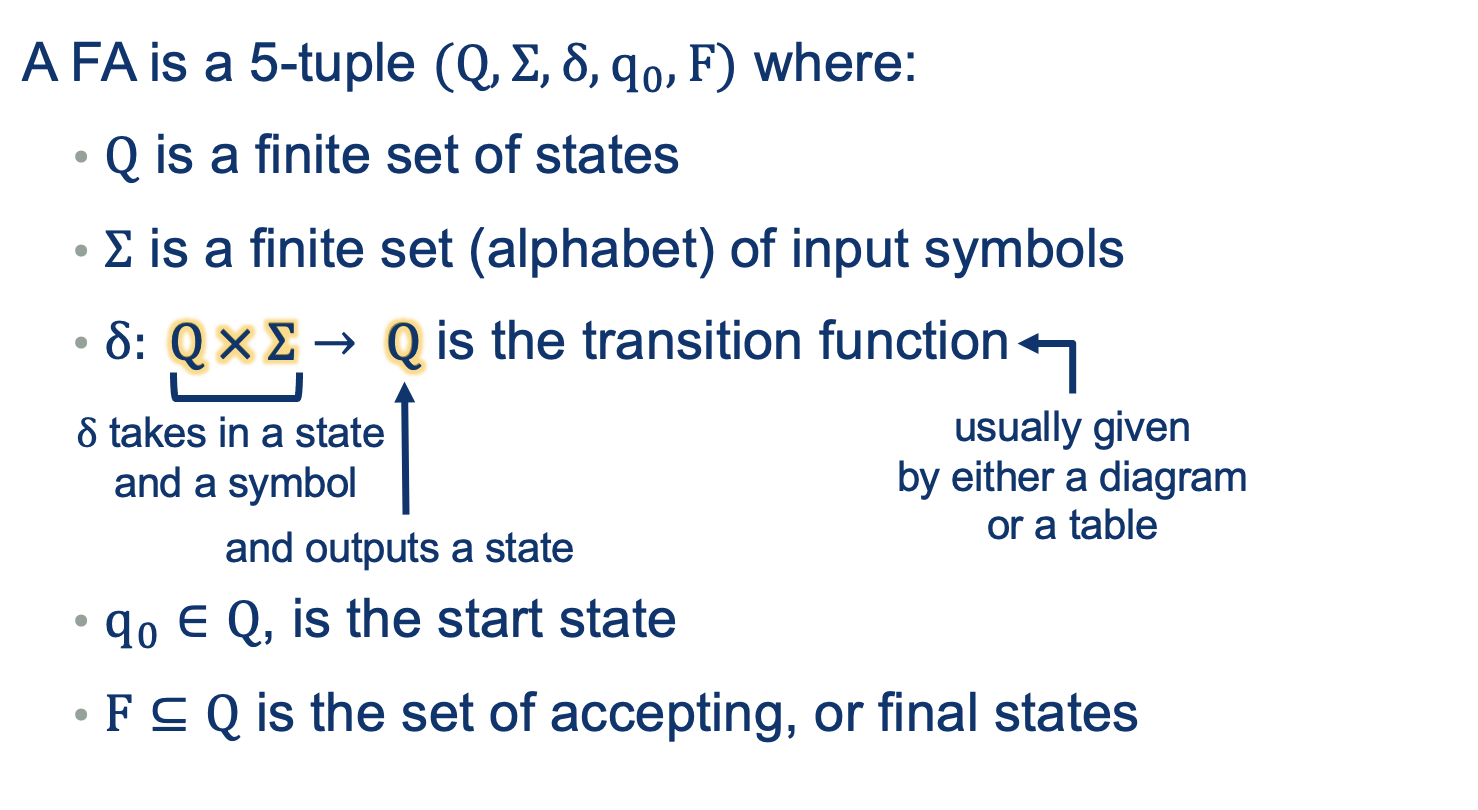
Formal Definition
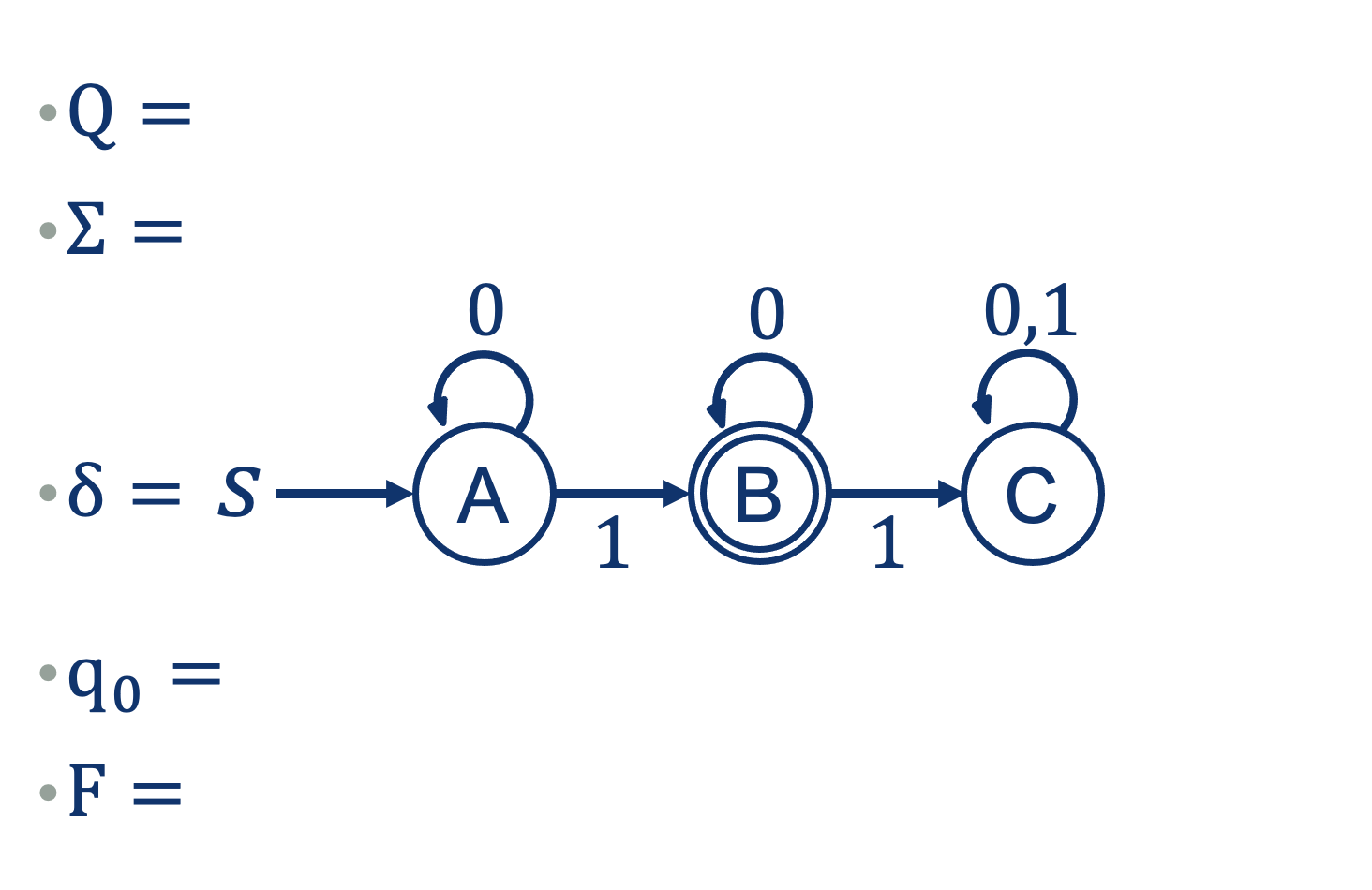
Our Last Example:
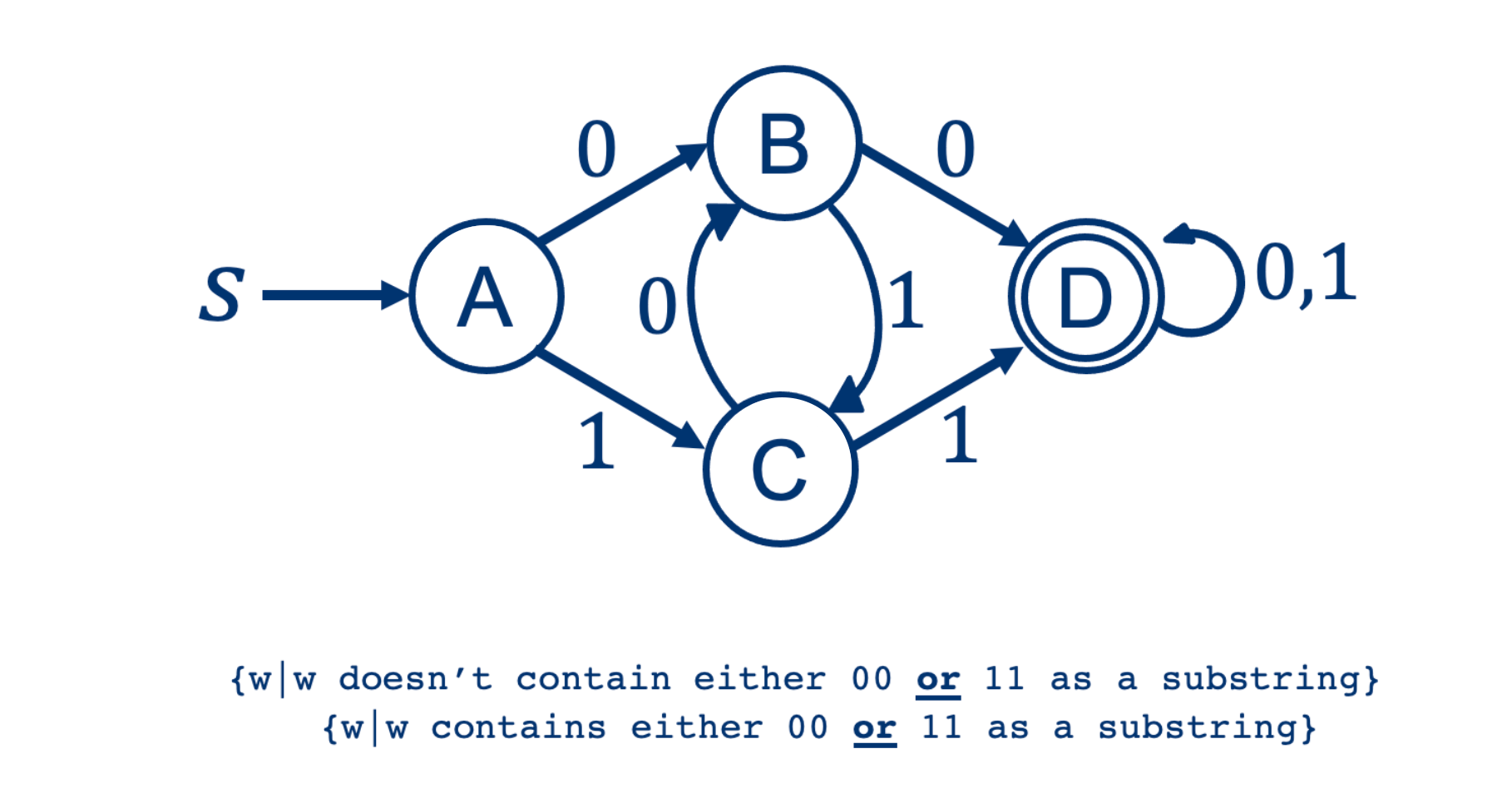
Operators in FSMs: OR
How might we handle a language that contains an or?
Example:
\[\{w \vert w \text{ doesn’t contain either 00 or 11 as a substring}\}\]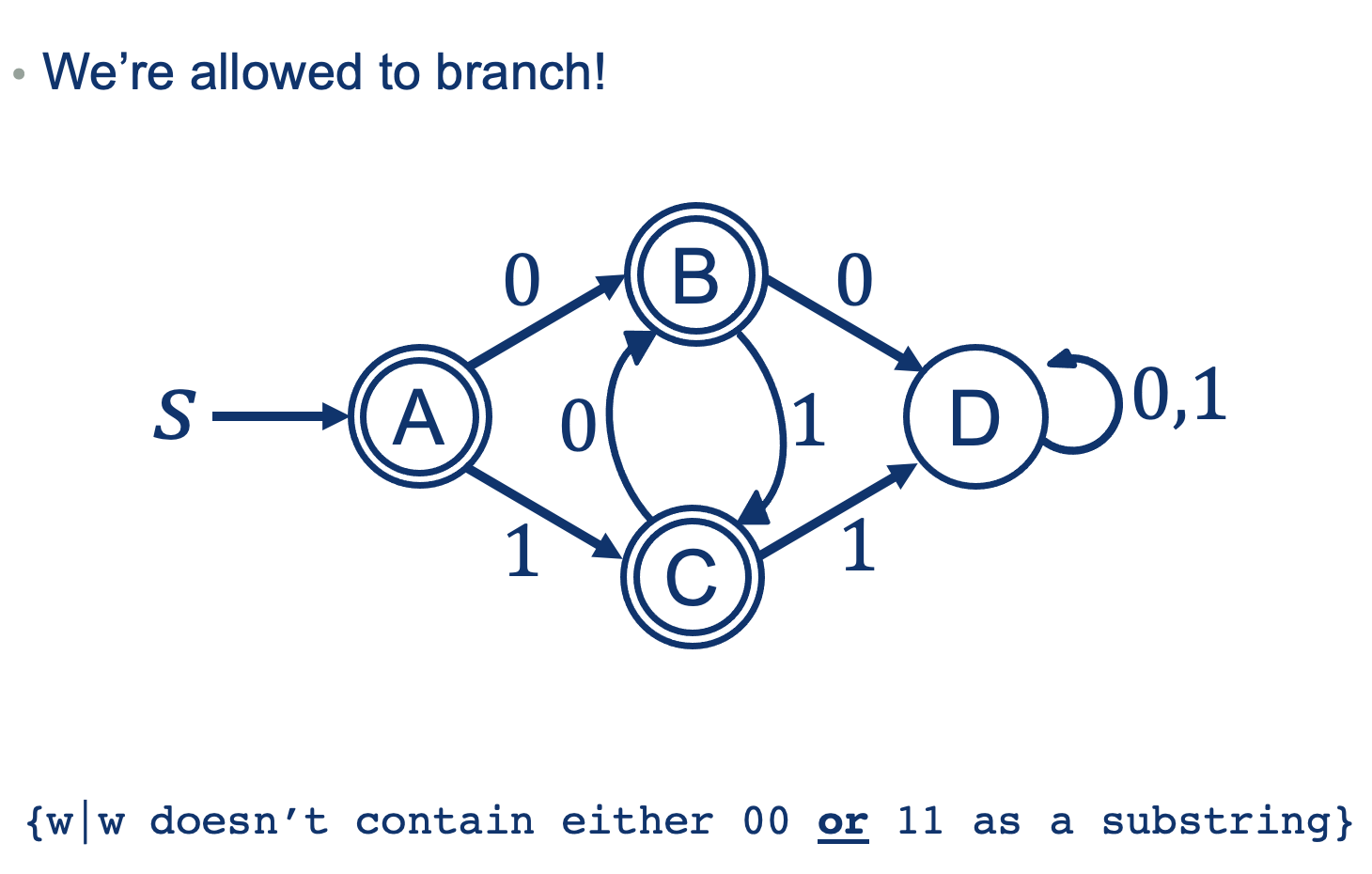
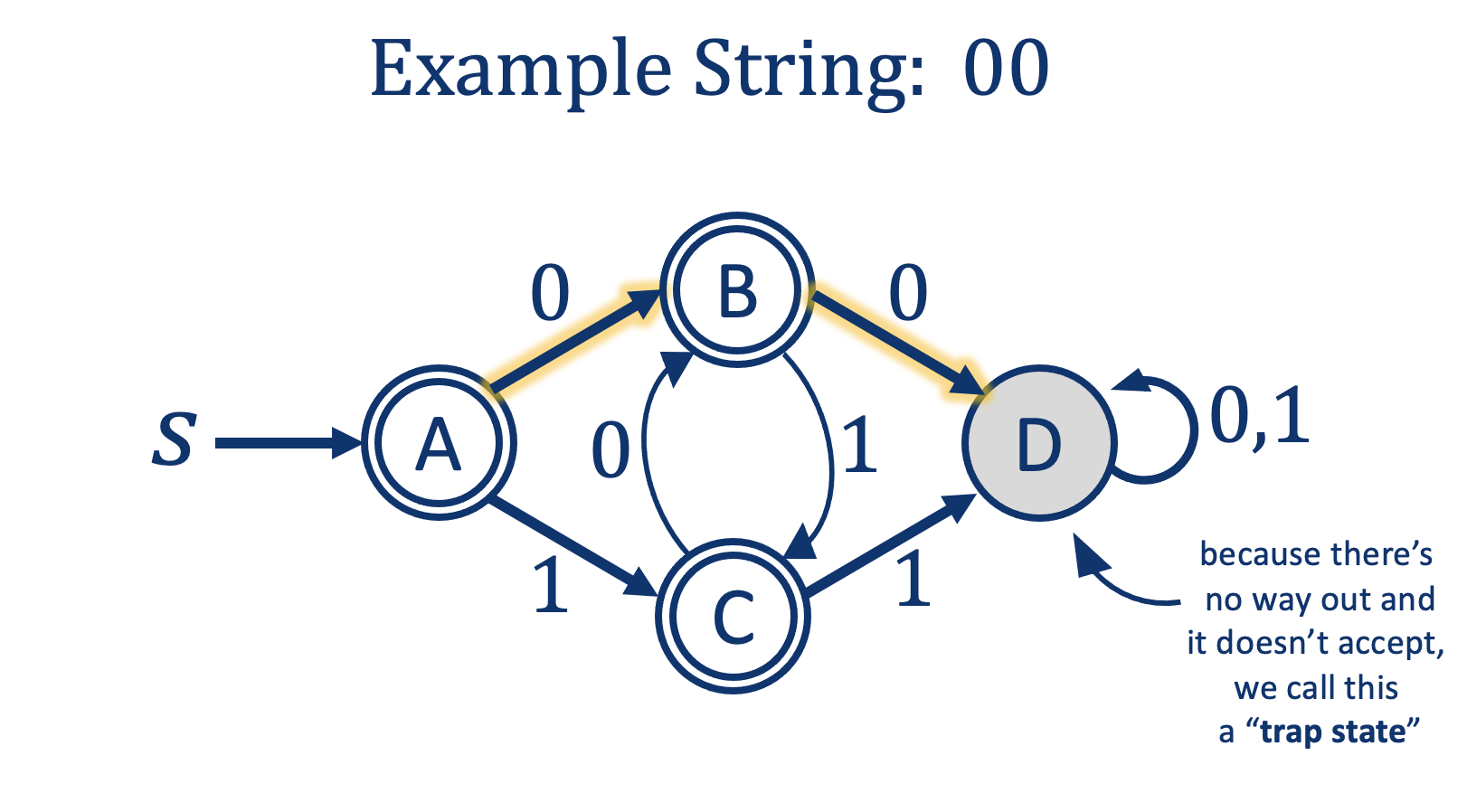
Let’s try one basic example:
Activity 2 [2 minutes]:
Explain the sequence of states for these words:
- 101010
- 010110
- 110011
Activity 3 [2 minutes]:
Answer the following questions:
- What is the descriptive power of Finite Automata? (Wait; then Click)
(Wait; then Click)
We need to compare it with regular expressions... we'll do that bit by bit.

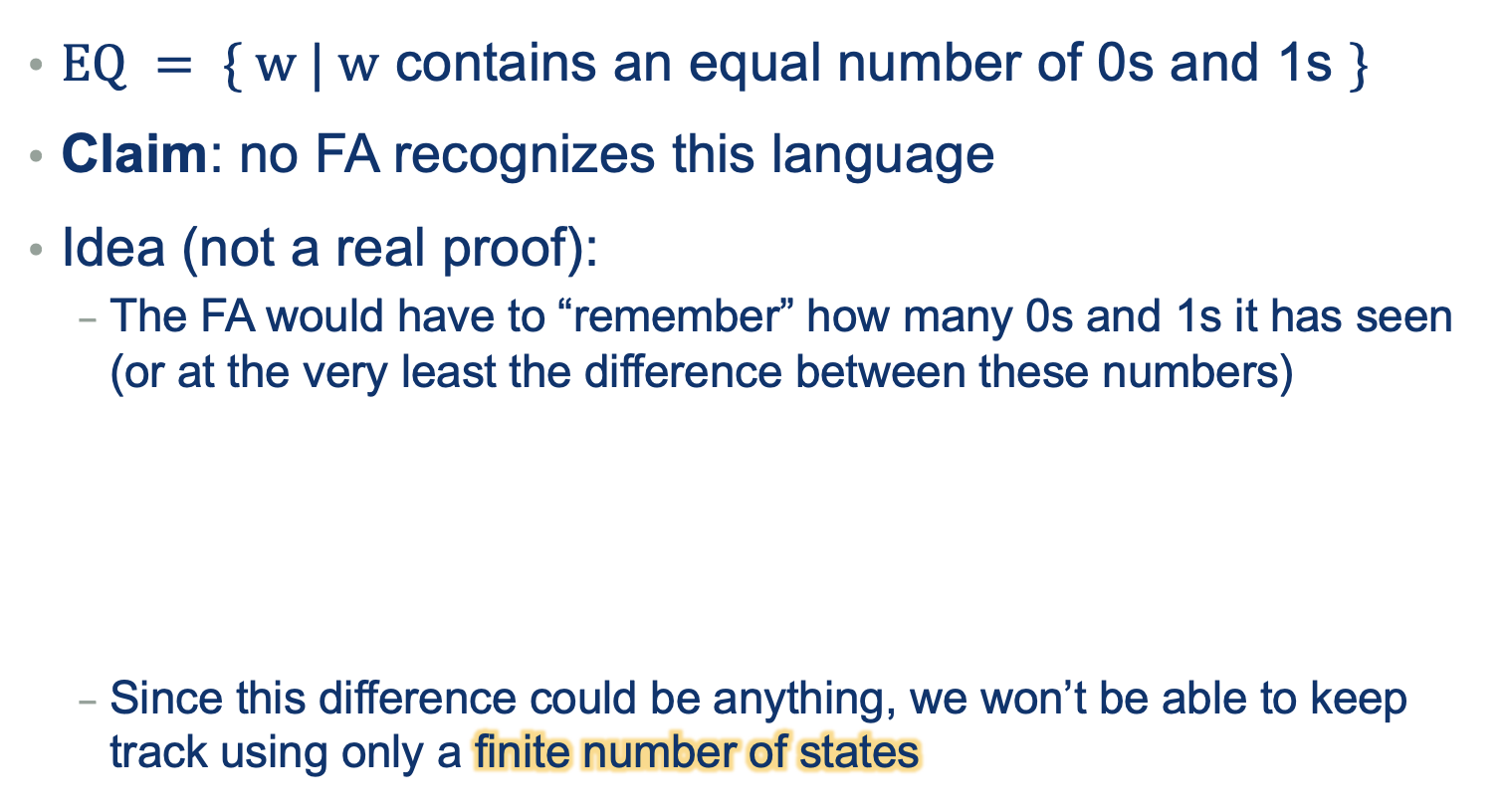
- Are there languages that Cannot be described by a finite automaton?
(try to come up with a counter example)
(Wait; then Click)
YES! NON Regular Languages!
Useful Properties
These are some properties that can help you deduce, generalize, or analyze FSMs with respect to their RegEx and Regular Languages.
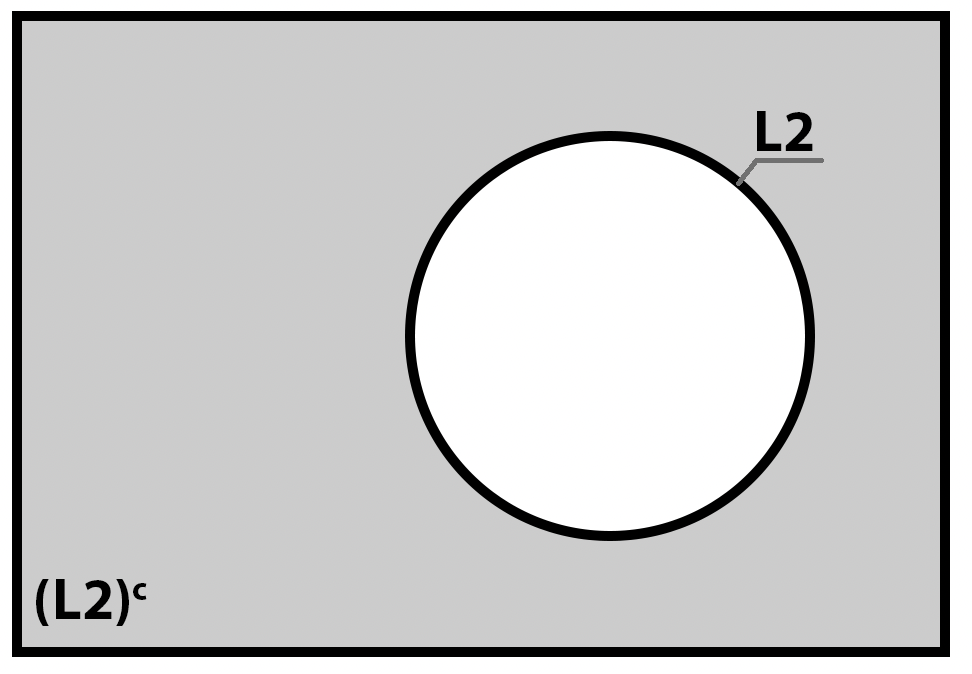
Complement
IF a Language \(L_1\) is recognizable by an FA \(M_1\),
is language \((L_1)^{c}\) also recognizable by some FA?
Or in other words, \(\exists M_2 \quad \vert \quad L(M_2) = L(M_1)^{c}\)
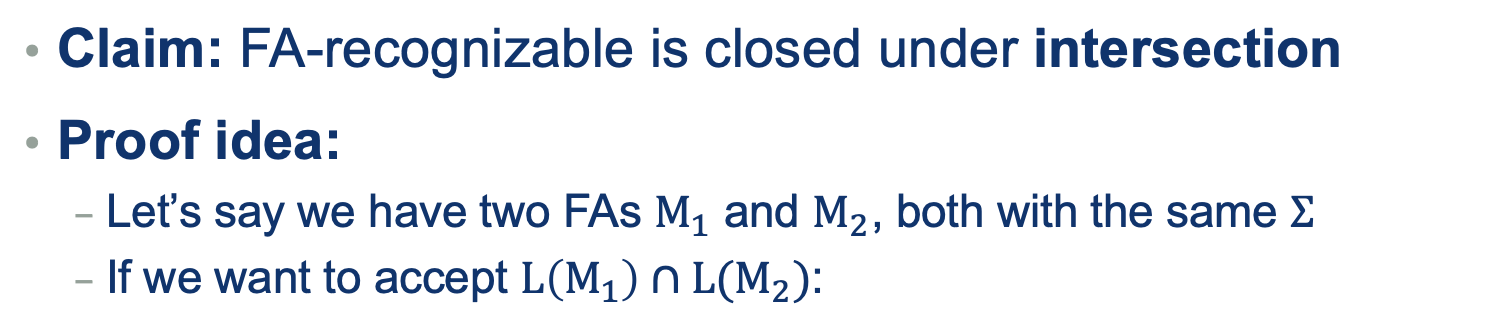
Intersection
Activity 4 [2 minutes]:
How would you prove this (by construction)?
(Wait; then Click)
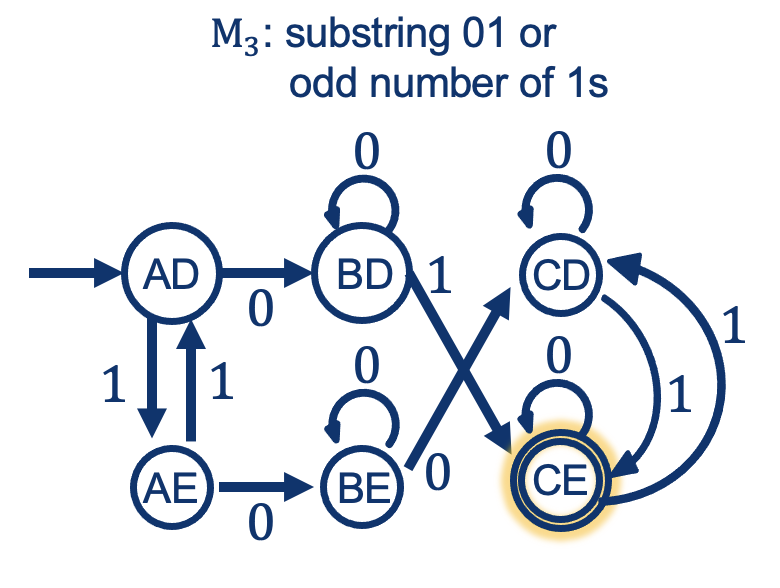
1. run both machines “in parallel”
2. accept if (and only if) both reach an accepting state
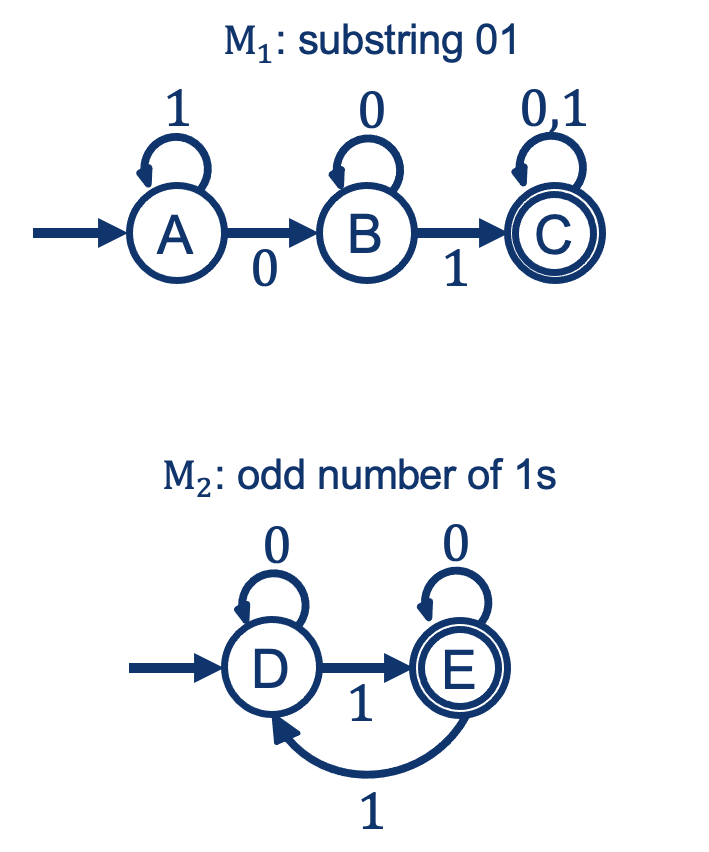
Example:
Intersection: General Rule
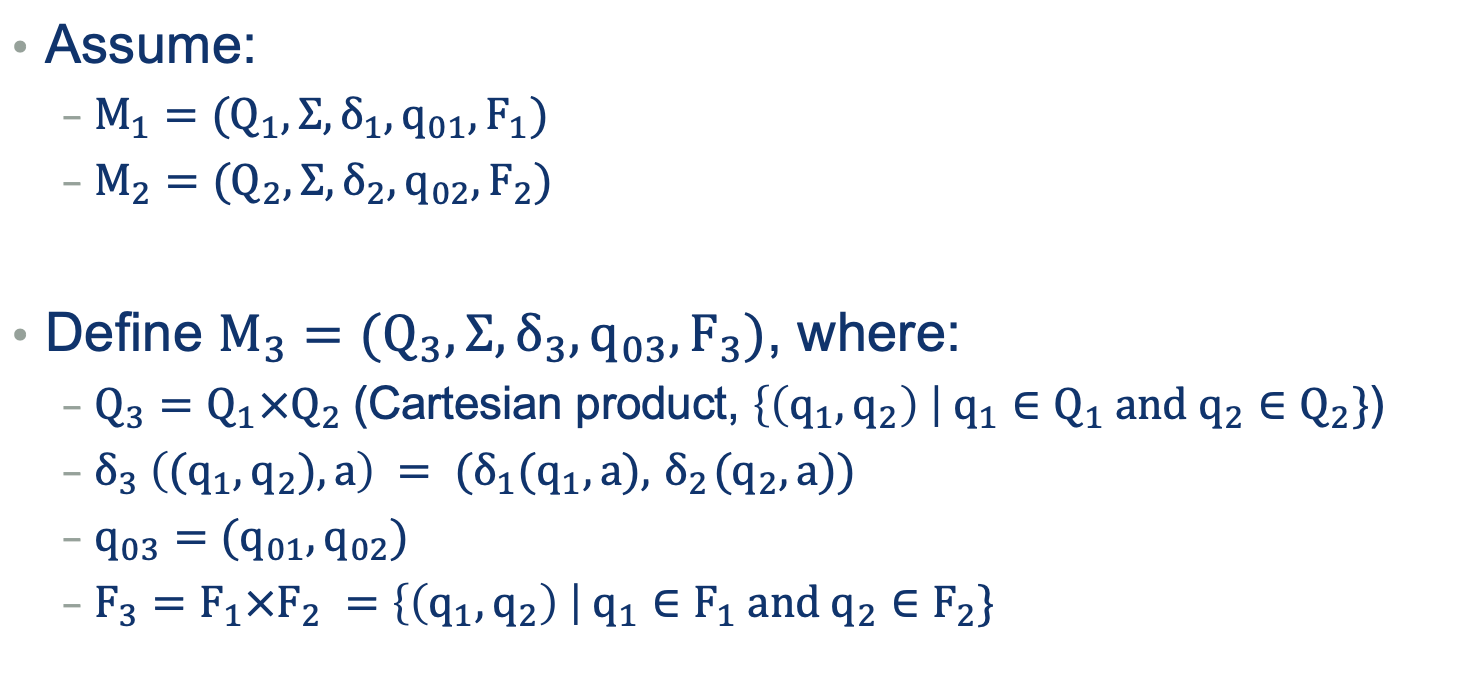
The set of possible states
\[Q_3 = \{ AD, BD, CD, AE, BE, CE \}\]Look at the rule for the transition function:
\[\delta_3 ( (q_1, q_2), a ) = (\delta_1(q_1,a), \delta_2(q_2,a))\]That means:
\[\mathbf{ \delta_3 ( (q_1, q_2), a ) }\]the transition for \(M_3\) starting at the combo state: \(q_1q_2\) and input symbol \(a\).
the combo state resulting from the output of \(M_1\) when starting at state \(q_1\) and input symbol \(a\),
and the state resulting from the output of \(M_2\) when starting at state \(q_2\) and input symbol \(a\)
or \(\mathbf{ \delta_1(q_1,a), \delta_2(q_2,a)) }\)
The set of starting states
\[q_{03} = (q_1,q_2)\]Which is the combination state of the starting states of each of the machines: \(q_1\) from \(M_1\) and \(q_2\) from \(M_2\).
The set of Accepting states
\[F_3 = (q_1,q_2)\]Where each one is the combination state of states where both are accepting states in each of the machines:
\(C\) from \(M_1\) AND \(E\) from \(M_2\).
Notice that for the example word \(w = 0111\) , the sequence of states is:
\(AD \xrightarrow{0} BD \xrightarrow{1} CE \xrightarrow{1} CD \xrightarrow{1} CE\) (Accept)
Union
Activity 5 [2 minutes]:
How would you prove this (by construction)?
(Wait; then Click)
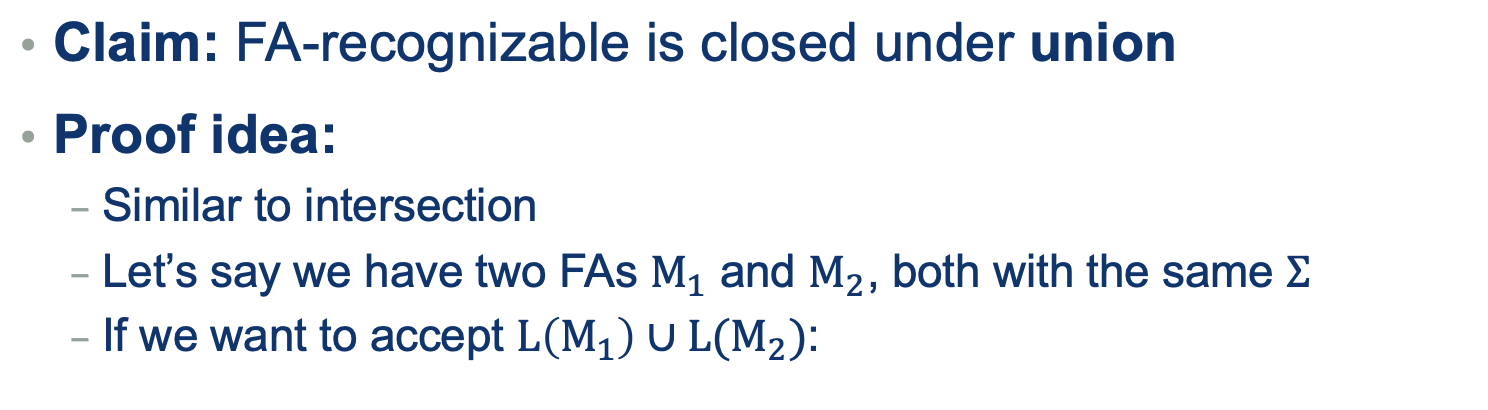
1. run both machines “in parallel”
2. accept if either reach an accepting state
Example:
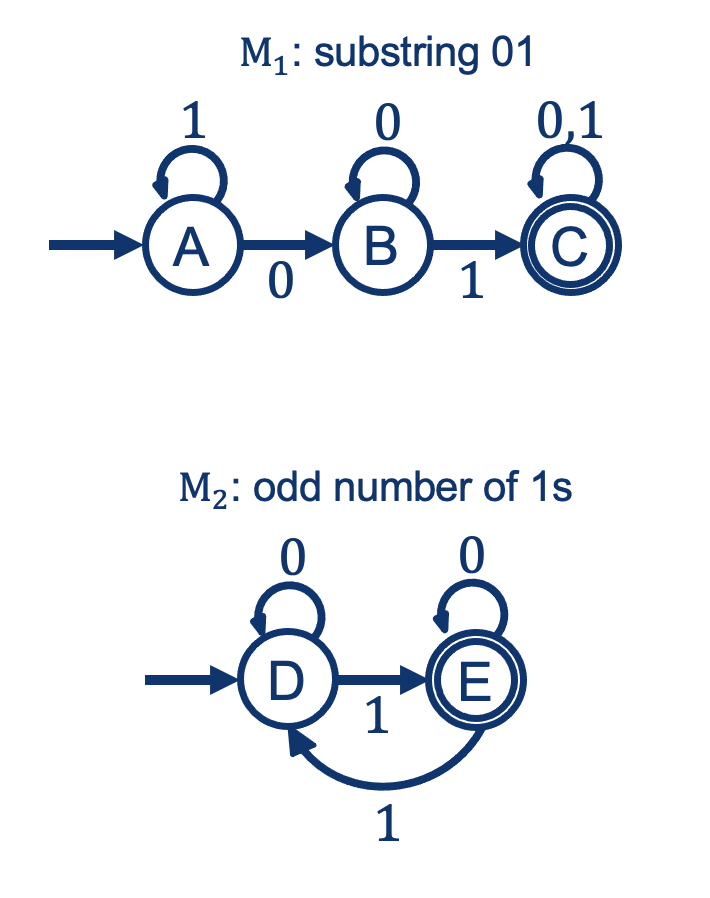
NOW, the set of Accepting states \(F_3 = (q_1,q_2)\)
Where each one is the combination state of states where either are accepting states in each of the machines:
\(C\) from \(M_1\) OR \(E\) from \(M_2\).
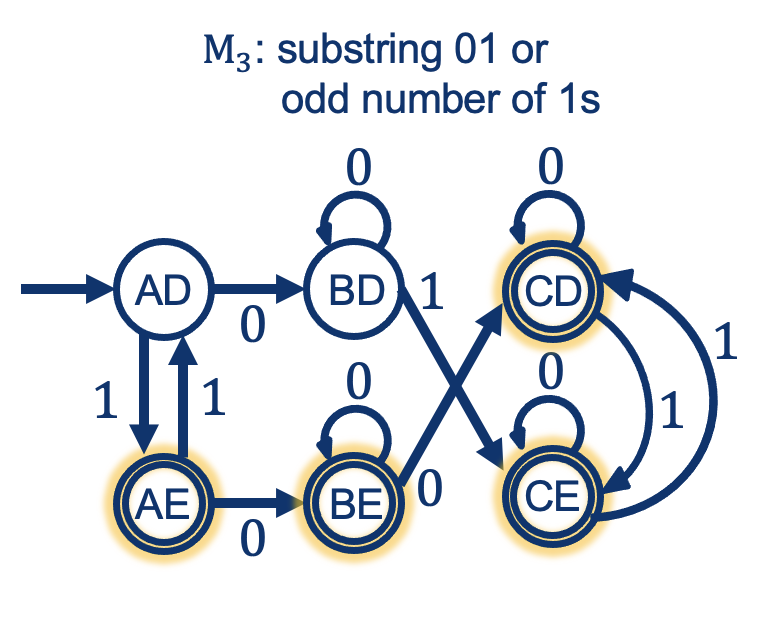
Union: General Rule
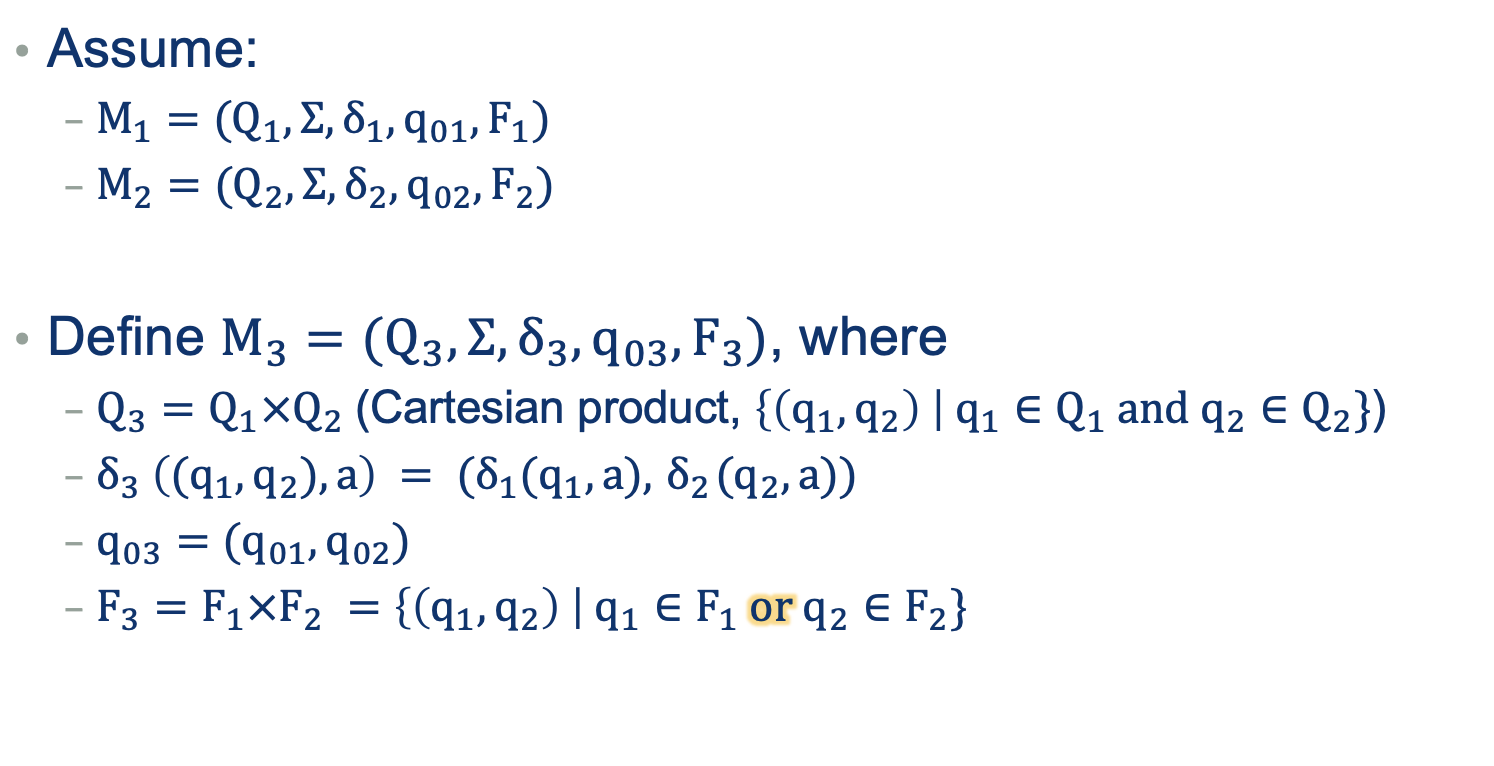
Example: word \(w = 0111\)
Set Difference
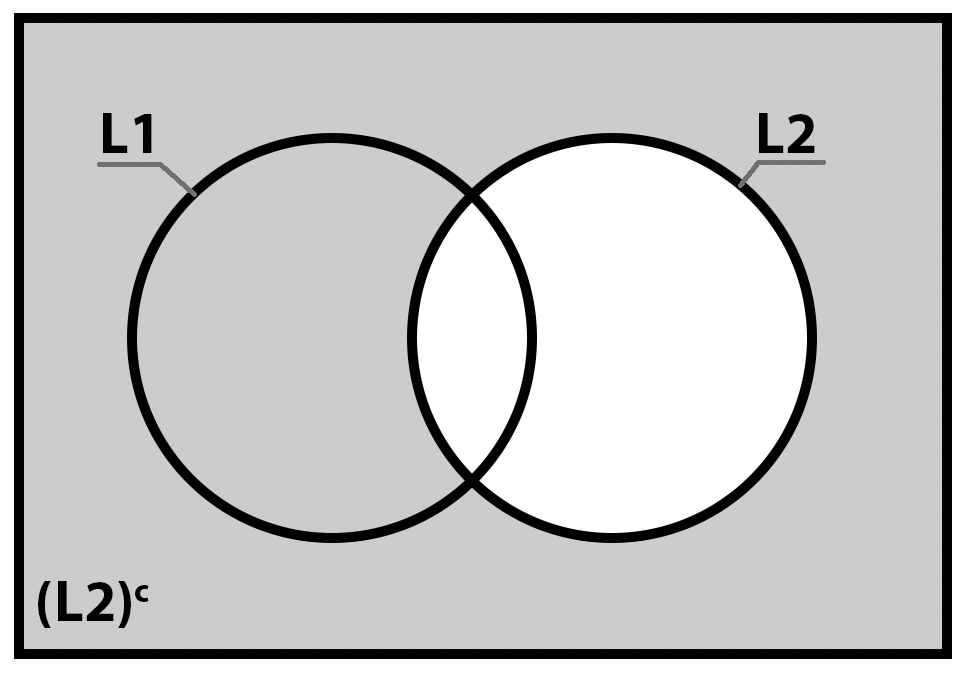
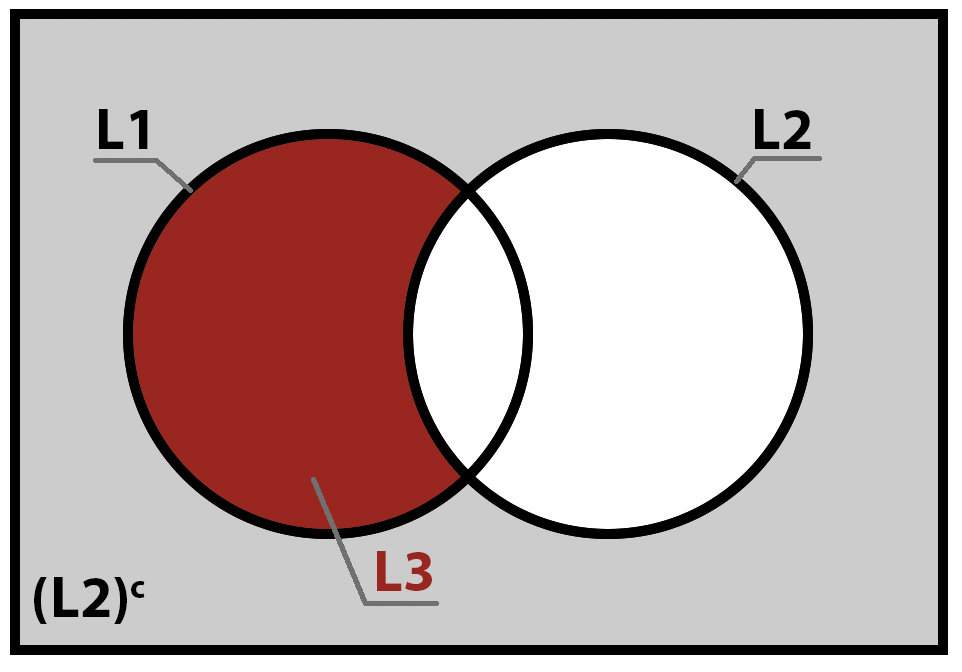
\[L_3 = L_1 - L_2\]
Activity 1 [2 minutes]:
How would you prove this (draw the Venn Diagram and use previous properties)?
(Wait; then Click)
$$ L_3 = L_1 - L_2 = L_1 \cap (L_2)^c $$ 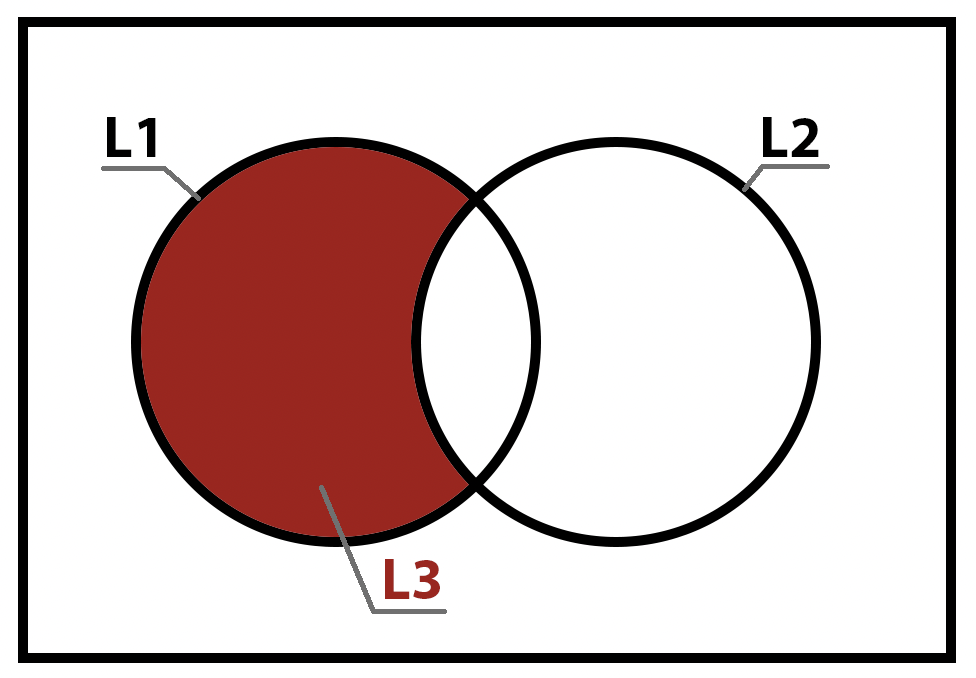
Concatenation

Activity 2 [2 minutes]:
How would you prove this (by construction)?
(Wait; then Click)
1. Let’s say we have two FAs $M_1$ and $M_2$, both with the same $\Sigma$
2. Want to build another FA $M_3$ with $$ L(M_3)=L(M_1) \circ L(M_2) \texttt{, which is } \{ x_1 x_2 | x_1 \in 𝐿(𝑀_1) \texttt{ and } 𝑥_2 \in 𝐿(𝑀_2) \} $$
3. Just need to attach the accepting states of $M_1$ to the start state of $M_2$
4. Caution: since we don’t know when we’re done with the L($M_1$) part of the string; could go through accepting states of $M_1$ several times!
Example: word \(w = 000\)
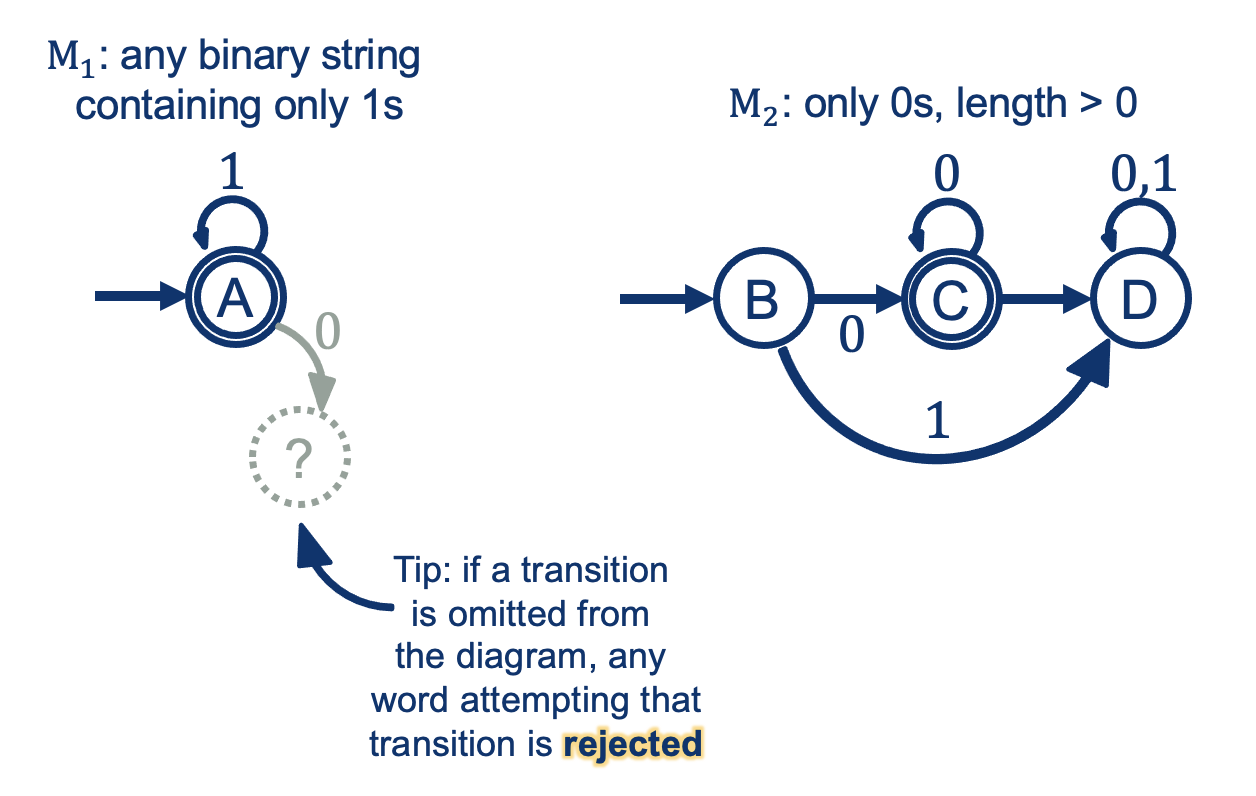
Notice that for the example word \(w = 000\) , the sequence of states might be:
\(A \xrightarrow{0}\) “invisible reject state” (Reject)
or
\(A \rightarrow B \xrightarrow{0} C \xrightarrow{0} C \xrightarrow{0} C\) (Accept)
How to combine them?
We seem to need to be able to “guess” when to shift to the second machine.
And we can’t do that yet.
Another example of the logic and the issue:
- Say we have: \(M_1\): all strings with an odd number of 1’s
- And \(M_2\): all strings with alternating 0s and 1s
- Is \(L(M_3) = L(M_1) \circ L(M_2)\) FA-recognizable?
- Say we have the string \(101001101010101\)
- is this recognizable if we split the string into \(x_1\) and \(x_2\)
- such that \(M_1\) recognizes \(x_1\), and
- such that \(M_2\) recognizes \(x_2\)
- What happens if \(x_1 = 101001101\) and \(x_2 = 010101\)?
- What happens if \(x_1 = 1010011\) and \(x_2 = 01010101\)?
Kleene Star

- Start with FA \(M_1\)
- Build another FA \(M_2\), with \(L(M_2) = L(M_1 )^∗\)
- Same problem as with concatenation: we need to guess…
Homework
Prep to Demo Homework 01 next lecture. Every team presents 4 problems, 1 each and one randomly chosen to present the last problem. Practice to demo in a maximum of 5 minutes (about 1 minute per question).