Lecture Notes 20: Reductions and Enumeration
Outline
This class we’ll discuss:
- Recap: Reductions
- Recognizing and Enumeration
A Slideshow:
REVIEW Slides:
CLASS Slides
GUIDED NOTES (Optional)
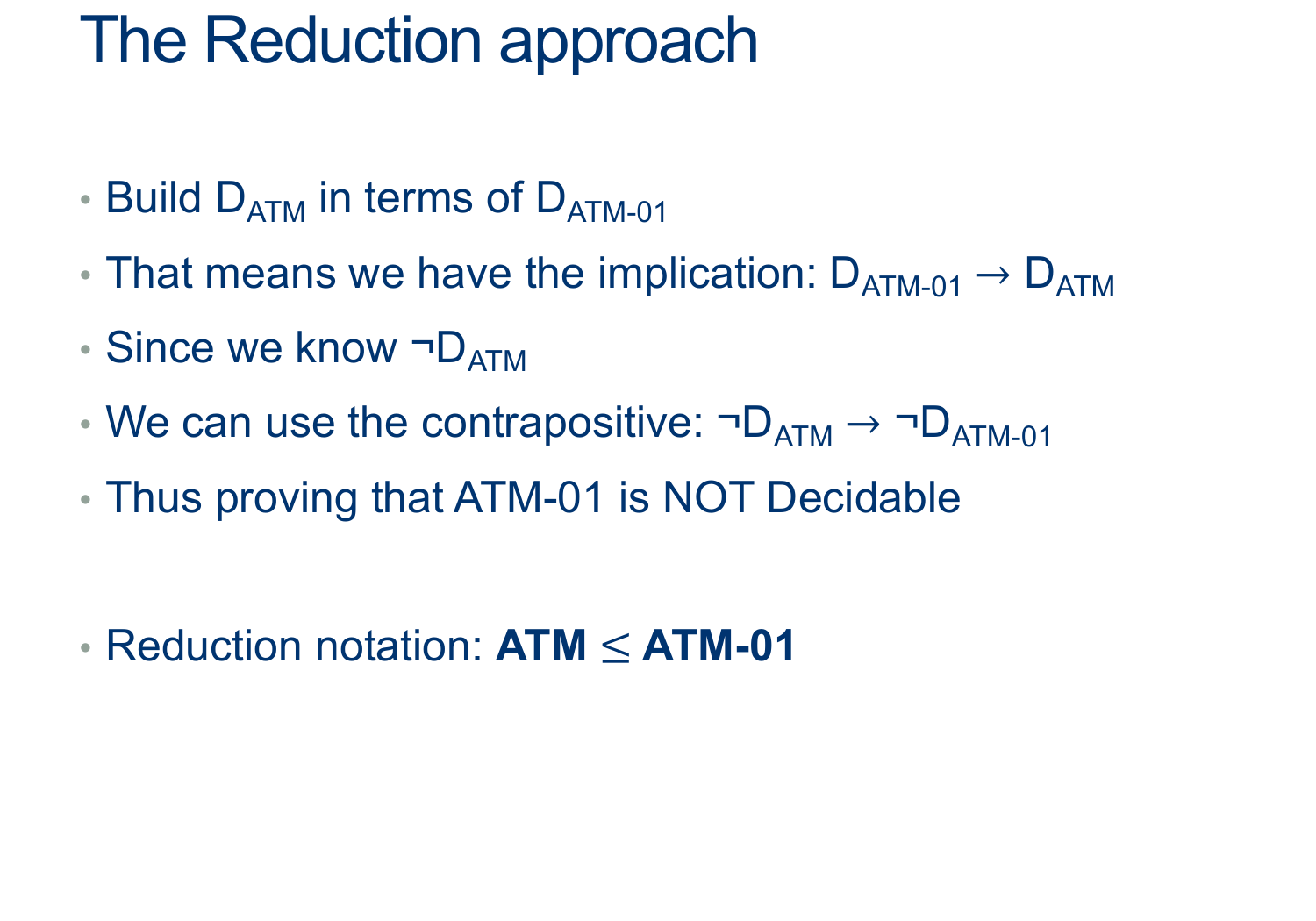
(ATM-01 is at least as hard to decide as ATM)
Note that:
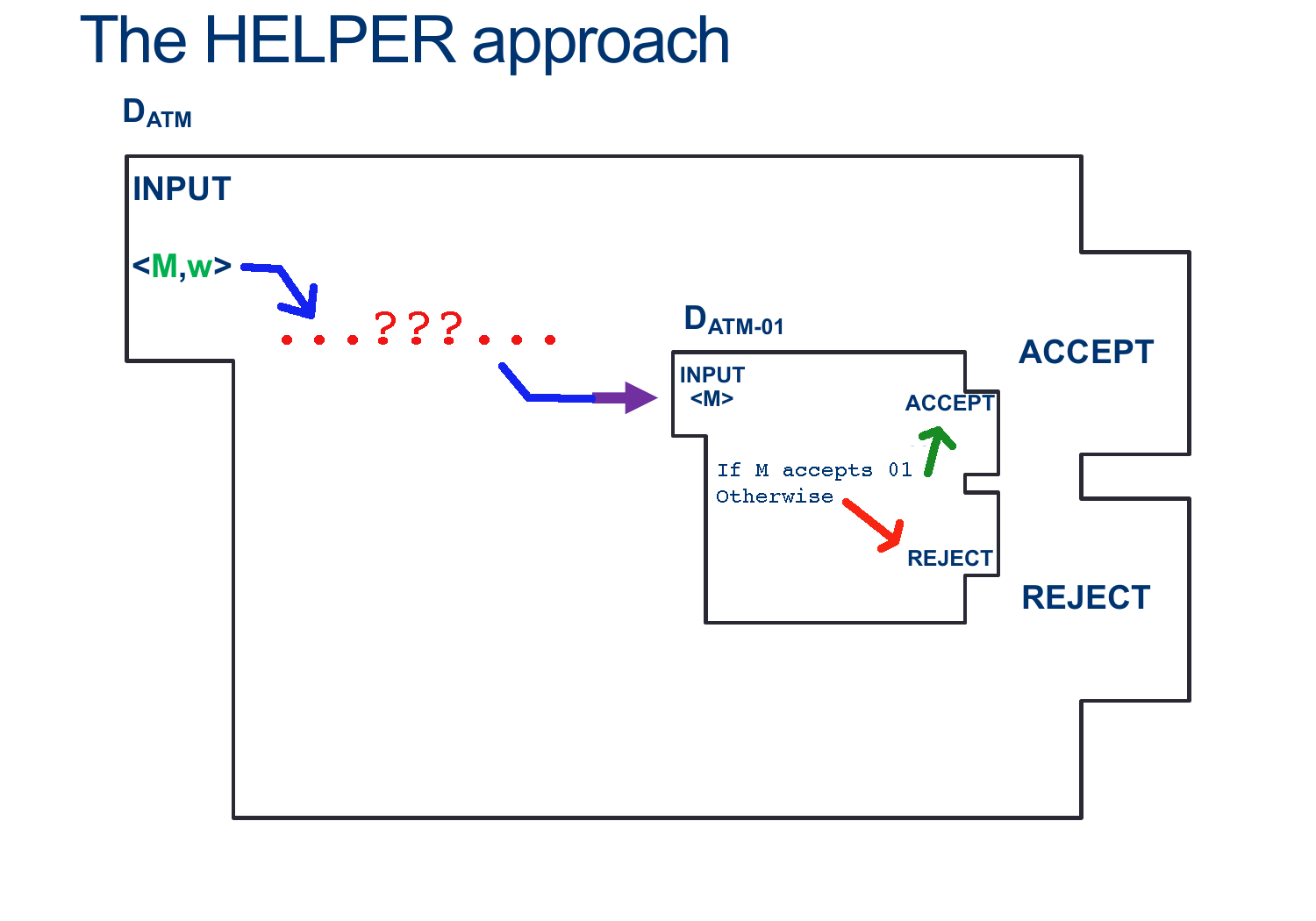
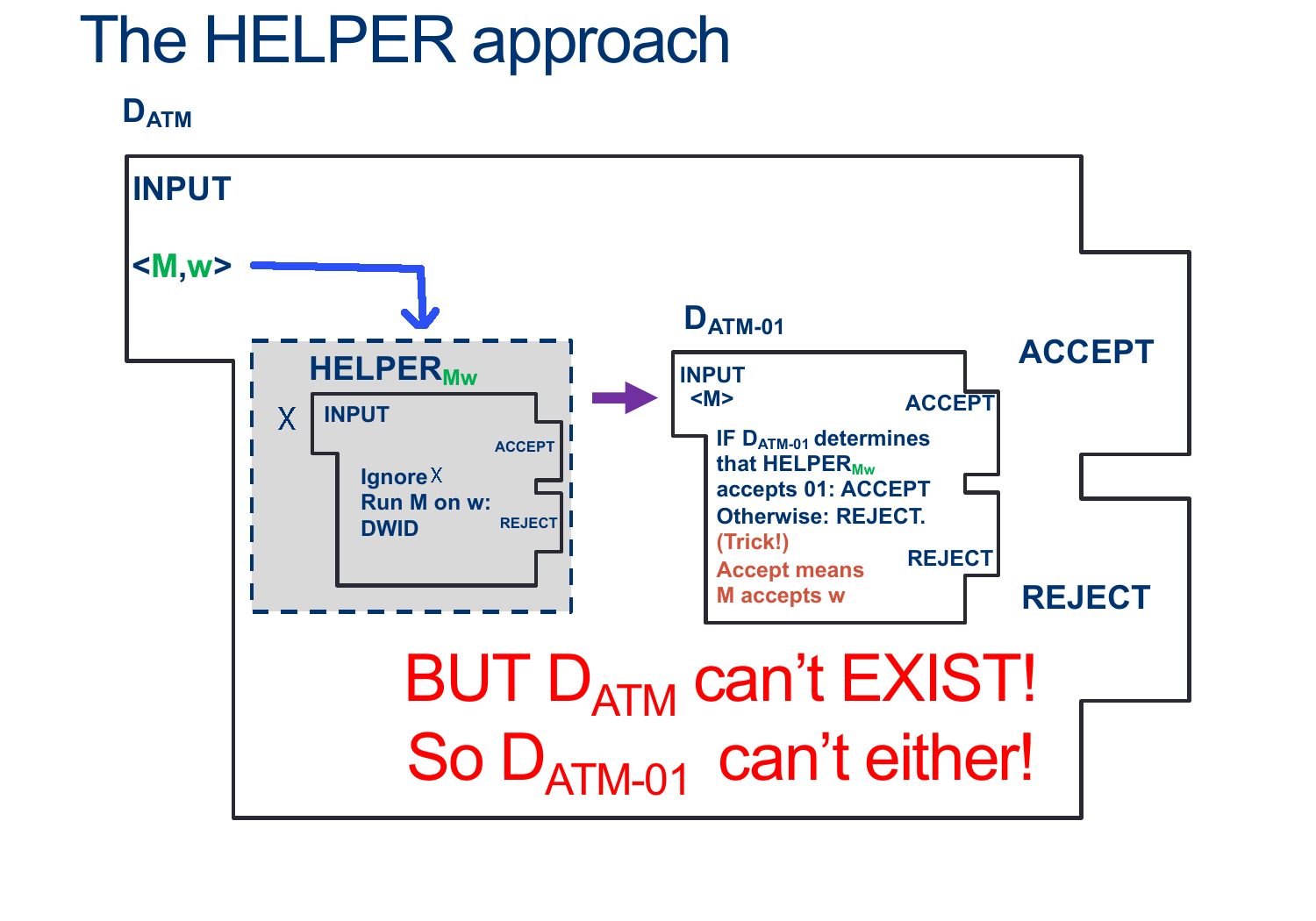
- IF a machine $D_{ATM}$ existed, it would receive input $ < M, w > $
- IF a machine $D_{ATM-01}$ existed, it would receive input $ < M > $
- The order of the proof is:
- Assume $D_{ATM-01}$ already exists
- We can use it to build another machine that should behave like $D_{ATM}$
- This larger machine, should be able to handle input $ < M, w > $
- You must somehow get a machine with ONLY $ < M > $ as input to handle the input $ < M, w > $
- Note that, as part of the steps, you can build helper machines
Activity 4 [2 minutes]:
In teams, write a Machine that uses $D_{ATM-01}$ to perform the work of $D_{ATM}$ (Wait; then Click)
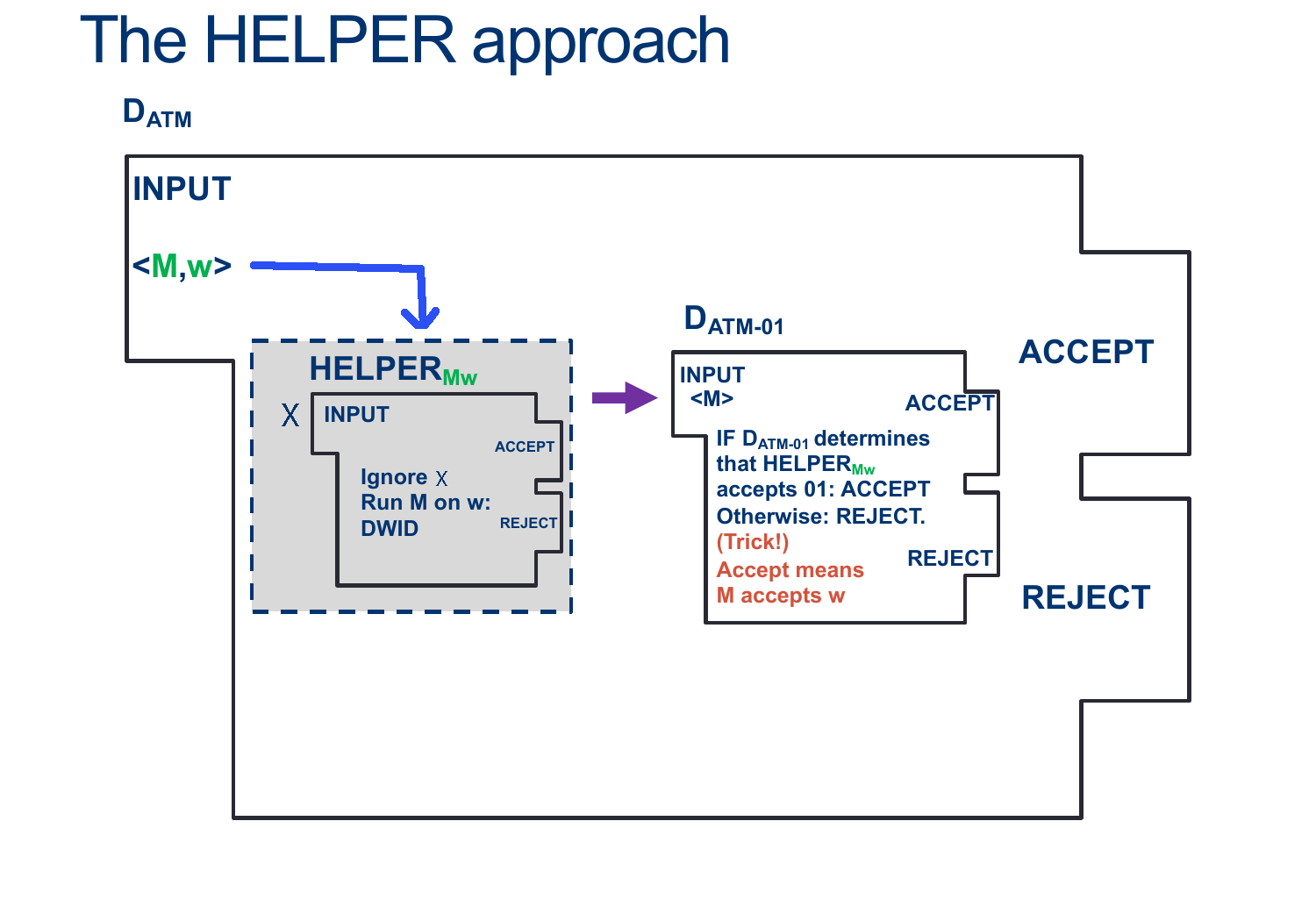
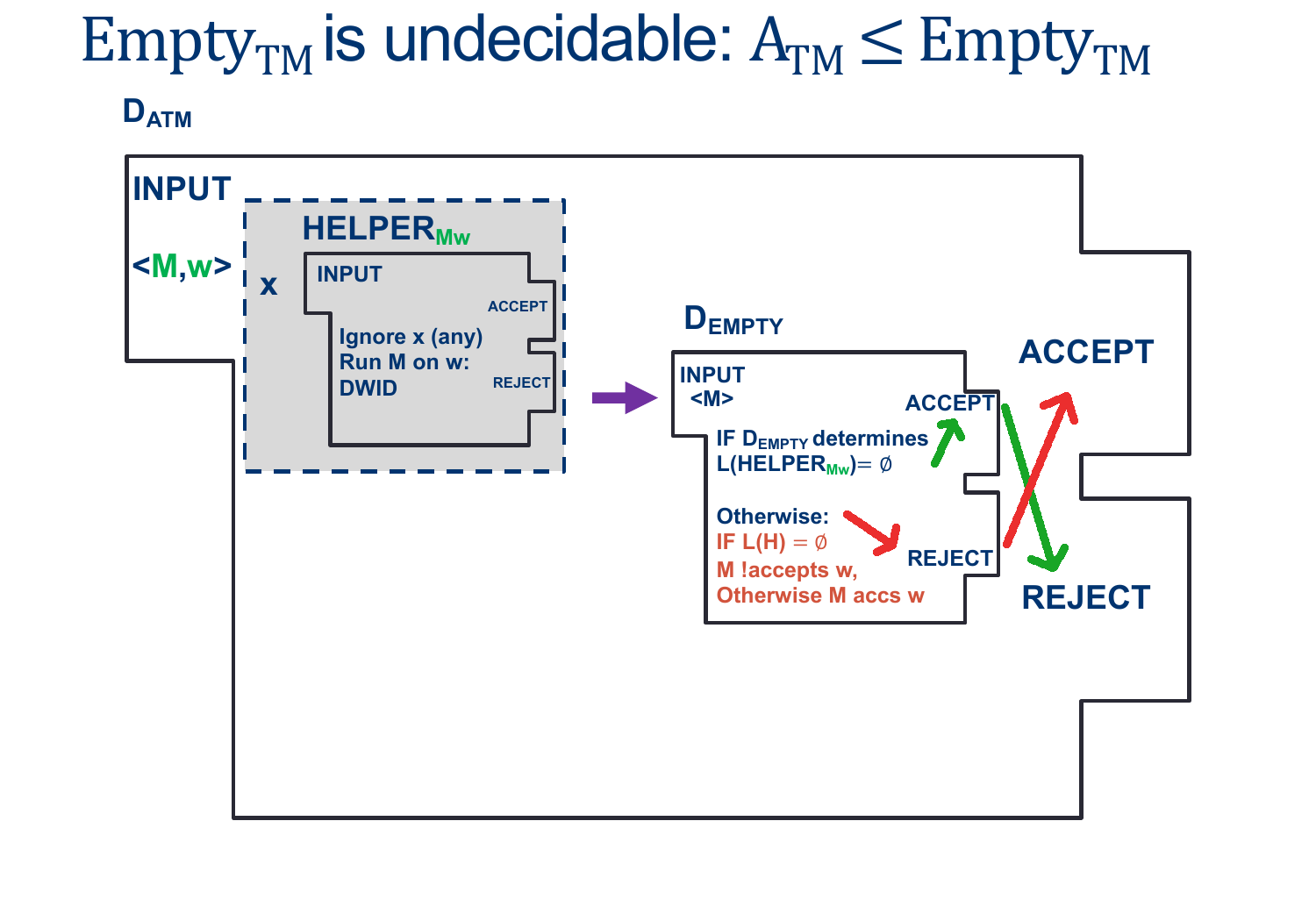
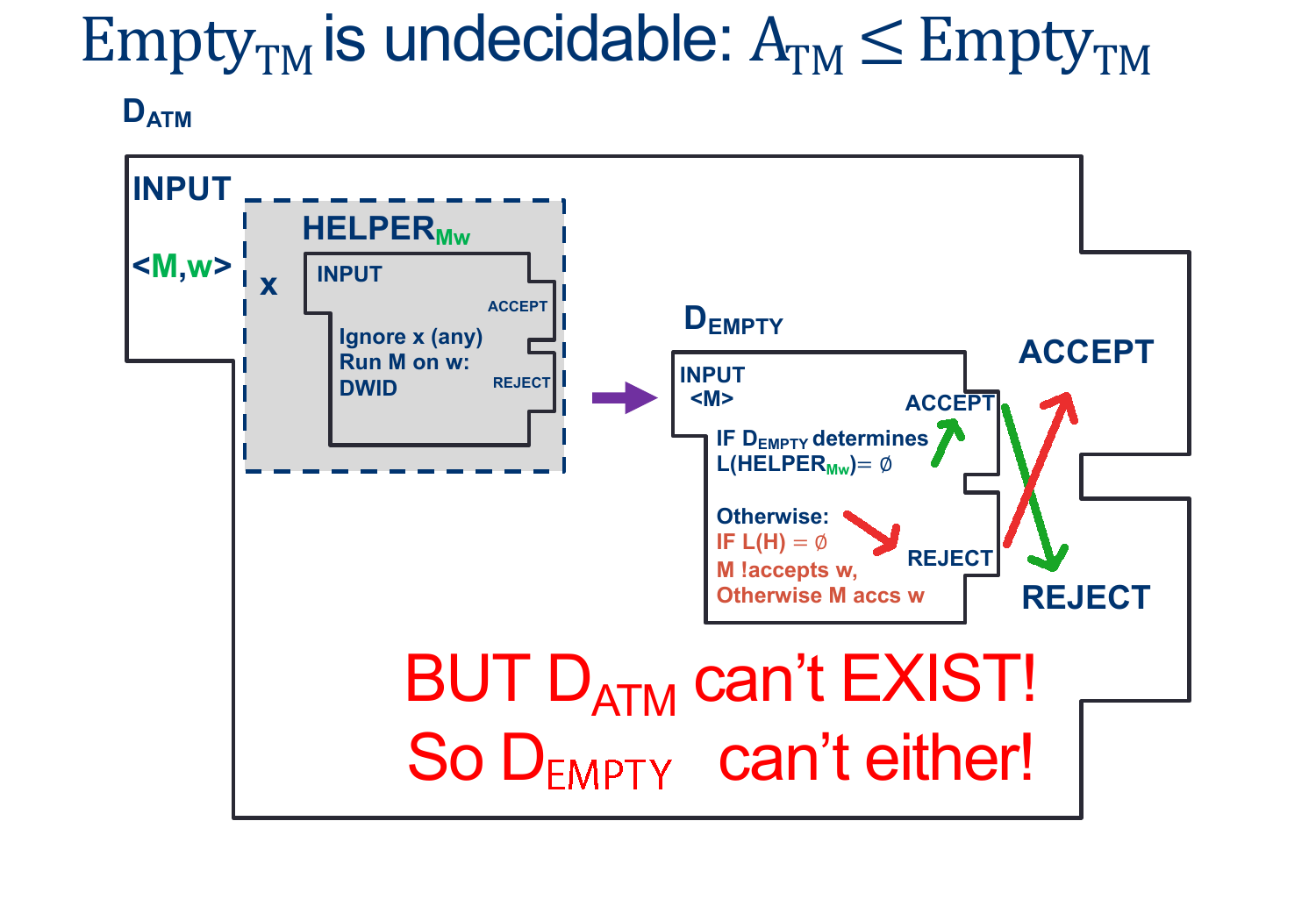
This can be written like this:
Assume EMPTY-TM is decidable, and so there exists some $D_{EMPTY-TM}$ that decides, for any input $< M >$, whether $L (M) $ is empty.
We’ll design the Machine $D_{ATM} $ as follows:
\[\begin{align*} &D_{ATM}:\\ & \text{ On input $ < M, w > $ }:\\ & \text{ Create (but don't run) $HELPER_{M,w}$ such that}\\ & \quad \text{ On input $ < X > $ }:\\ & \quad \quad \text{ Ignore $ < X > $ }\\ & \quad \quad \text{ Run $M$ on $w$ ADWID}\\ & \text{ Now Run $D_{EMPTY-TM}$ on $HELPER_{M,w}$}\\ & \text{ If $D_{EMPTY-TM}$ rejects, invert the result and our machine ACCEPTS}\\ & \text{ If $D_{HALT}$ accepts, , invert the result and our machine REJECTS}\\ \end{align*}\]As we saw above, the ONLY way $D_{EMPTY-TM}$ Rejects is if $HELPER_{M,W}$ Accepts, which happens ONLY when $M$ accepts $w$.
This means we CAN make $D_{ATM}$ as long as $D_{EMPTY-TM}$ exists.
However, $D_{ATM}$ doesn’t exist…which means $D_{EMPTY-TM}$ CANNOT EXIST EITHER.

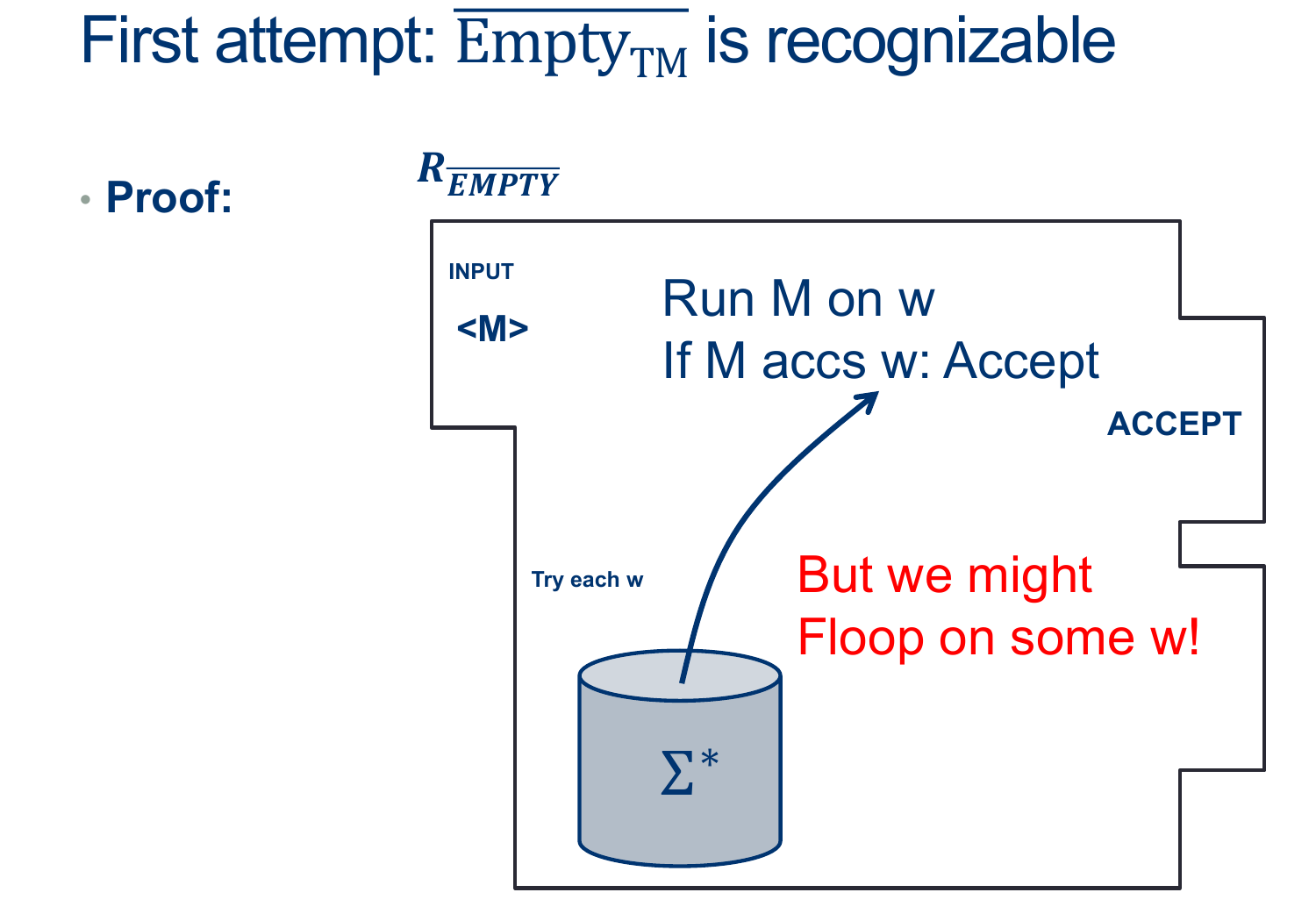
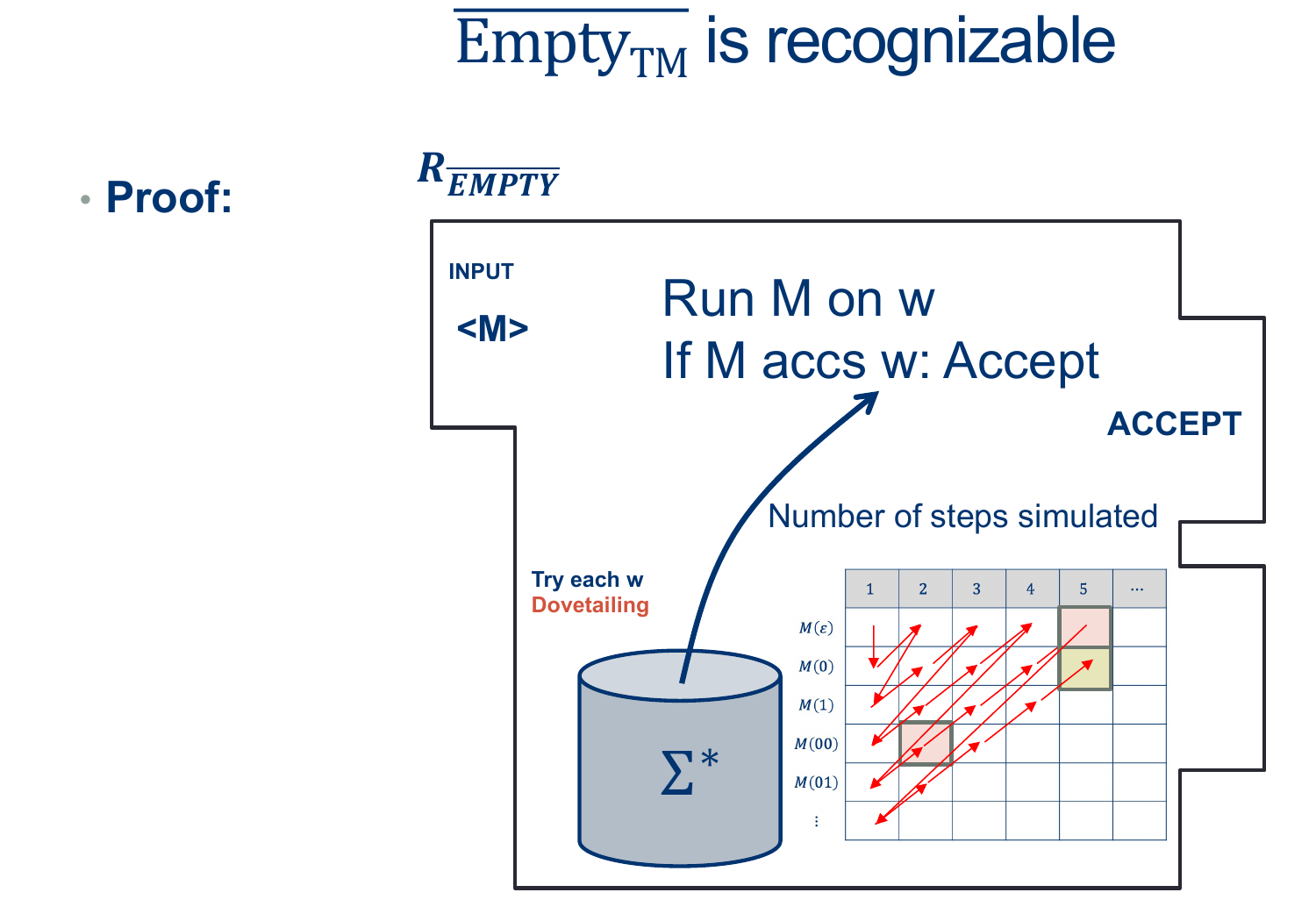
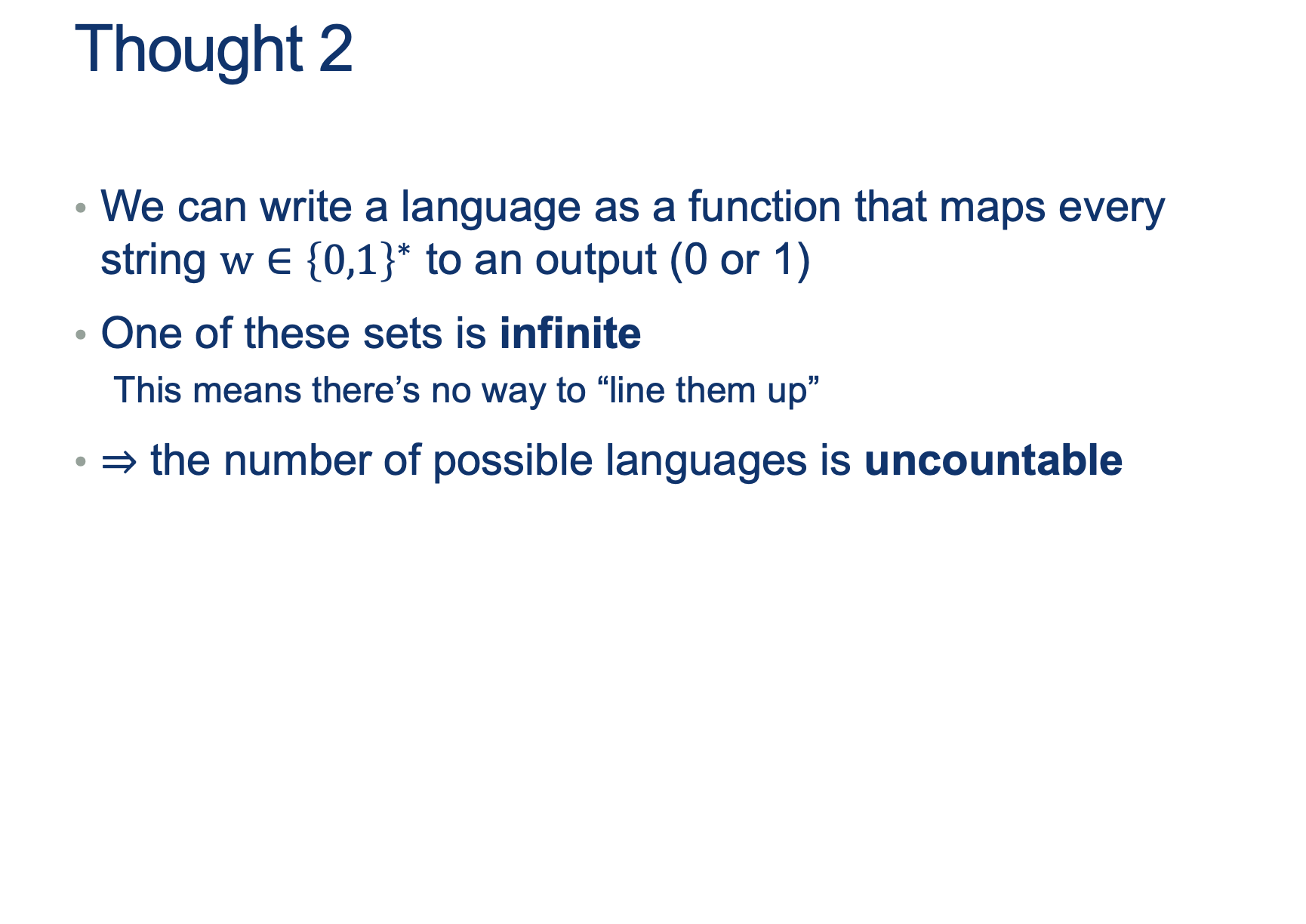
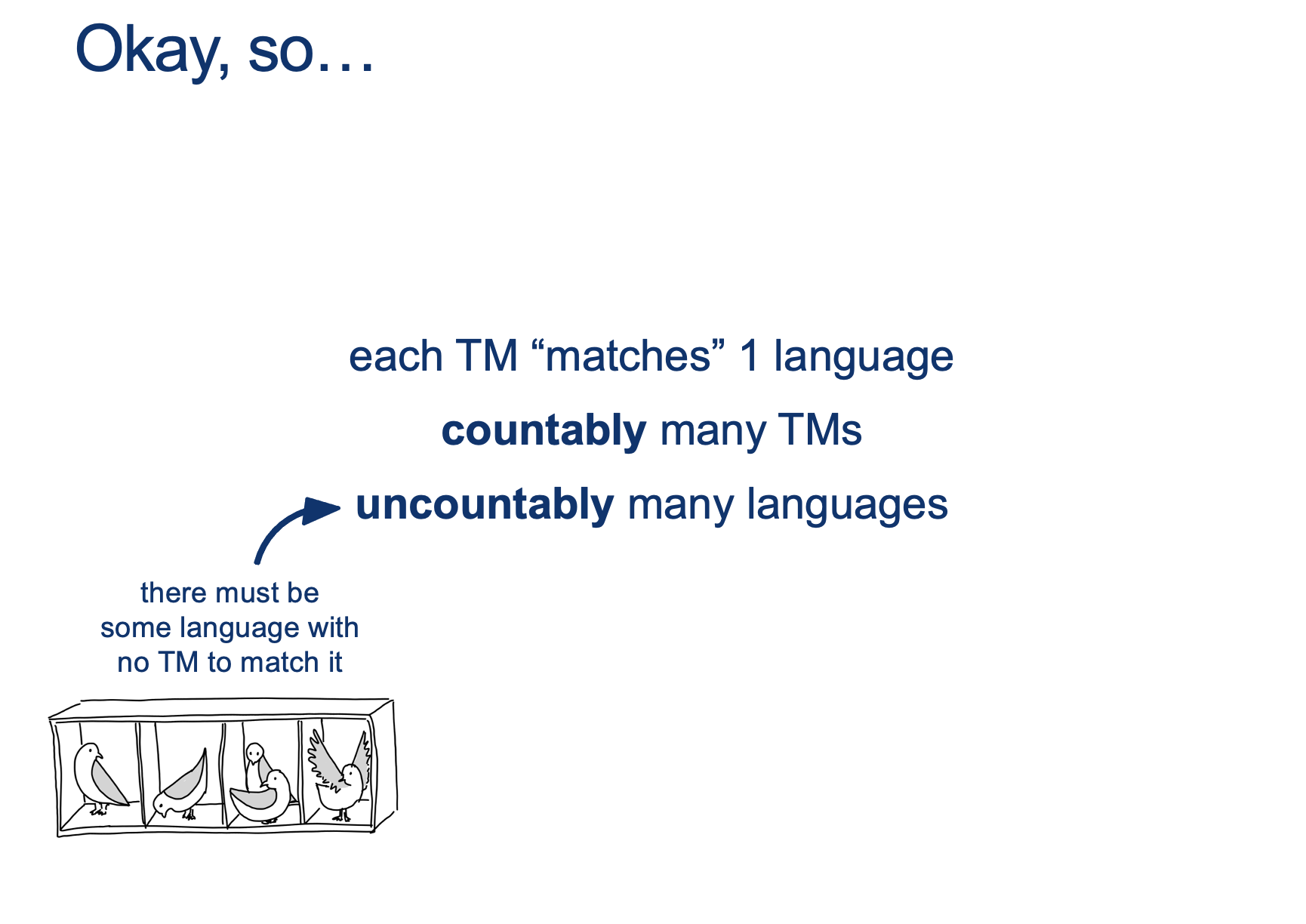
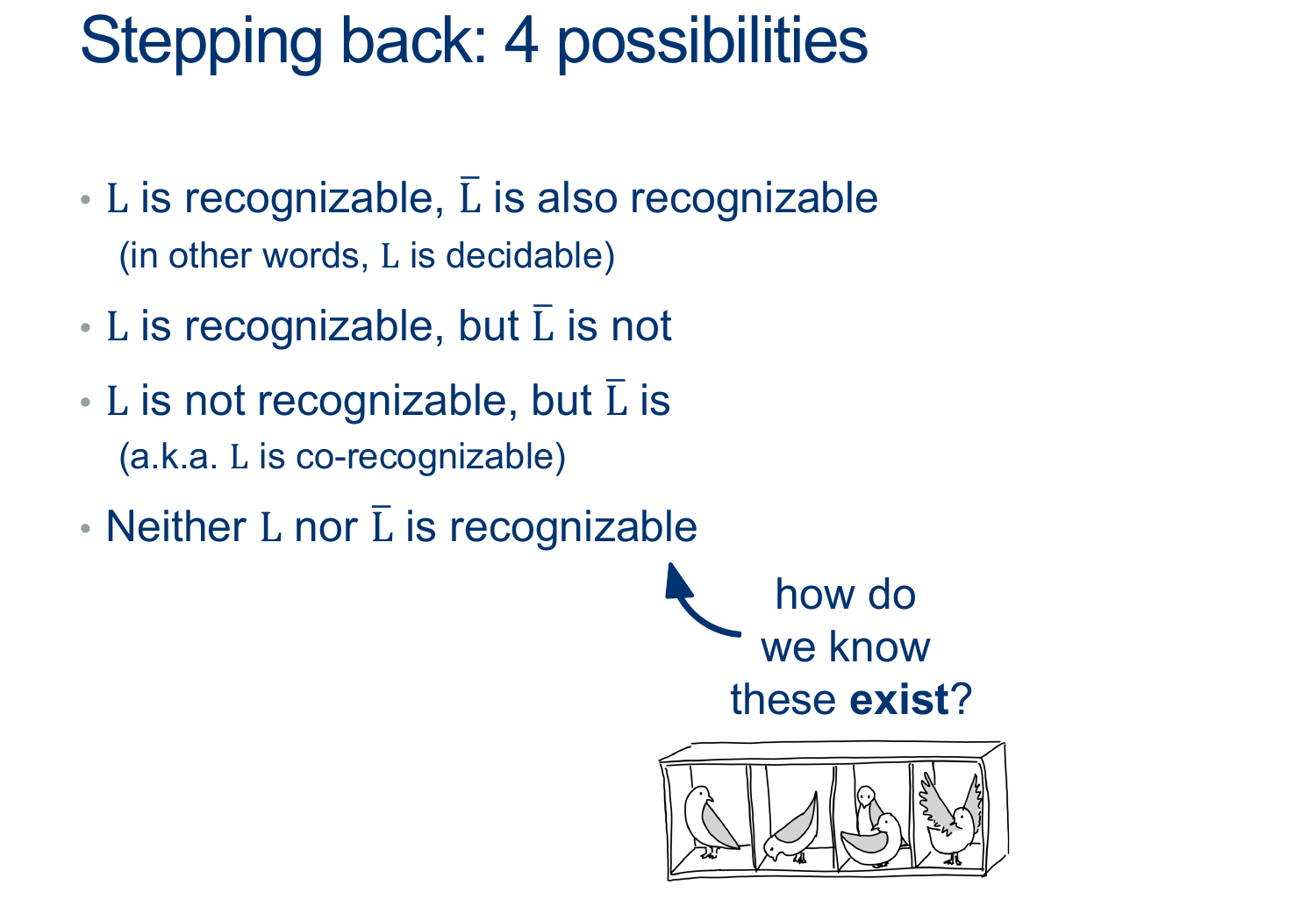
This will lead us to a new way of looking at Recognizers: Enumeration.
Enumeration
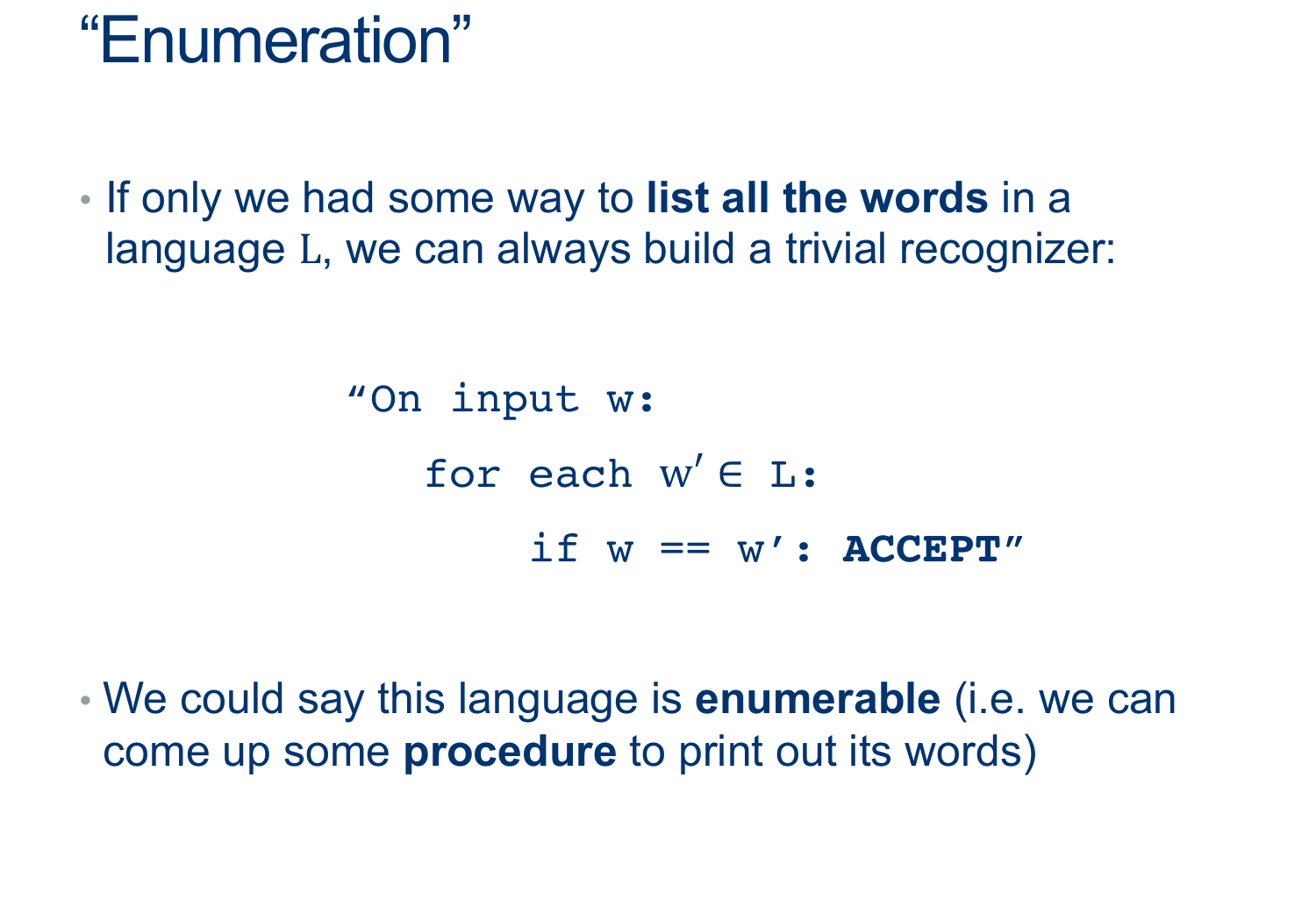
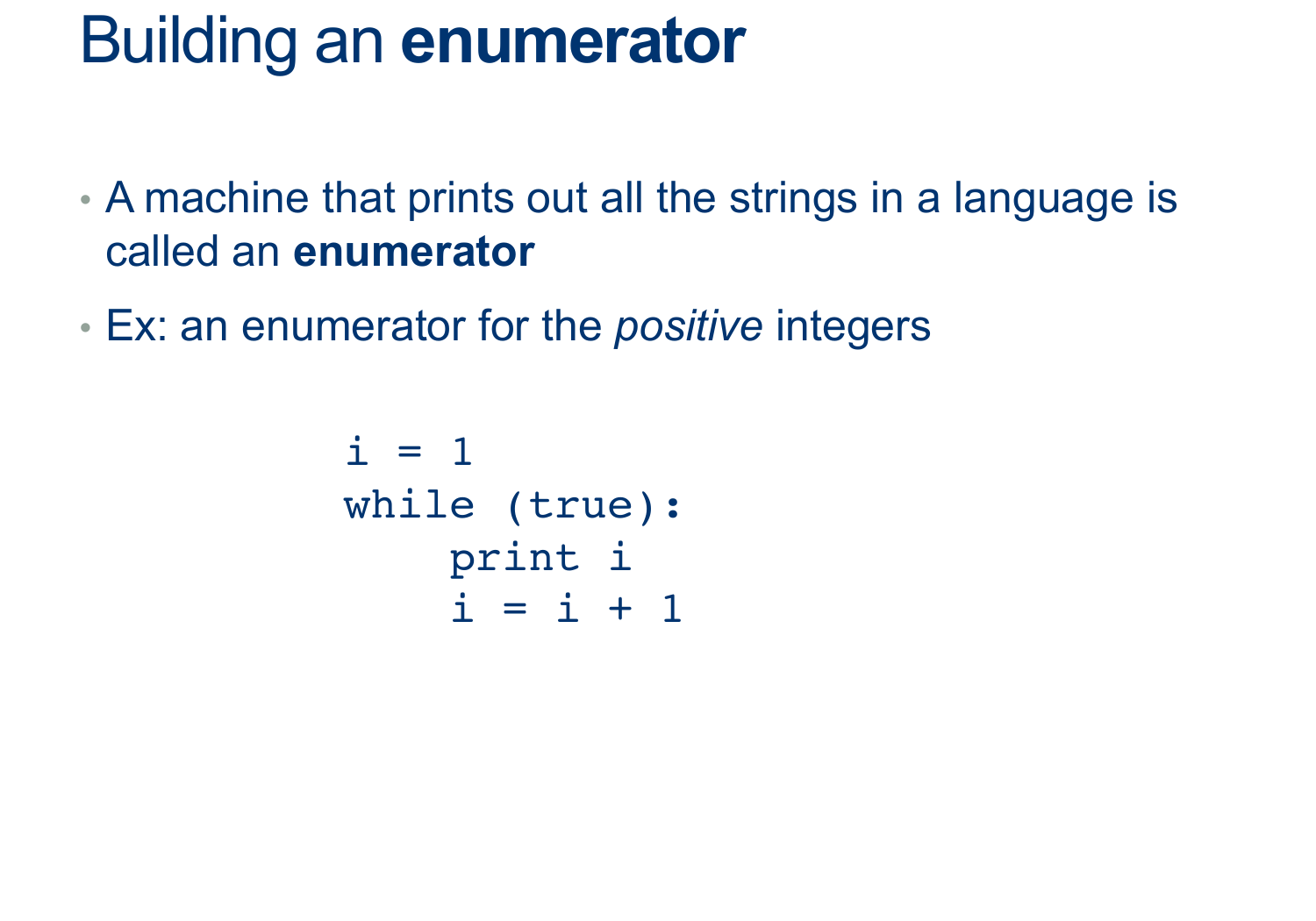
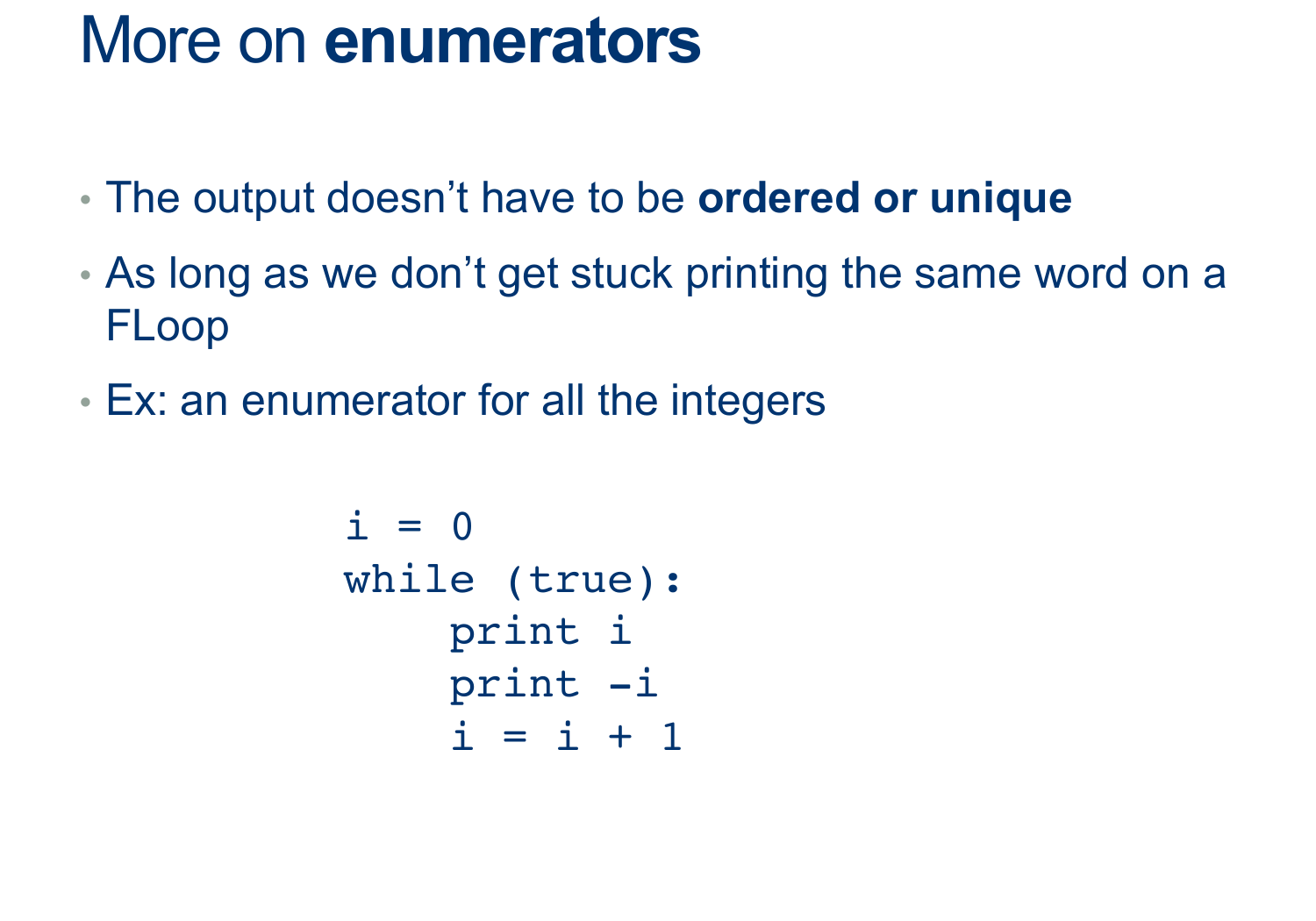
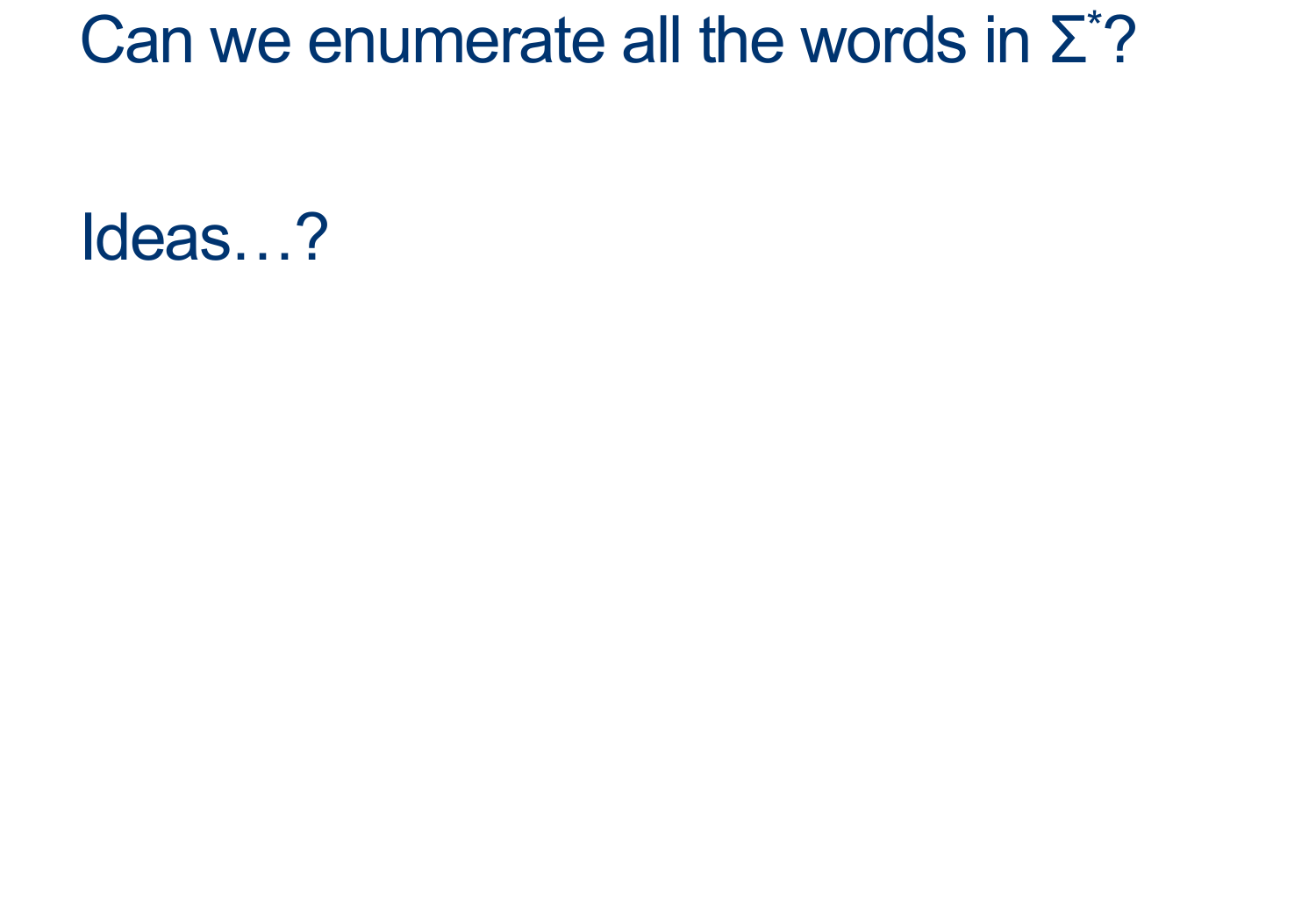
Activity 3 [2 minutes] In groups, come up with an algorithm to enumerate $\Sigma^*$?:
Activity 4 [2 minutes] In groups,
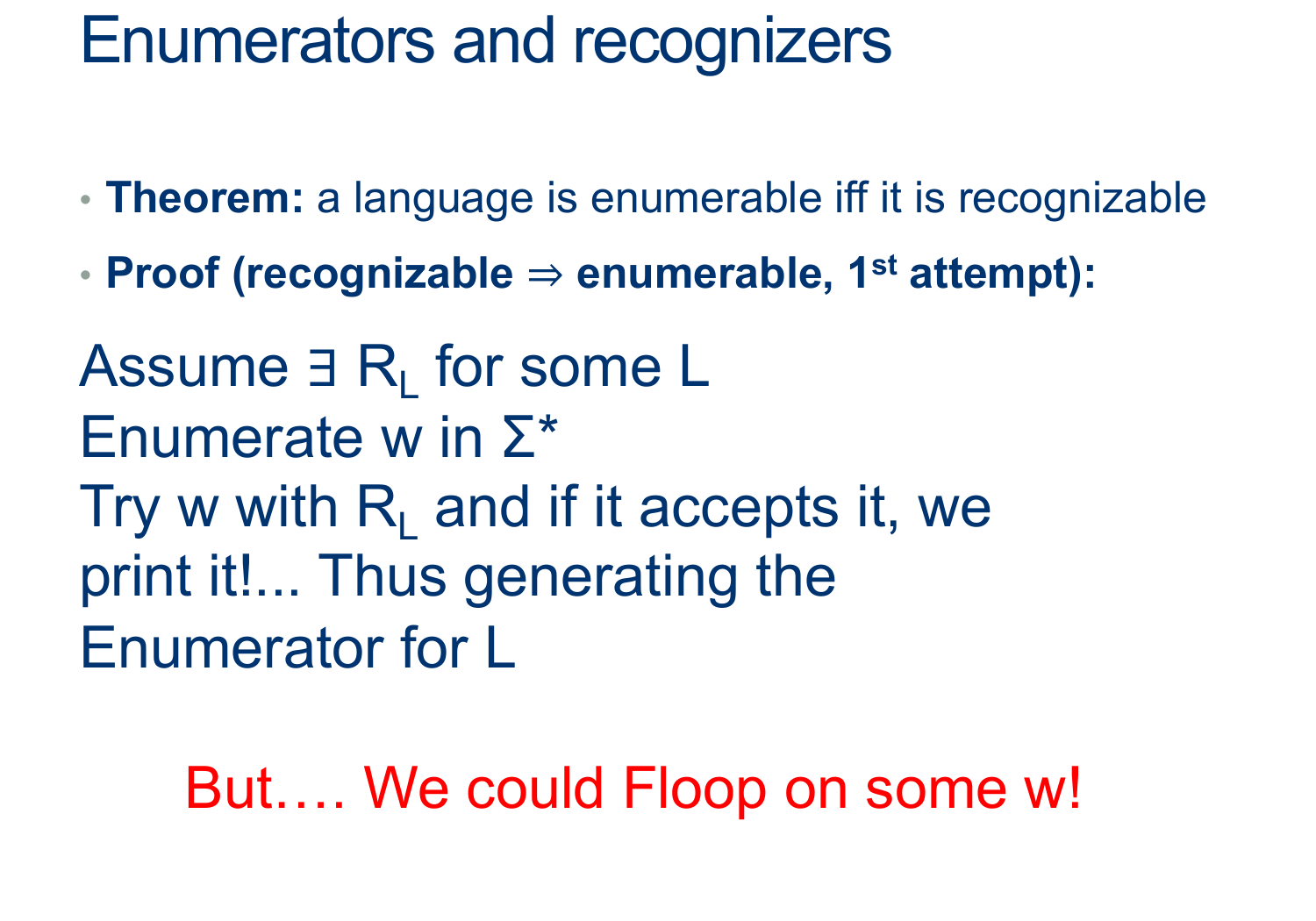
How would you prove that, IF you can enumerate a Language, then that language is Recognizable.
(Wait; then Click)
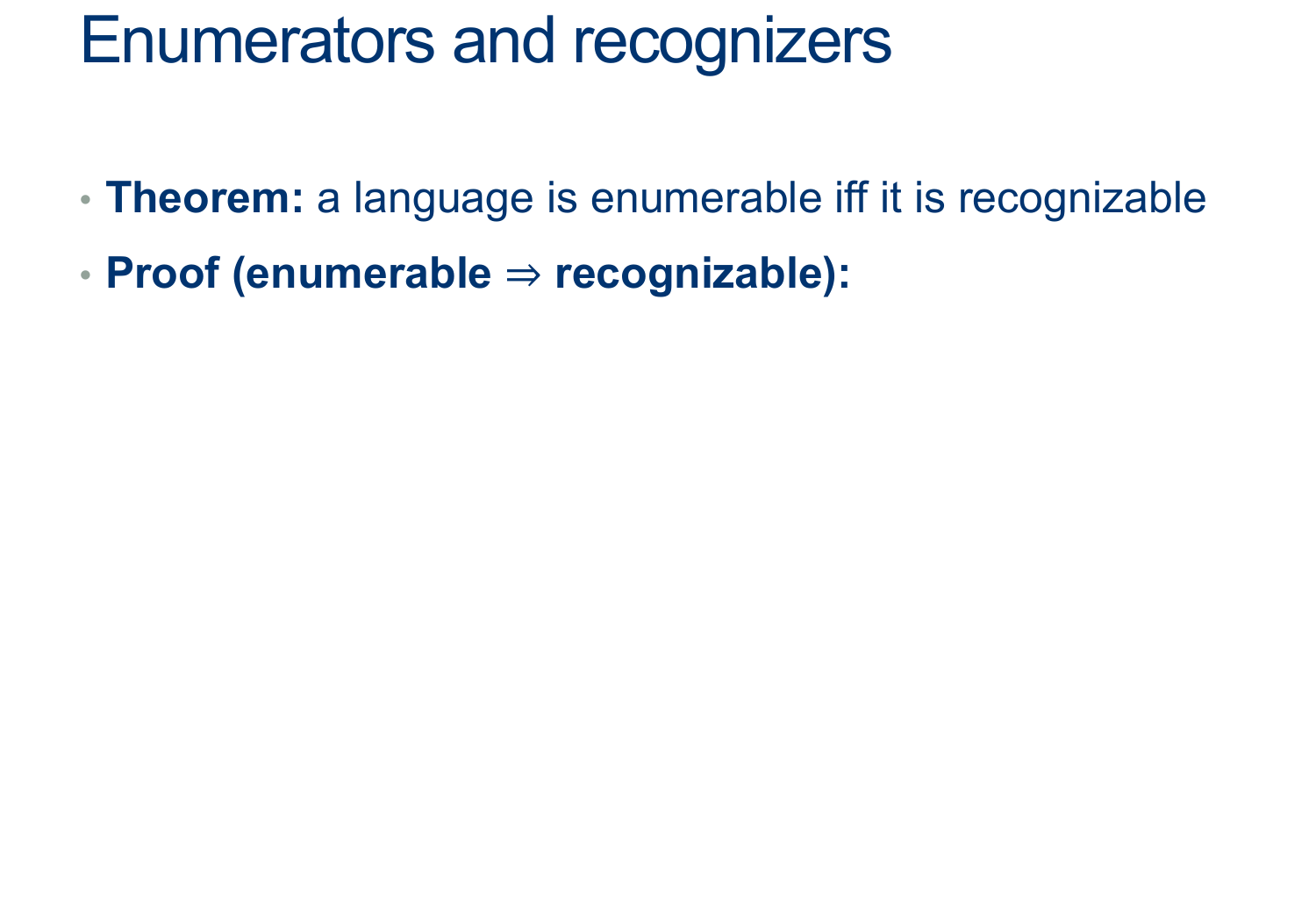
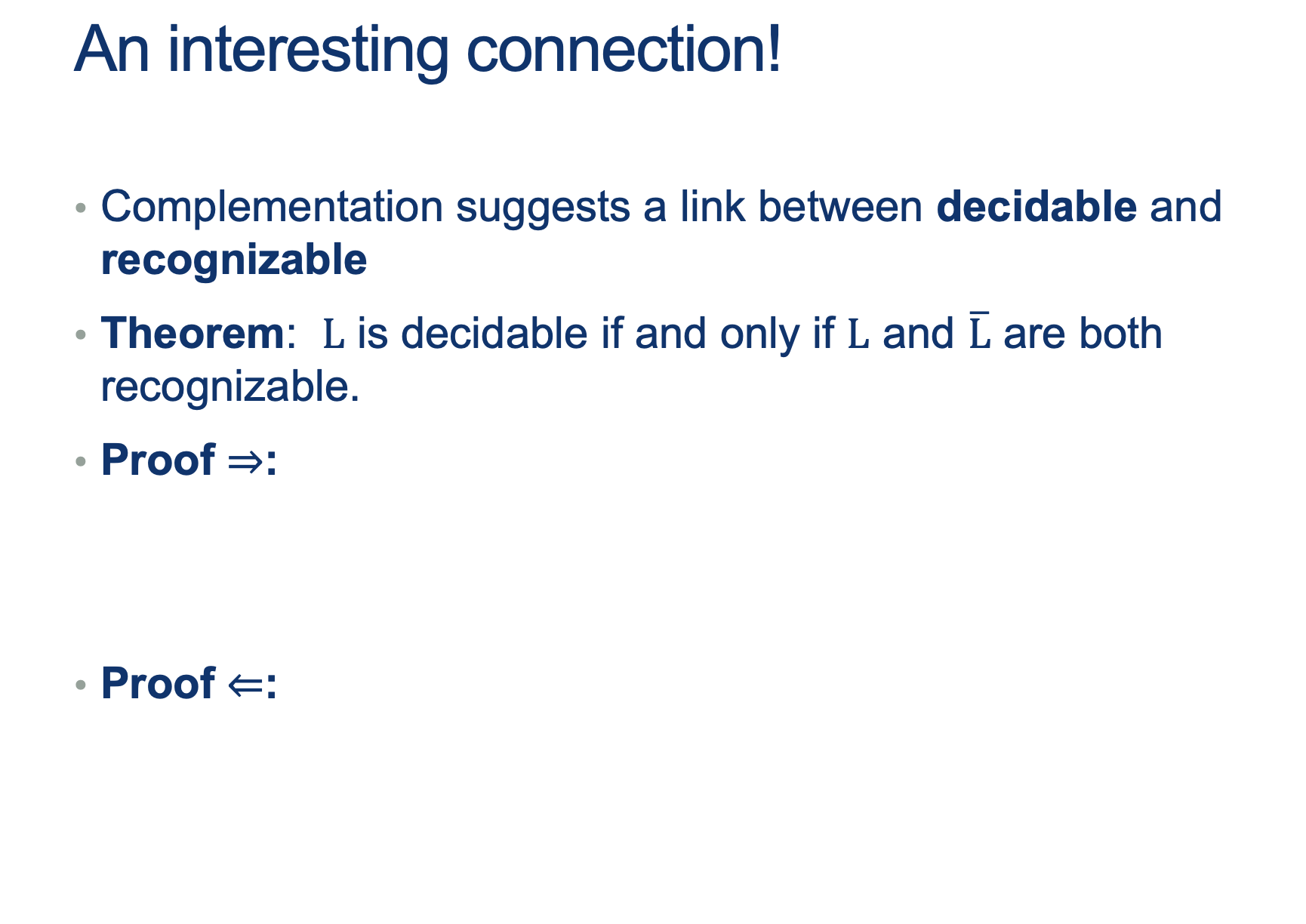
Assume L is enumerable, i.e. there exists some machine E_L that can print out all of Ls words.
Build a machine R_L that uses E_L to print them out one at a time, and compares each one with the input.
As soon as they match, accept.
This machine accepts only words that are in L, and if a word is in L we’re guaranteed to reach it at some point (though it might take awhile).
Thus, it recognizes L. QED.
(Wait; then Click)
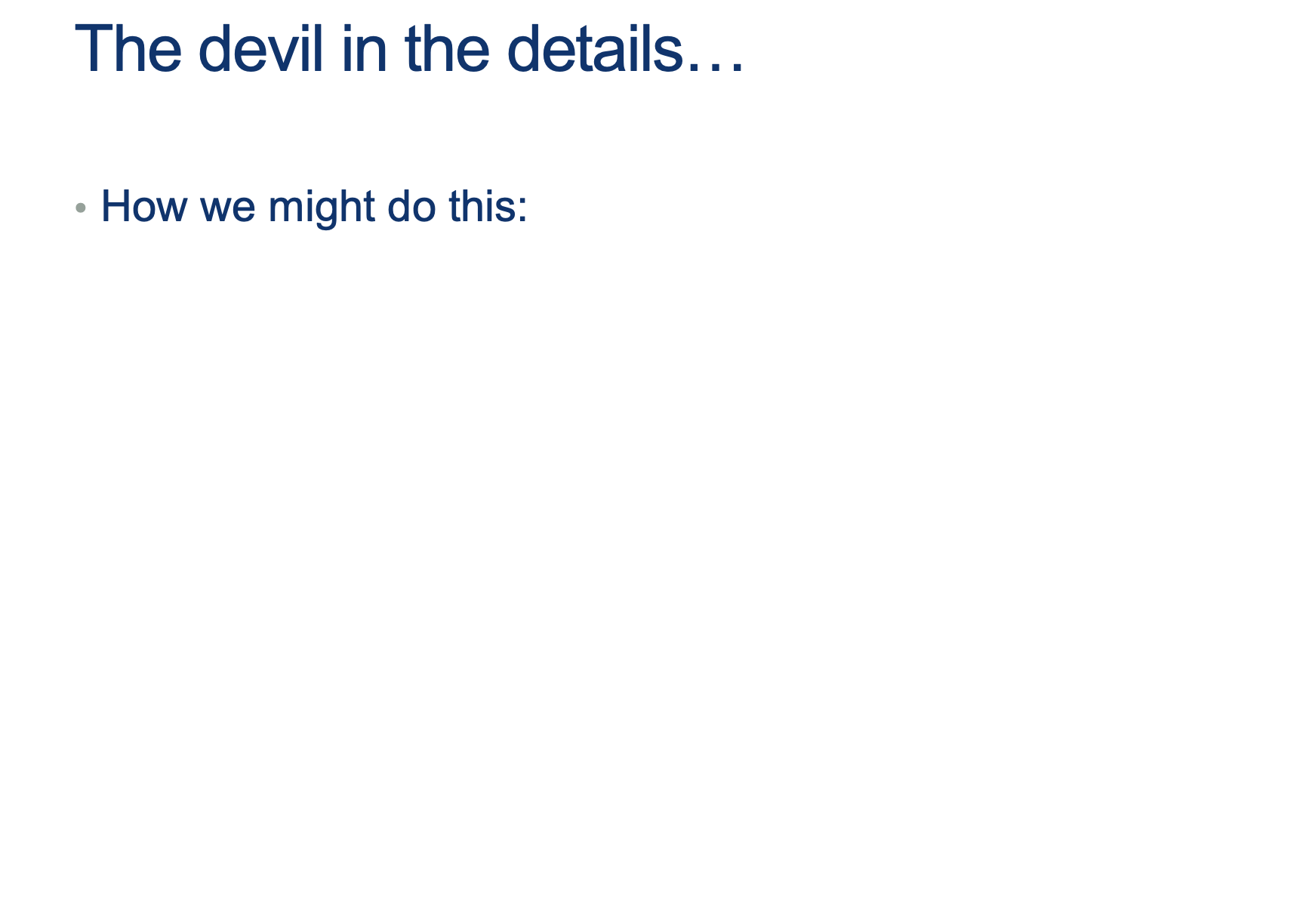
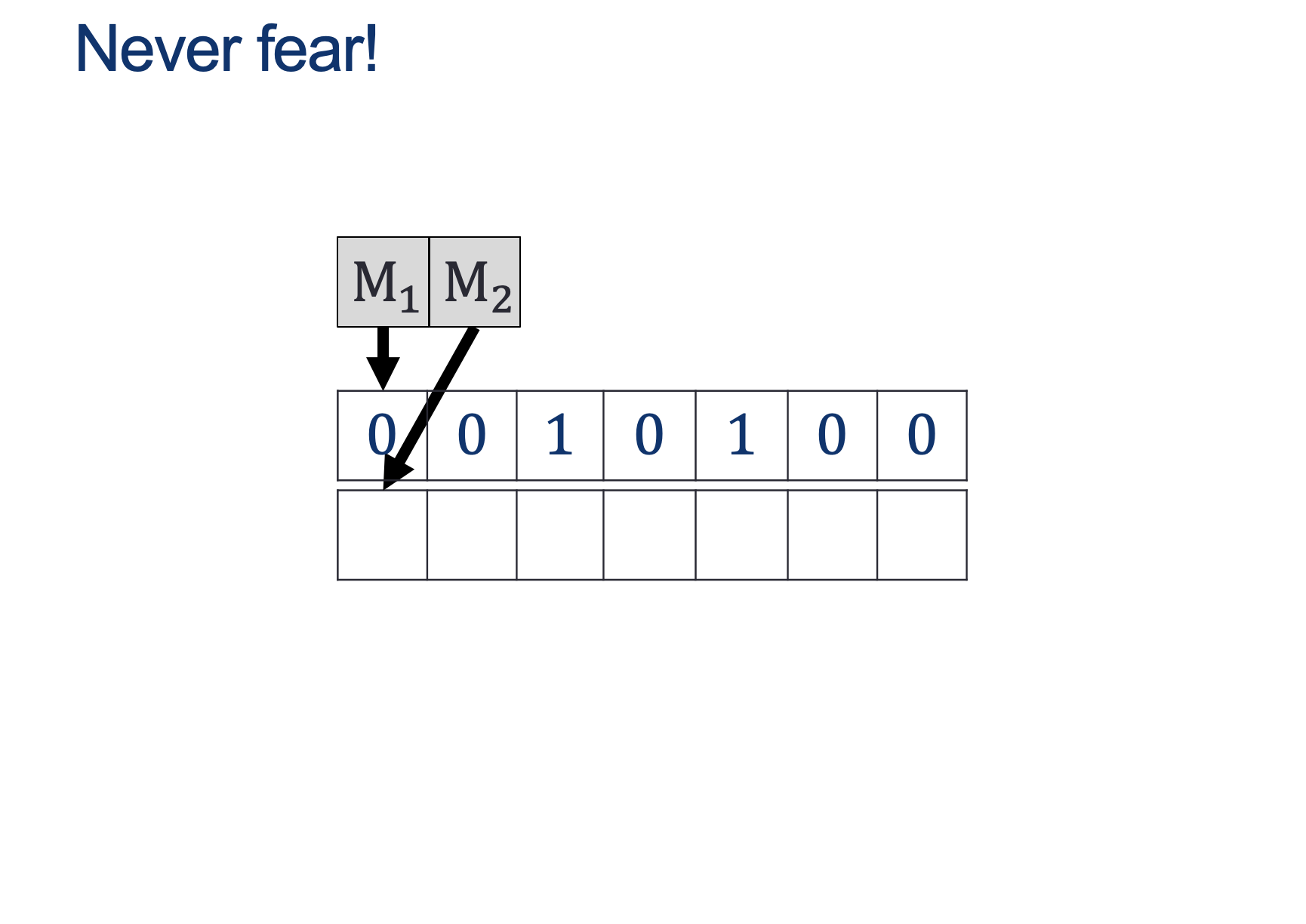
- Run both M1 and M2 on w
- One must accept
-
- If M1 accepts, then M accepts
- If M 2 accepts, then M rejects
What can we do?
{: width="80%"}
Undecidability
Intro to Undecidable Problems (Languages)
Problems as Languages
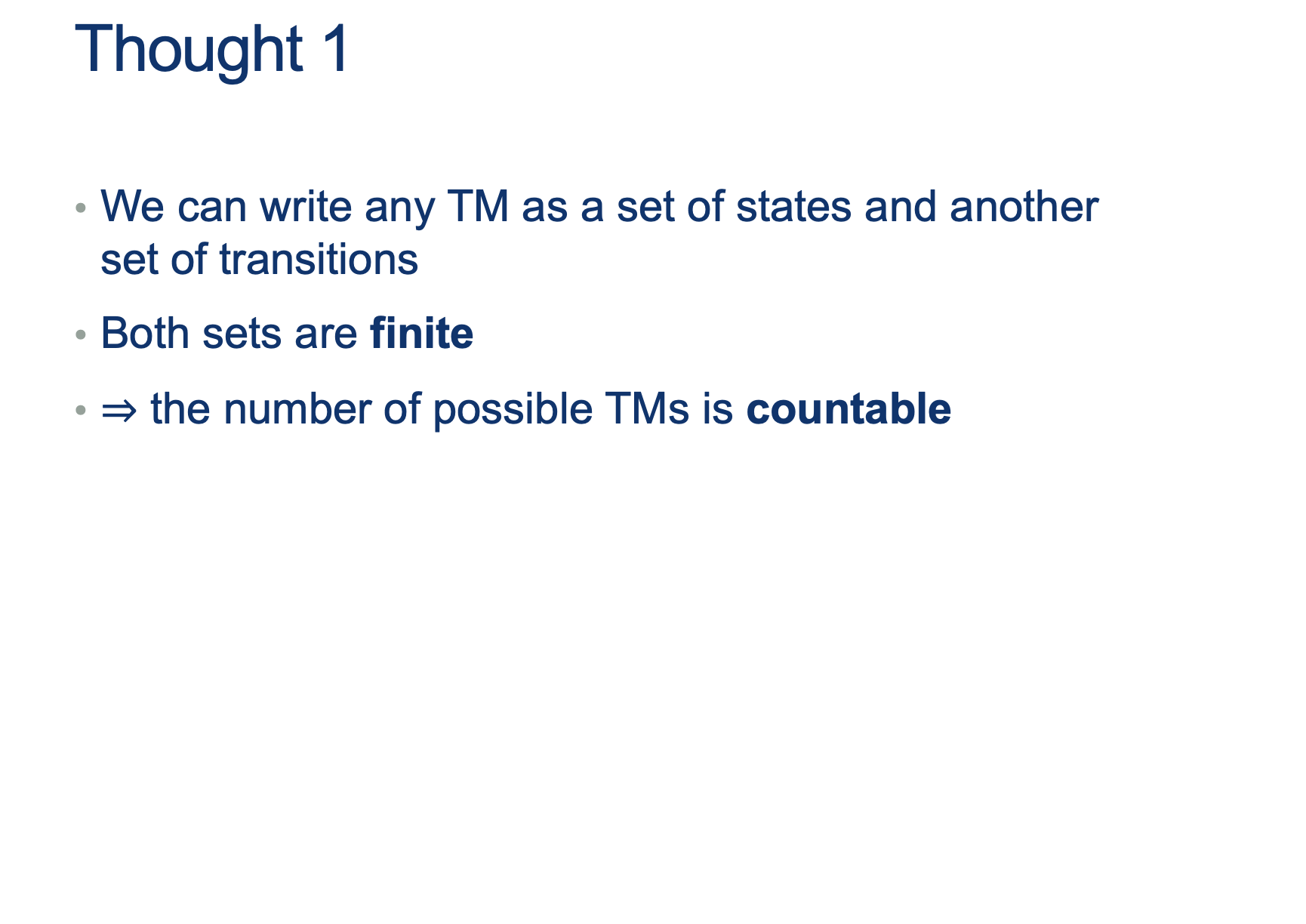
In this class, we have converted “finding a solution to a problem” to “Learning to accept words from a Language”.
In our world, Answering a question means building a machine that recognizes the language-version of that question.
Example problem:
“Can you come up with a binary string with a pattern of 0s and 1s such that the string is a palindrome”
Example Language-Version:
\(L = \{ w \in \Sigma^* | w^R = w \}\)
Example solution:
(See the CMF, PDA, or TM solutions to this problem)
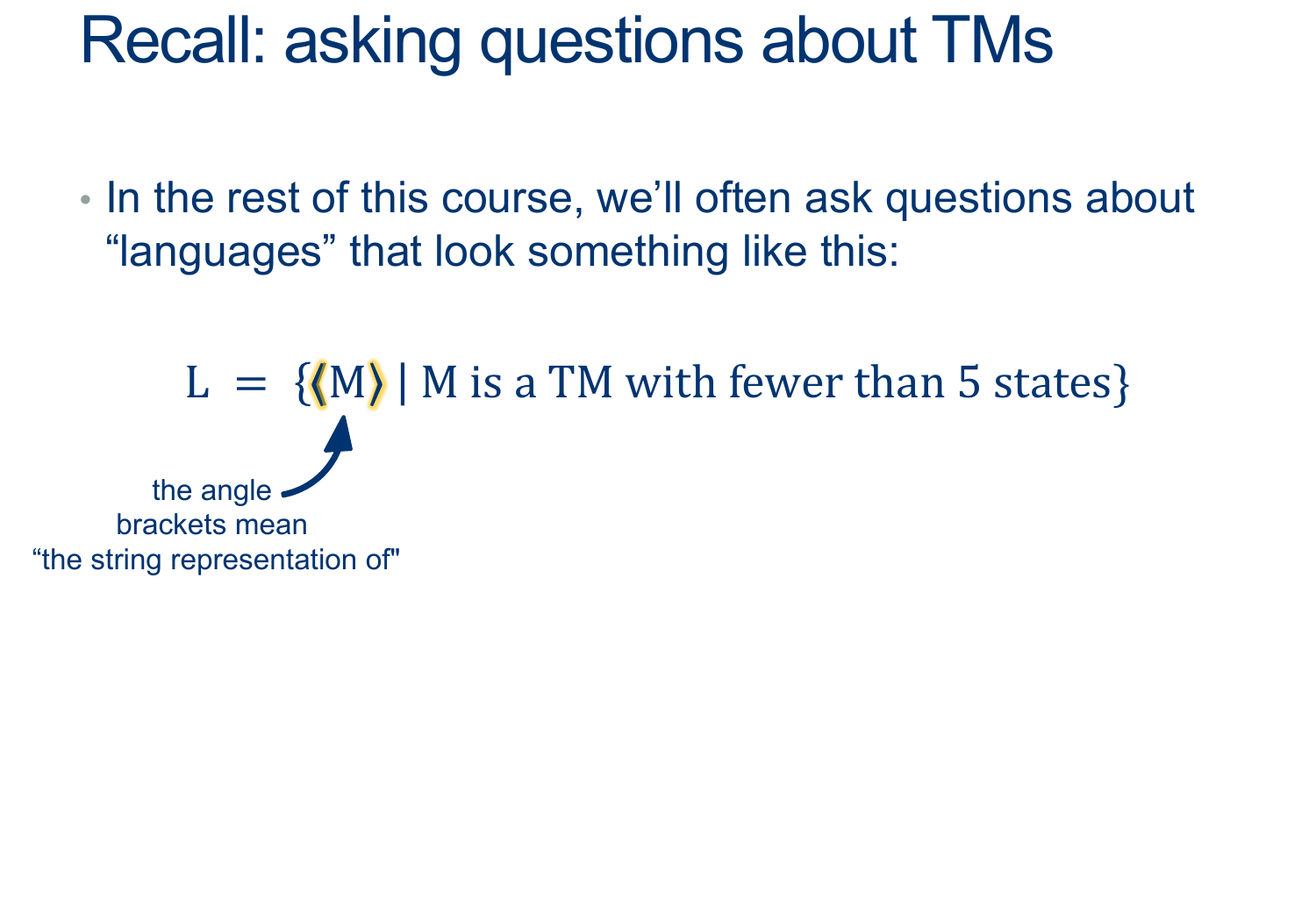
Questions about Machines
Often we’ll ask questions about the machines we’ve seen so far.
Again, answering a question means building a machine that recognizes the language-version of that question.
So, a problem like:
“Find the set of Turing Machines that have up to 5 states”,
can be rephrased as finding the Language:
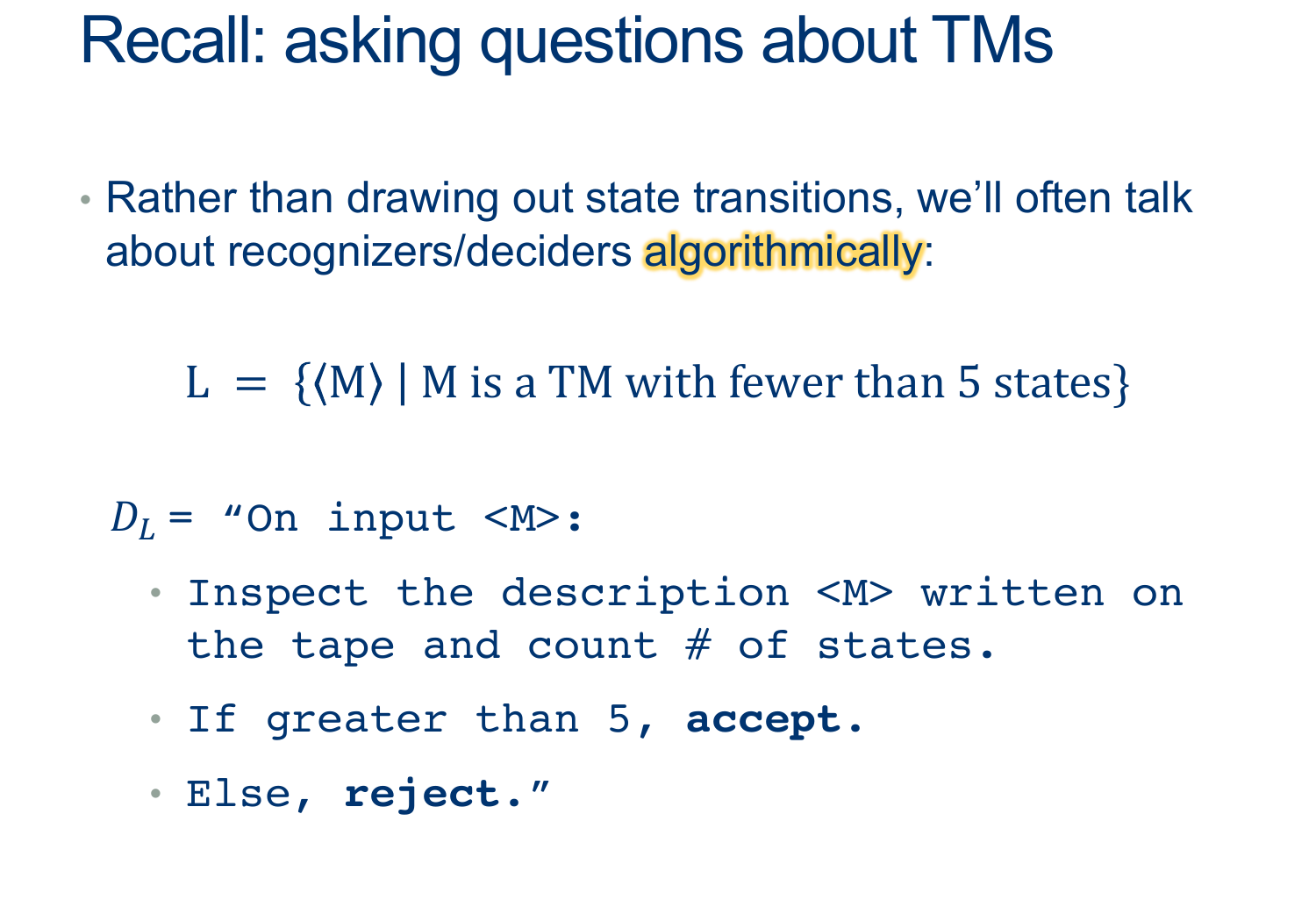
Answering with an Algorithm
How would you “Solve” the problem for:
\[L = \{ < M > | M \text{ is a TM and } M \text{ has fewer than 5 states} \}\]What could you use to “Solve” (Decide/Recognize) $L$?
(Wait; then Click)
Another Turing Machine!! ... A Decider for $L$ we'll call $D_L$ $$ \begin{align*} & D_L :\\ & \text{On INPUT } < M >\\ & \quad \text{Inspect the description of } M \\ & \quad \quad \text{IF $M$ is not a valid TM: REJECT} \\ & \quad \quad \text{ELSE IF $M$ has fewer than 5 states: ACCEPT} \\ & \quad \quad \text{ELSE: REJECT} \\ \end{align*} $$ CAN we get stuck on a loop? (Note that we know something about description $M$ that helps us answer this question)
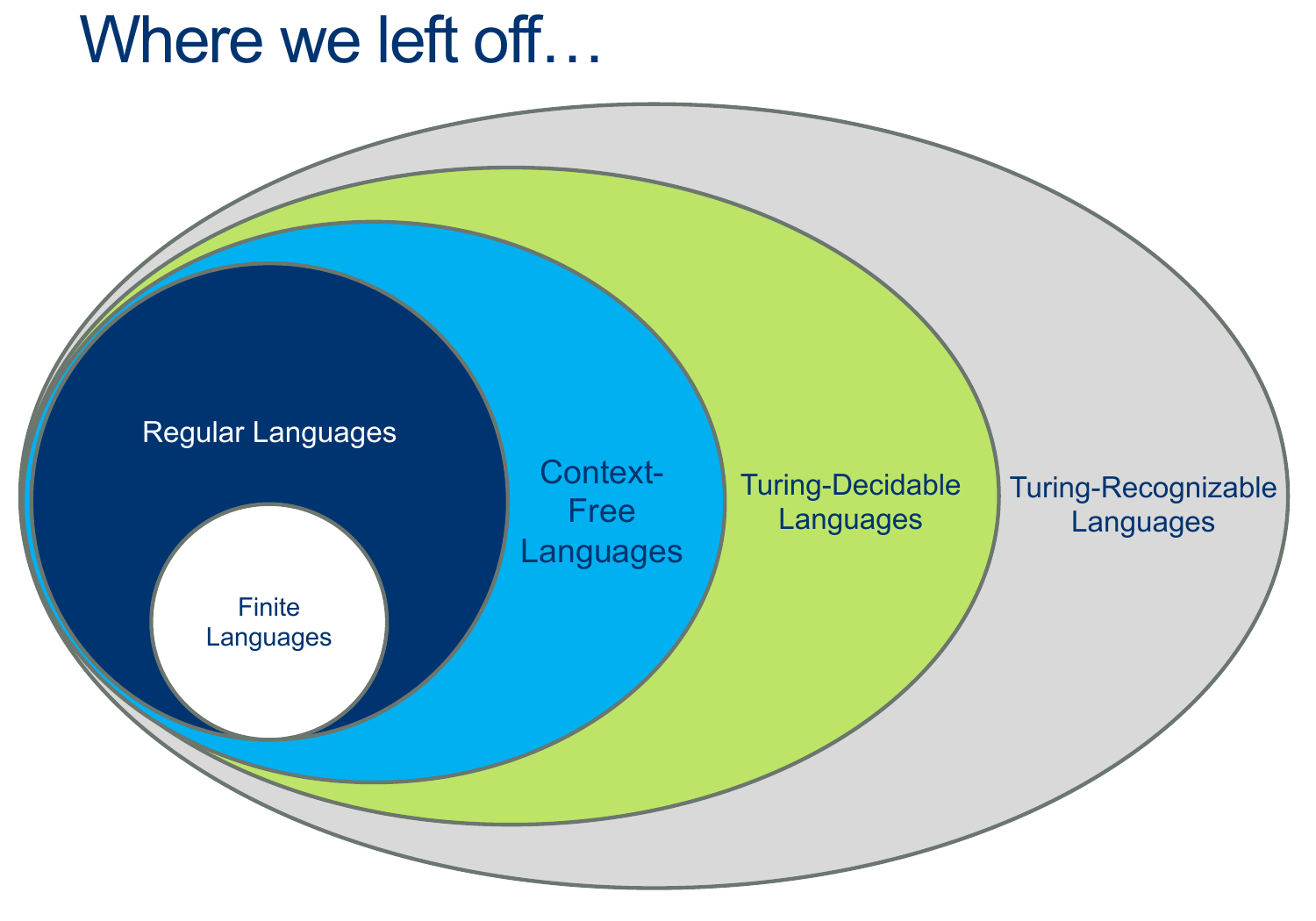
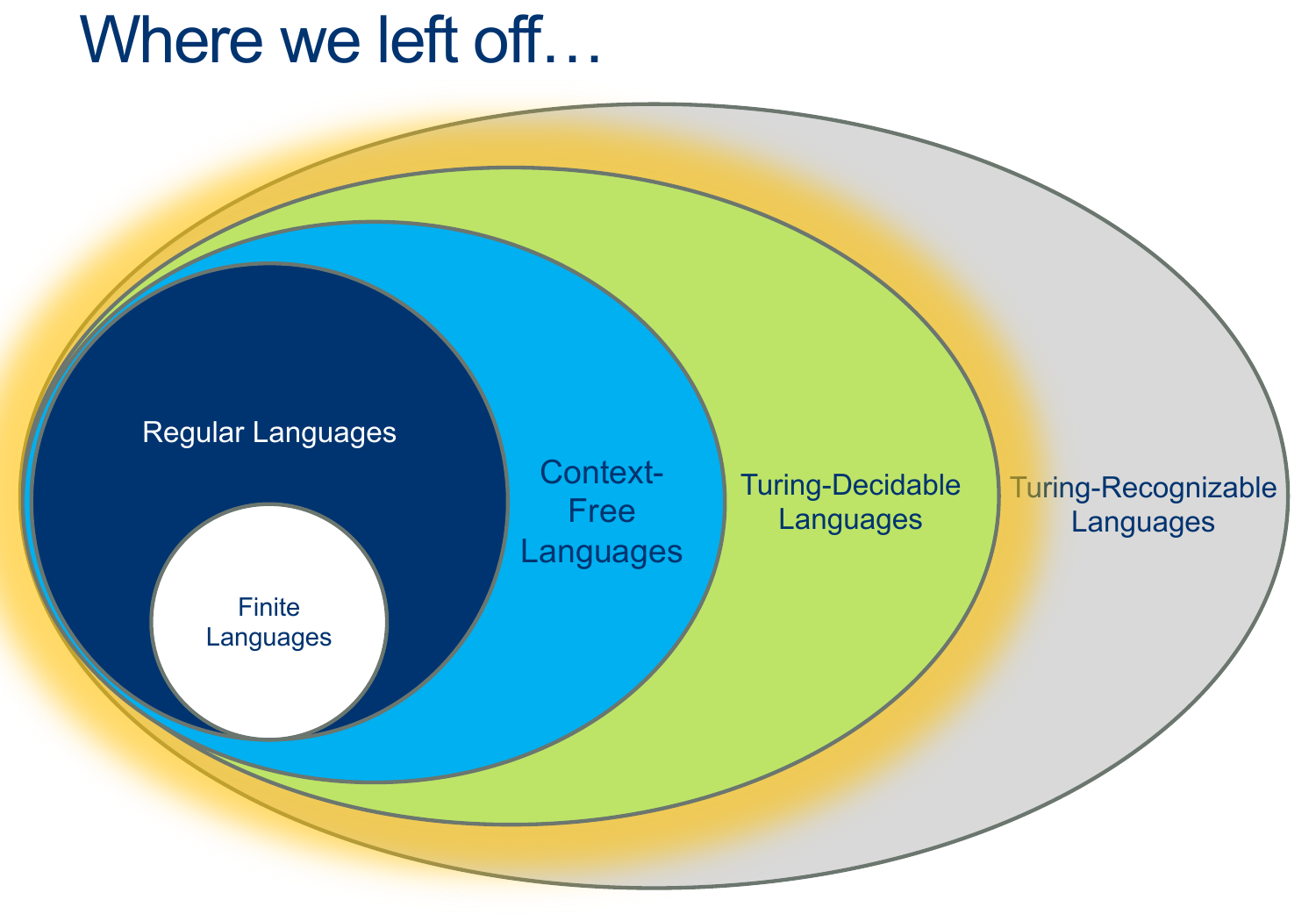
Another Recap (so we don’t get lost)
Questions about Machines
Discuss if you could build $D_L$ for the following language:
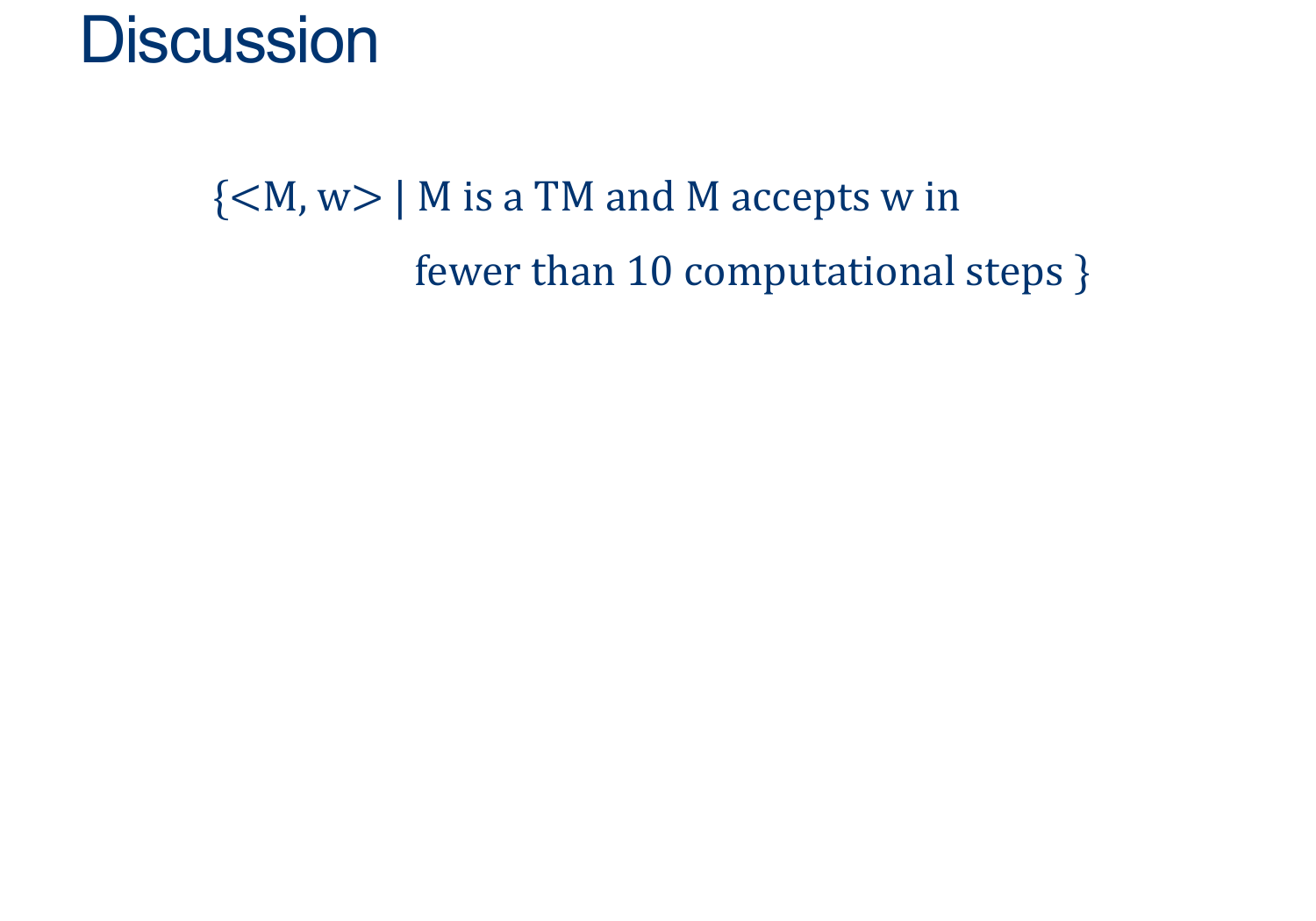
\[L = \{ < M, w > | TM \; M \text{ accepts } w \text{ in fewer than 10 steps} \}\]Discuss if you could build $D_L$ for the following language:
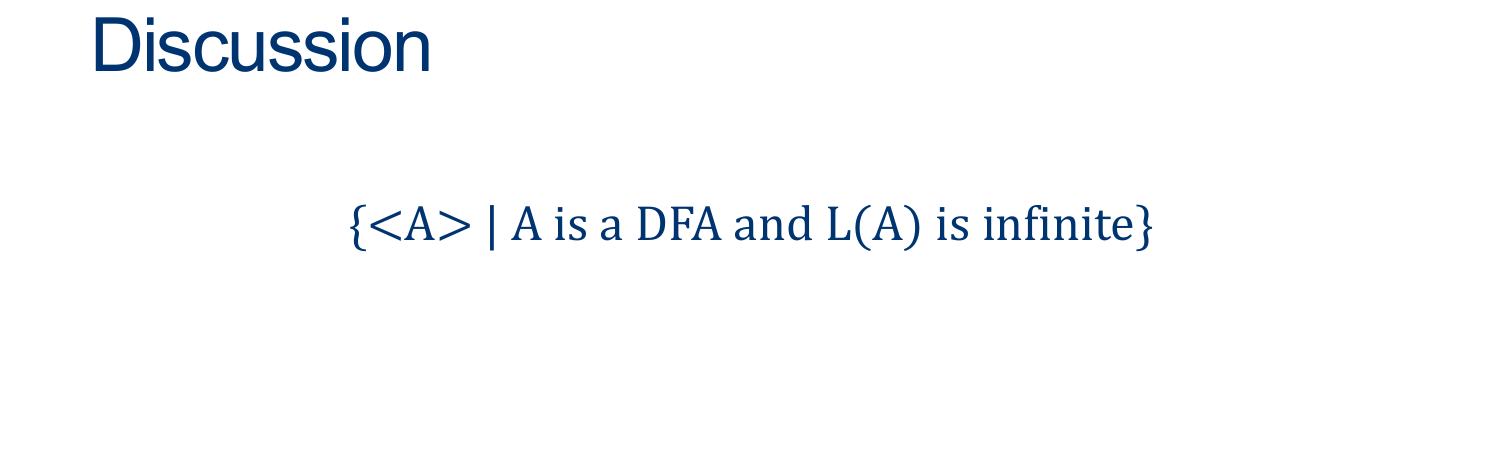
\[L = \{ < A > | \text{DFA $A$ accepts an infinite number of words (L(A) is infinite)} \}\]Discuss if you could build $D_L$ for the following language:
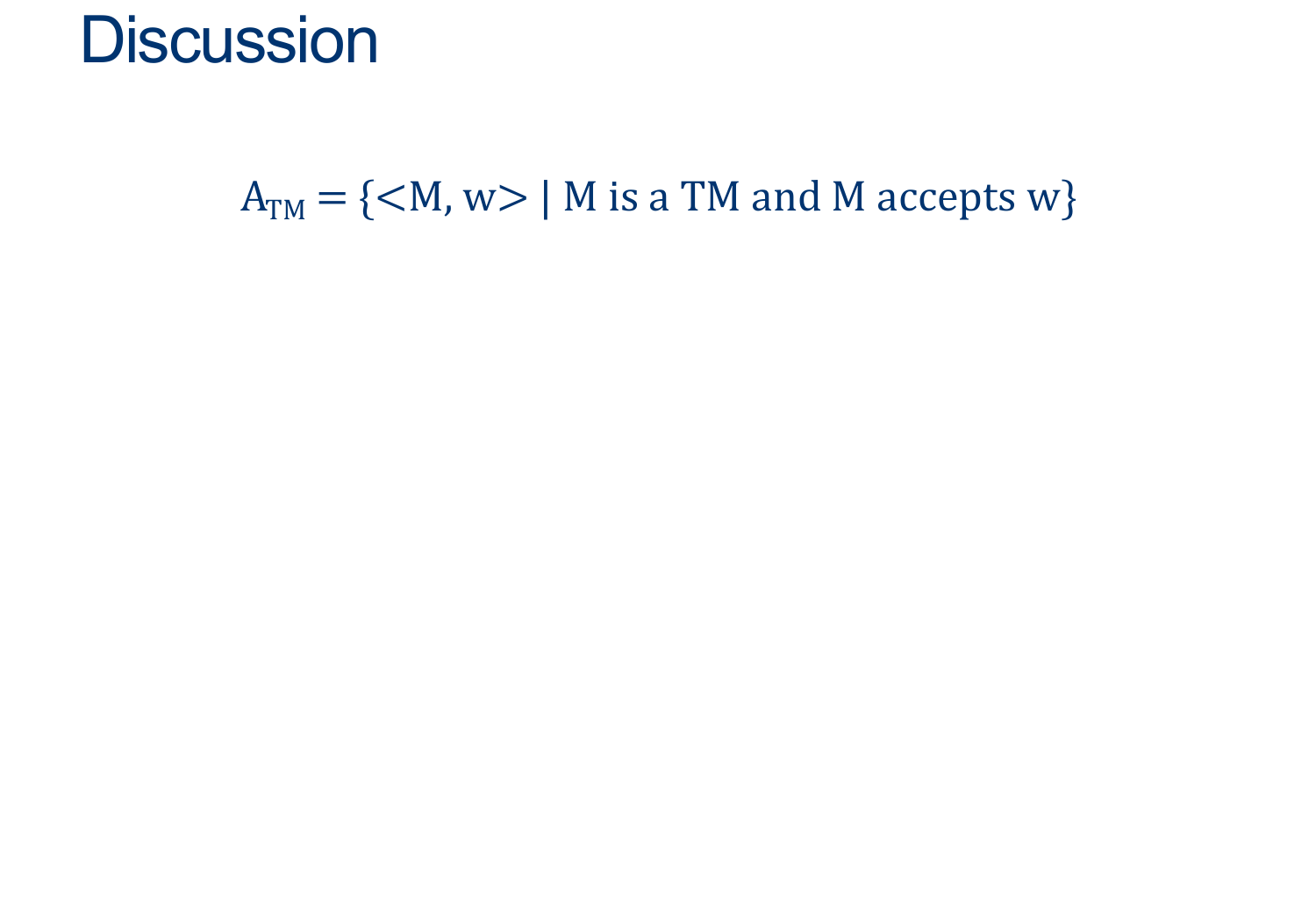
\[A_{TM} = \{ < M, w> | \text{TM $M$ accepts } w \}\](Wait; then Click)
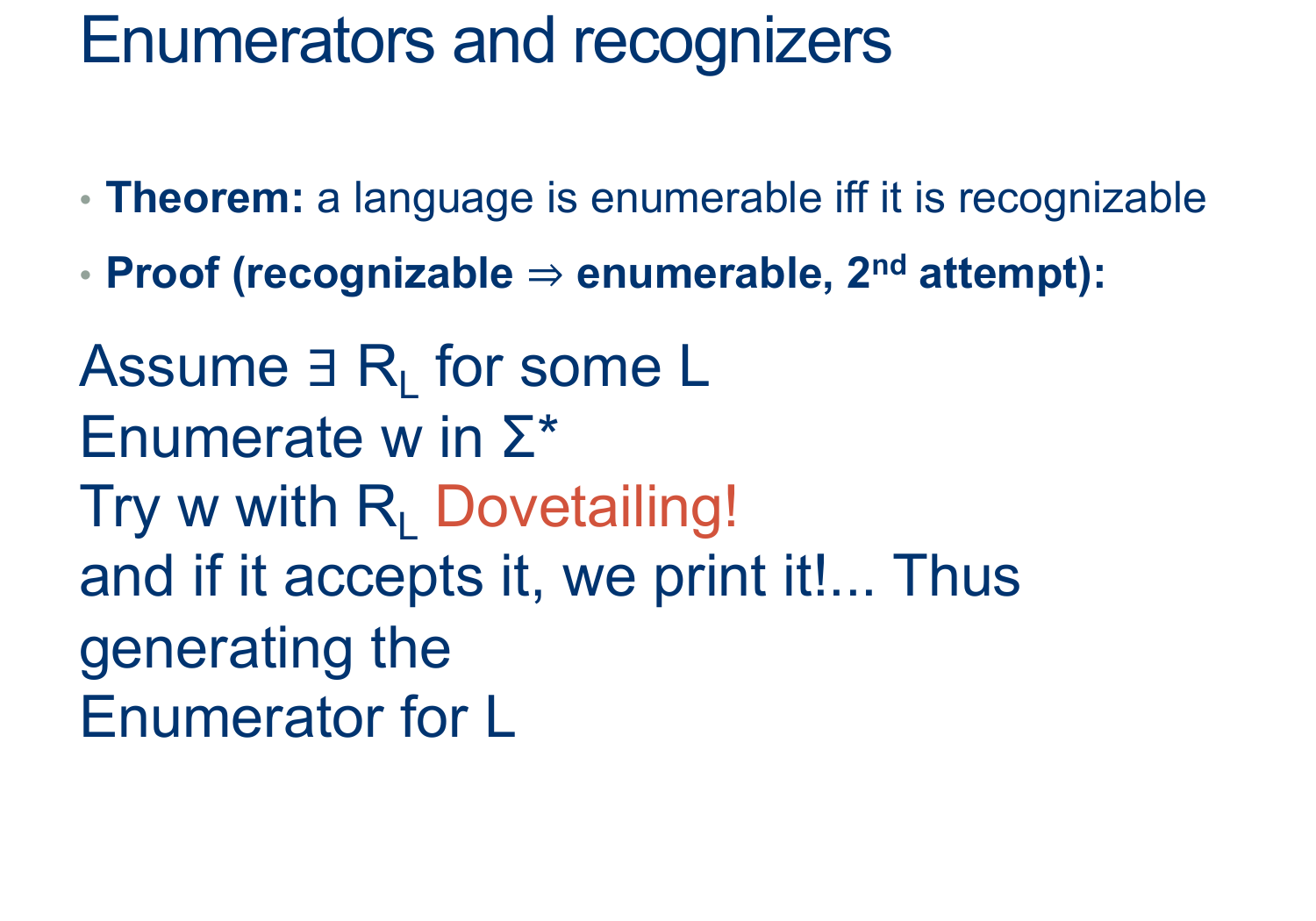
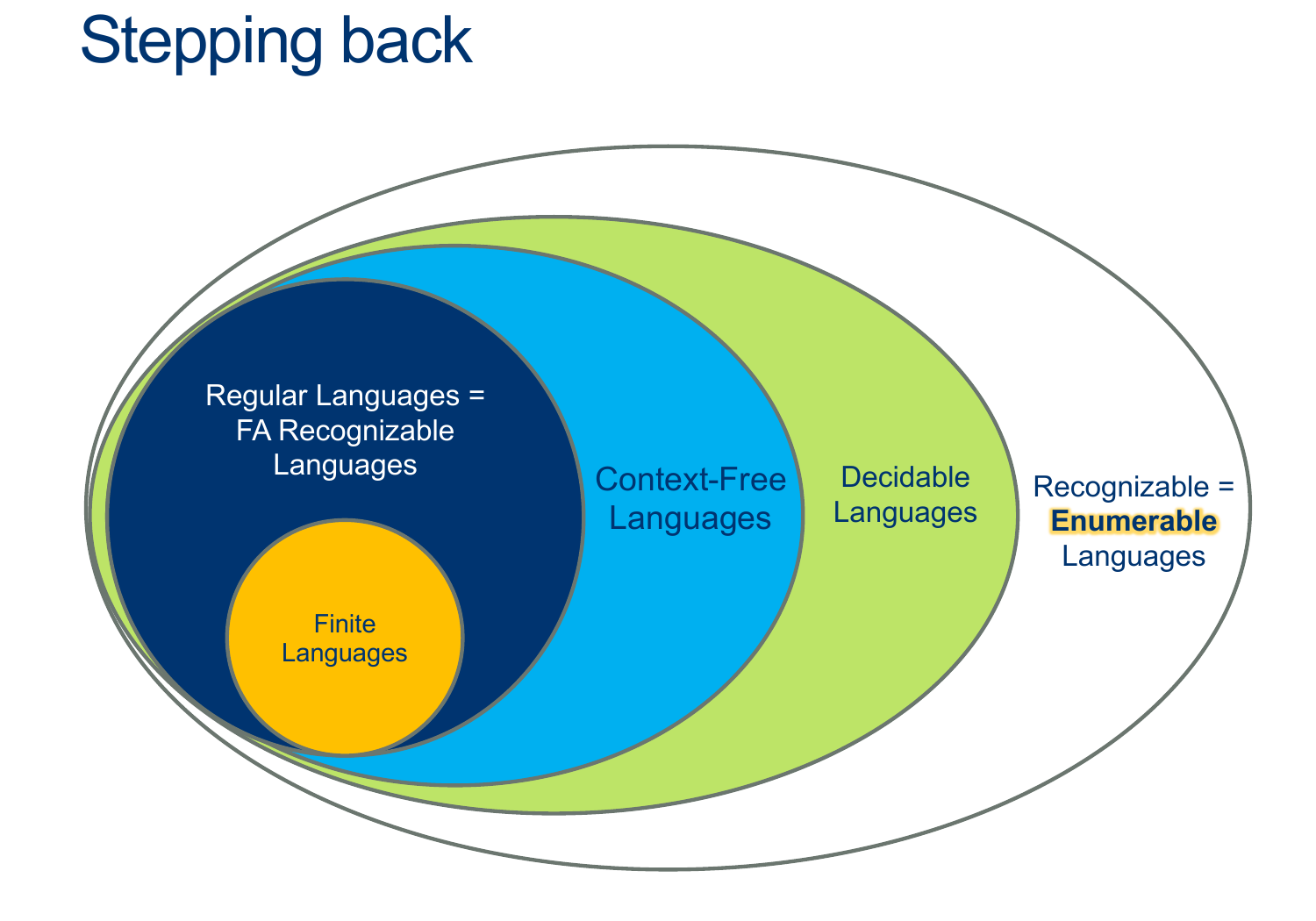
- Can we prove it is at least recognizable?
- Can we prove it is NOT Decidable?
- Are these two things the same?
How about ATM?
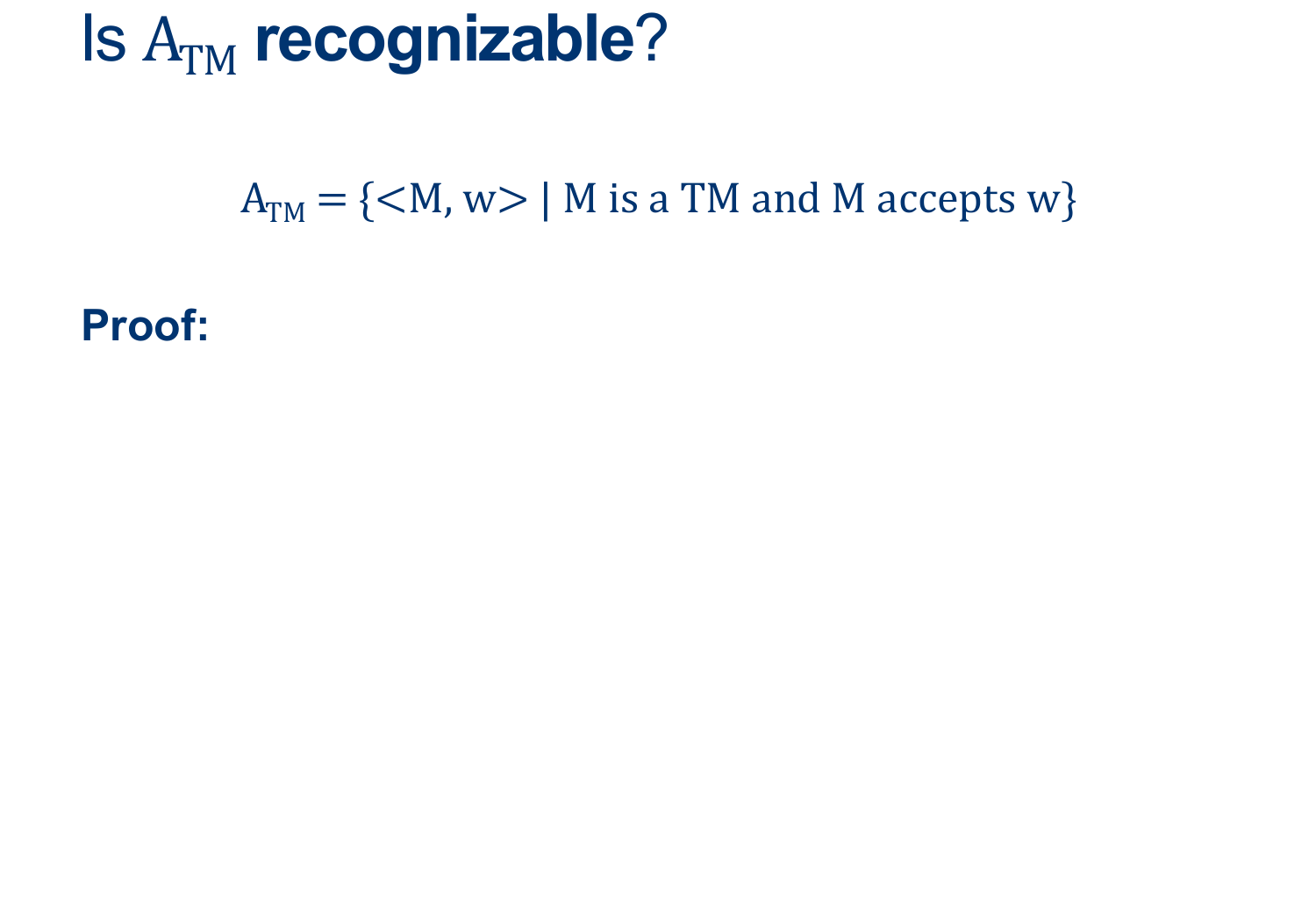
Can we come up with a simple proof?
(Wait; then Click)
Proof by construction: $$ \begin{align*} &R_{ATM}:\\ & \text{ On input $ < M,w > $ }:\\ & \text{ Simulate M on w.}\\ & \text{ If it accepts, accept. }\\ \end{align*} $$
Is ATM decidable?
Discuss if you could build $D_L$ for the following language:
\[A_{TM} = \{ < M, w> | \text{TM $M$ accepts } w \}\]Can a $D_{ATM}$ be constructed such that:
- It Accepts any $w $ such that $w \in A_{TM}$
AND
- It Rejects any $w $ such that $w \notin A_{TM}$
(Wait; then Click)
Intuition...Not decidable:
- we can’t tell the difference between looping and “just haven’t waited long enough”.
- But we can't prove "we haven't waited long enough" for each input... (AND we have infinite inputs)
- But we can use another technique to try to prove this... CONTRADICTION!
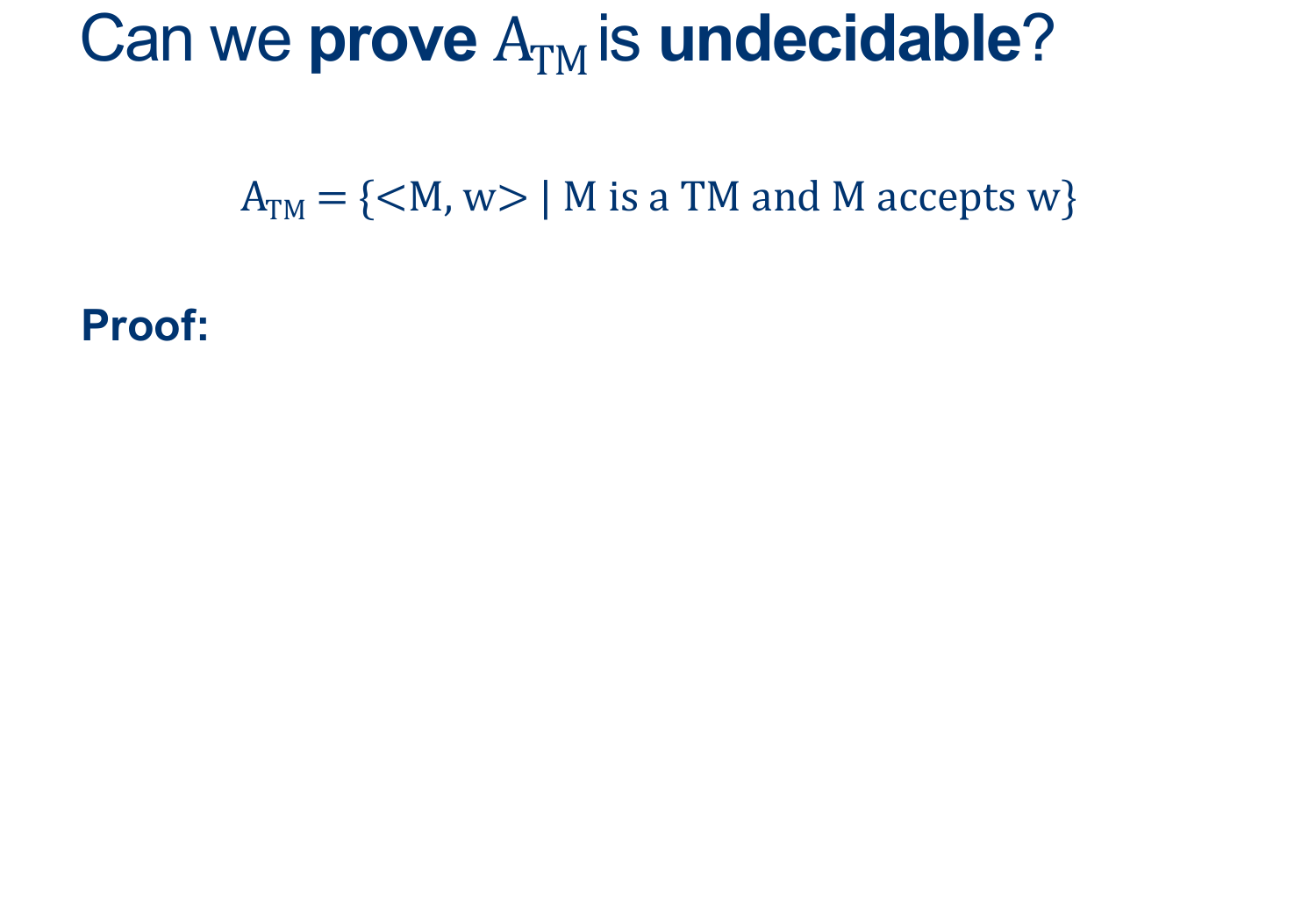
Step 1: Assume Is ATM is Decidable Now try to use this “fact” to arrive at a contradiction
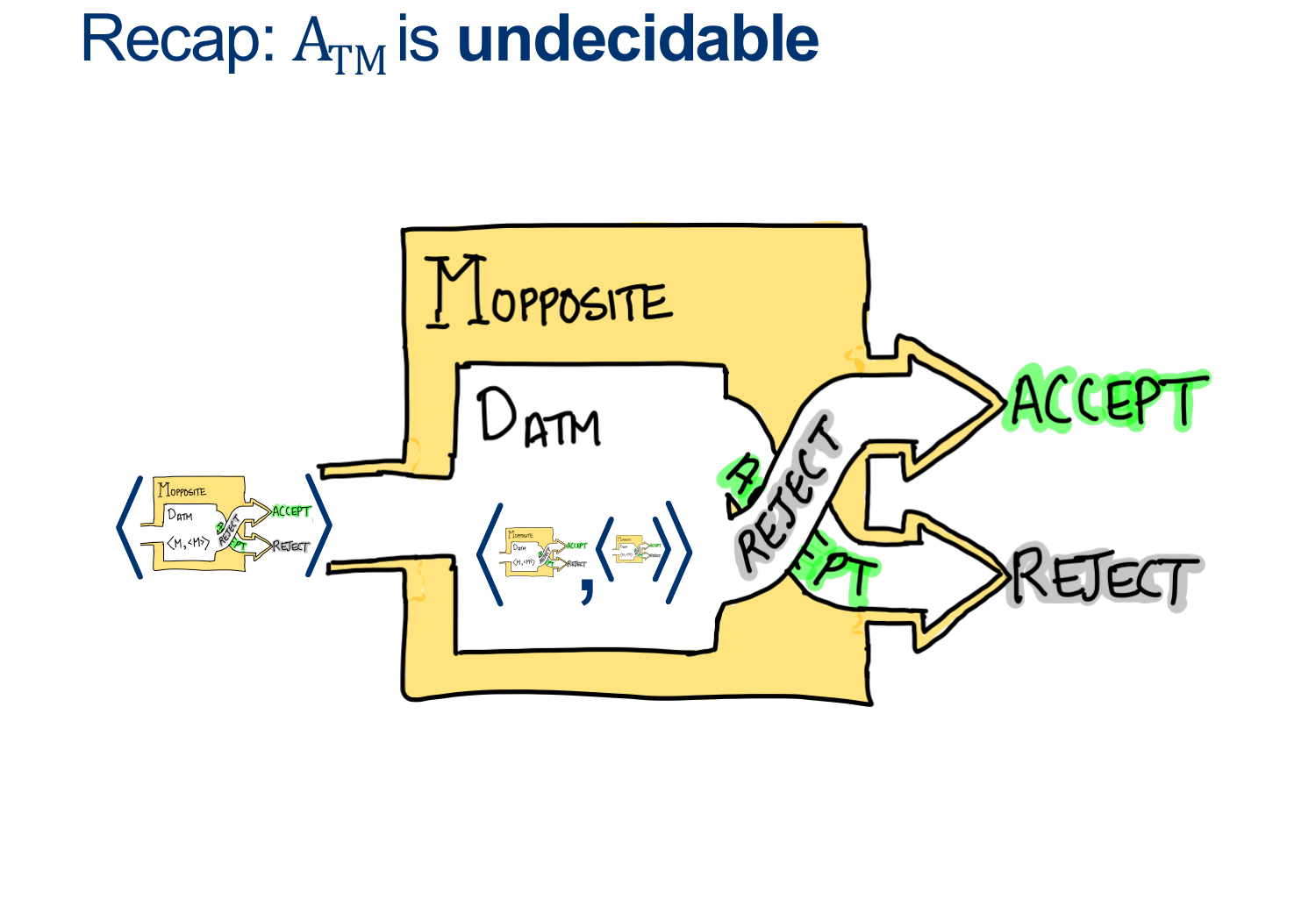
Consider the Machine $M_{OPPOSITE} ( < M> )$
\[\begin{align*} &M_{OPPOSITE}:\\ & \quad \text{ On input $ < M > $ }:\\ & \quad \text{ Simulate $D_{ATM} \; on \; < M , < M > > $}\\ & \quad \text{ If $D_{ATM}$ accepts, REJECT. }\\ & \quad \text{ If $D_{ATM}$ rejects, ACCEPT. }\\ \end{align*}\]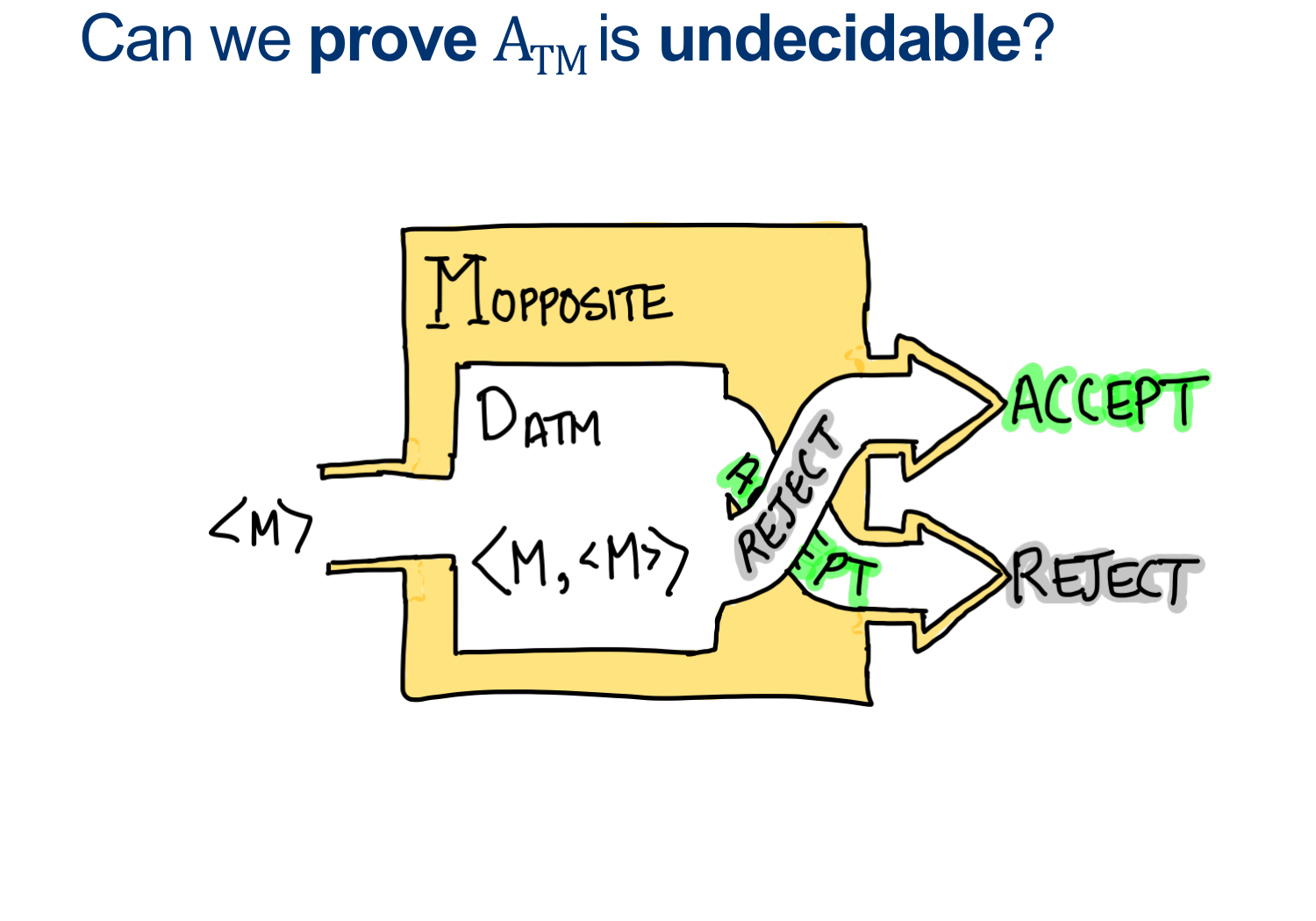
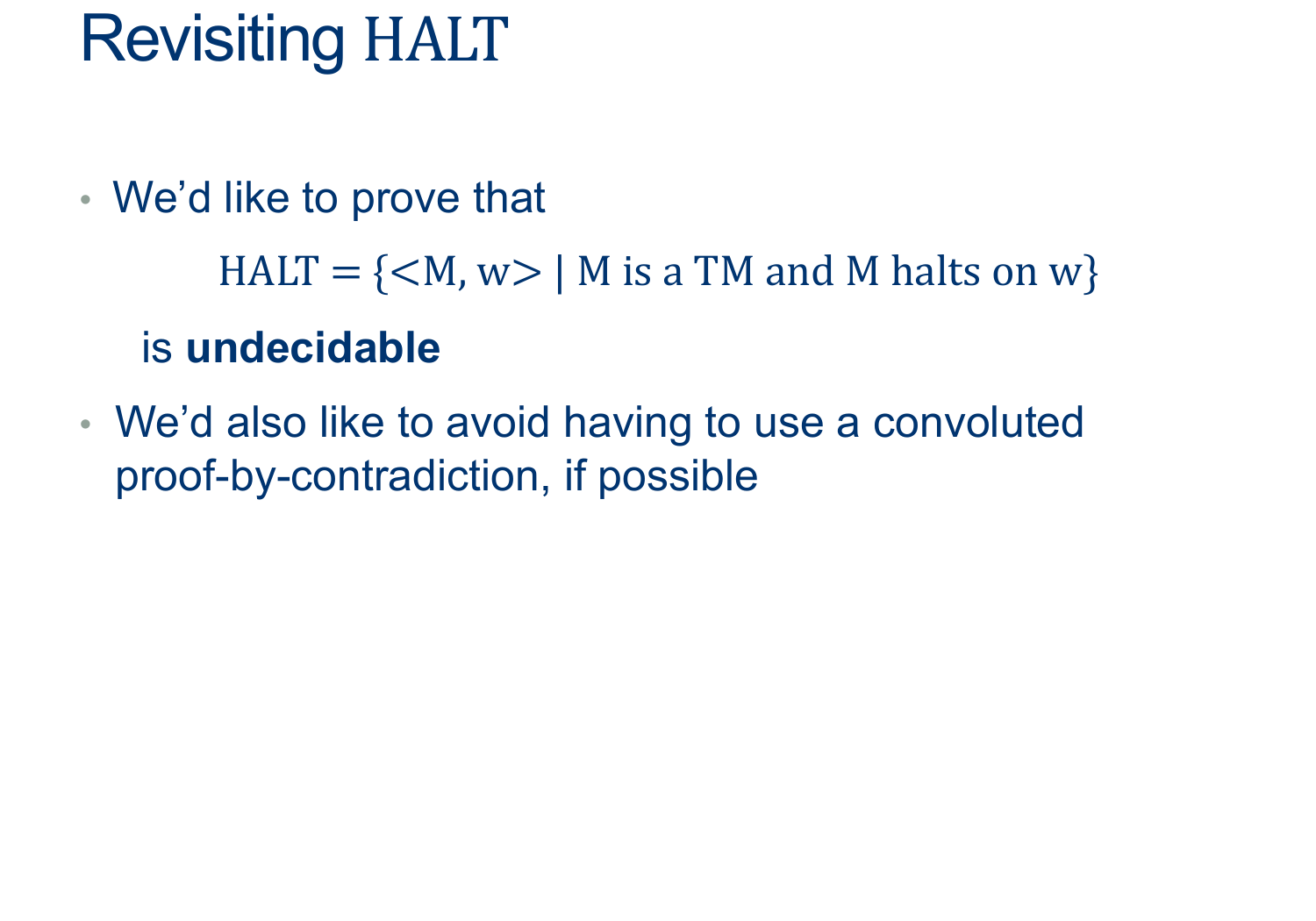
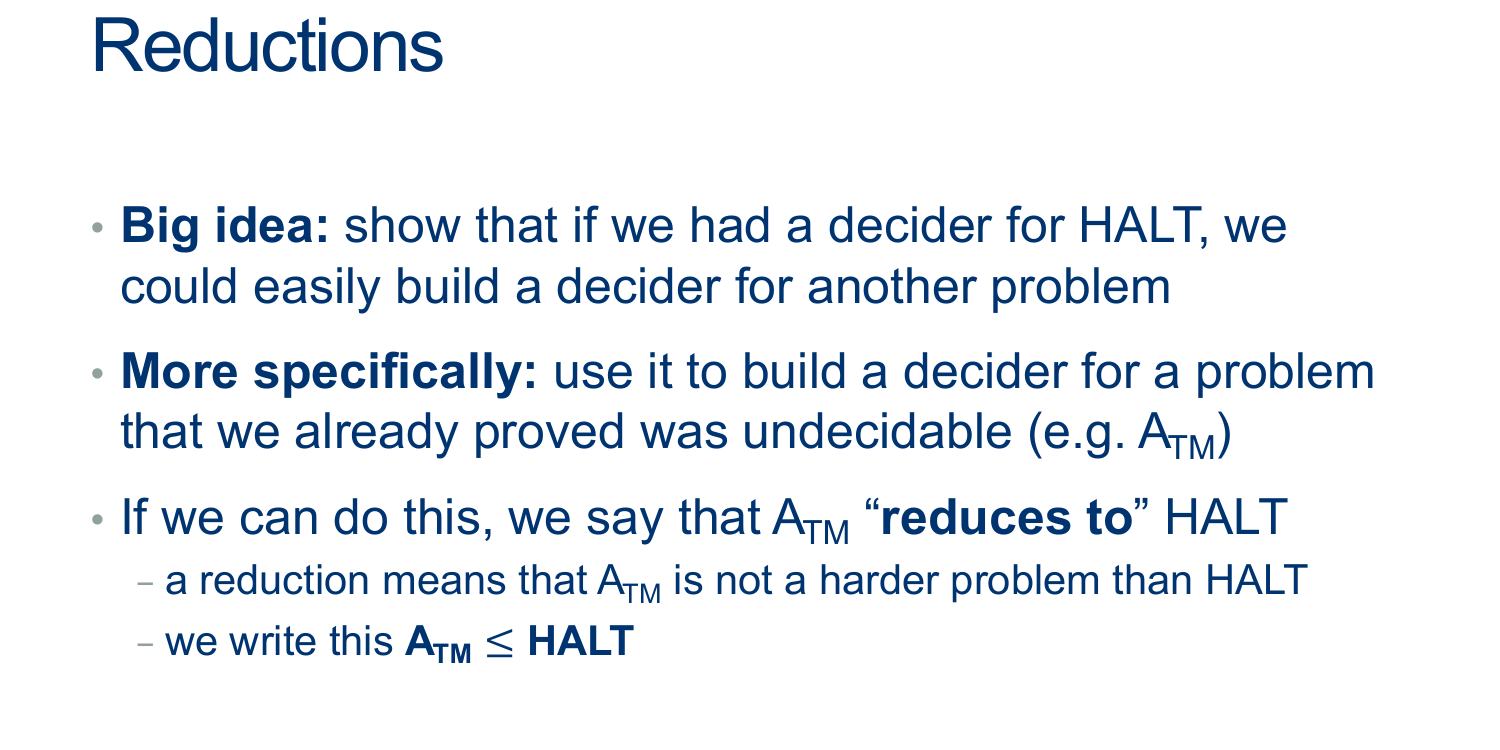
In other words, $ HALT$ is AT LEAST as hard as $ ATM $
(So if we can solve HALT, we can, for sure, solve ATM)
Try it out yourselves first
Think of a way you can get to say:
if we can solve HALT, we can, for sure, solve ATM
(Wait; then Click)
Assume HALT is decidable, and so there exists some $D_{HALT}$ that decides, for any input $< M,w>$, whether $M$ halts on $w$. We'll design the Machine $D_{ATM} $ as follows: $$ \begin{align*} &D_{ATM}:\\ & \quad \text{ On input $ < M, w > $ }:\\ & \quad \text{ Simulate $D_{HALT} \; on \; < M, w > $}\\ & \quad \text{ If $D_{HALT}$ rejects, $M$ doesn't halt, so it did not accept: REJECT. }\\ & \quad \text{ If $D_{HALT}$ accepts, we know $M$ won't loop forever, so }\\ & \quad \quad \text{ Simulate $M$ on $w$ ADWID }\\ \end{align*} $$ This machine is a decider for ATM (why?) – it avoided the only problem we had with solving ATM, namely telling the difference between looping and lot waiting long enough.
However, we proved that ATM was undecidable by contradiction just a few minutes ago. Aaaand...the only condition we need to build $D_{ATM}$ was that $D_{HALT}$ existed, so ... $D_{HALT} \; $ must not exist.
–>