Lecture Notes 21: Mapping Reducibility
Outline
This class we’ll discuss:
- Recap: Enumeration and Recognizers
- Mapping reducibility
A Slideshow:
GUIDED NOTES (Optional)
Mapping Reducibility
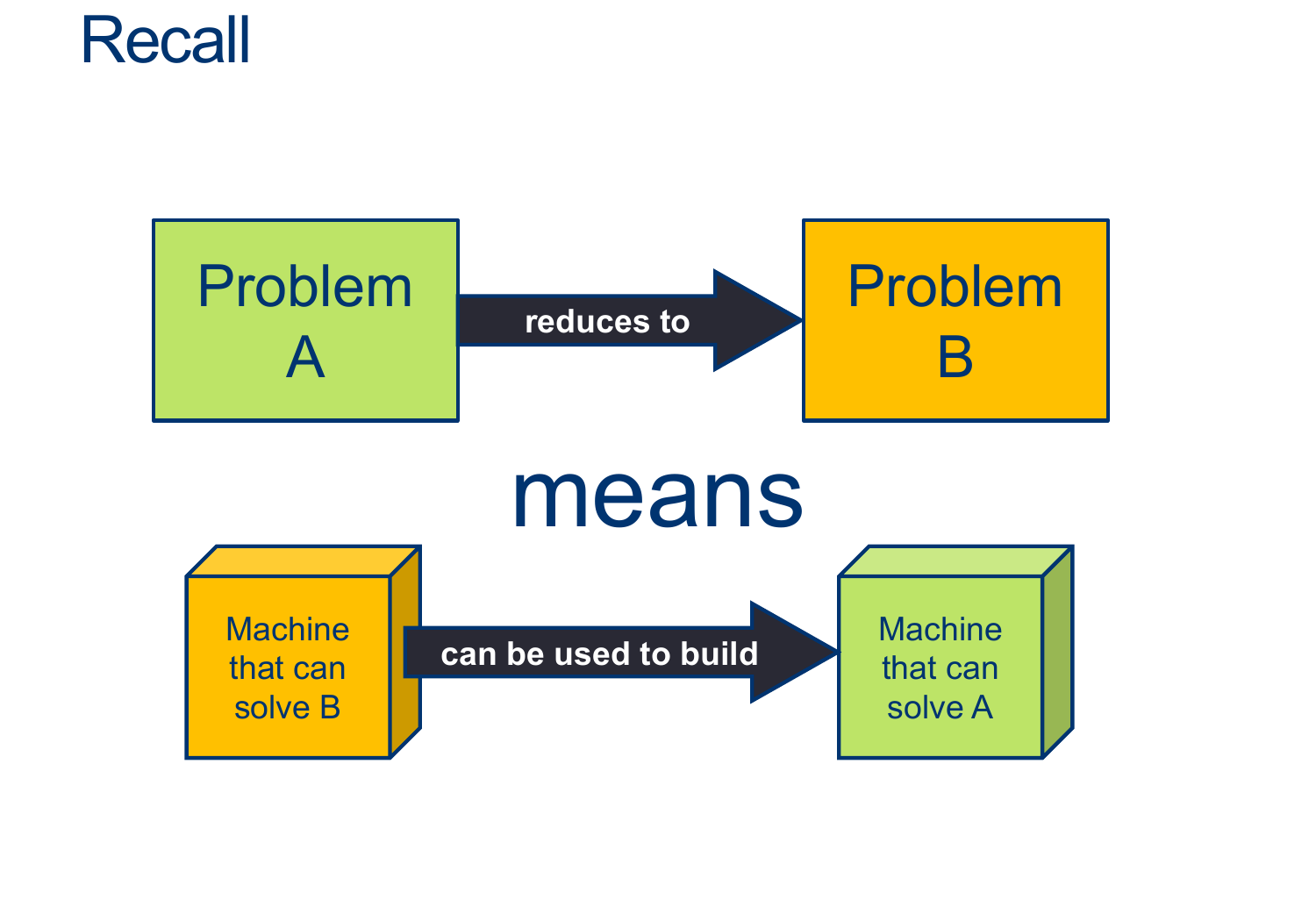
Recap: Reductions
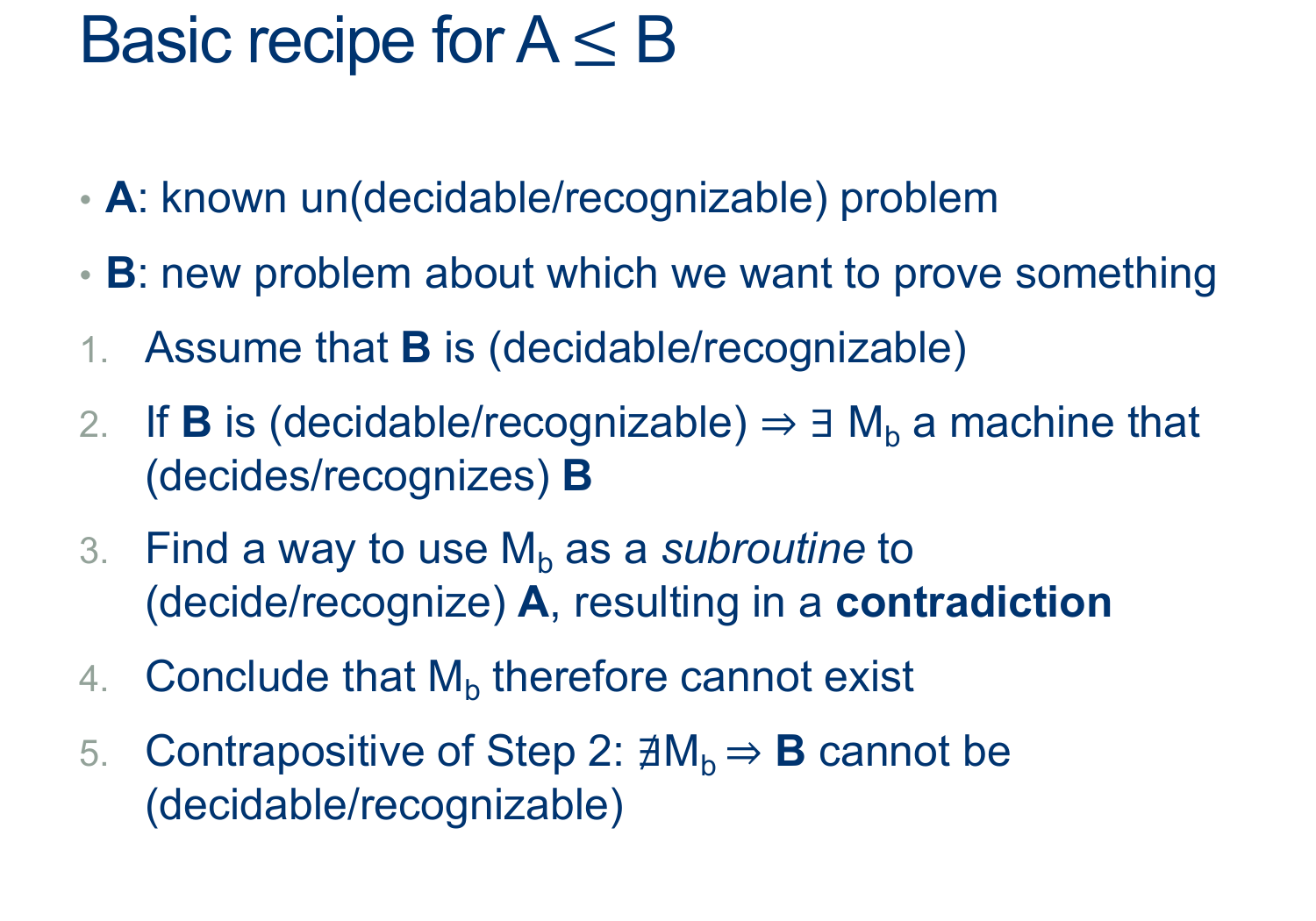
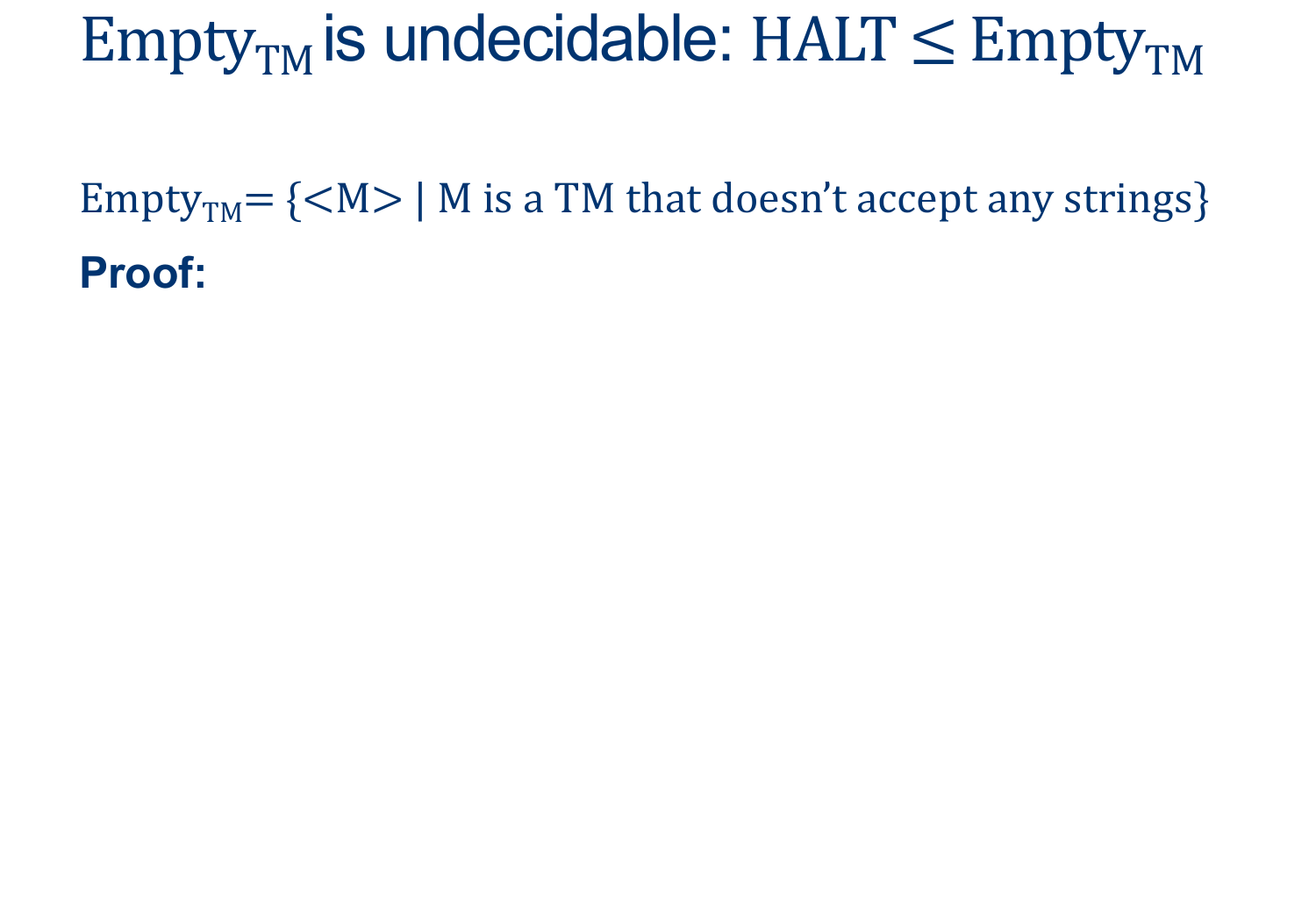
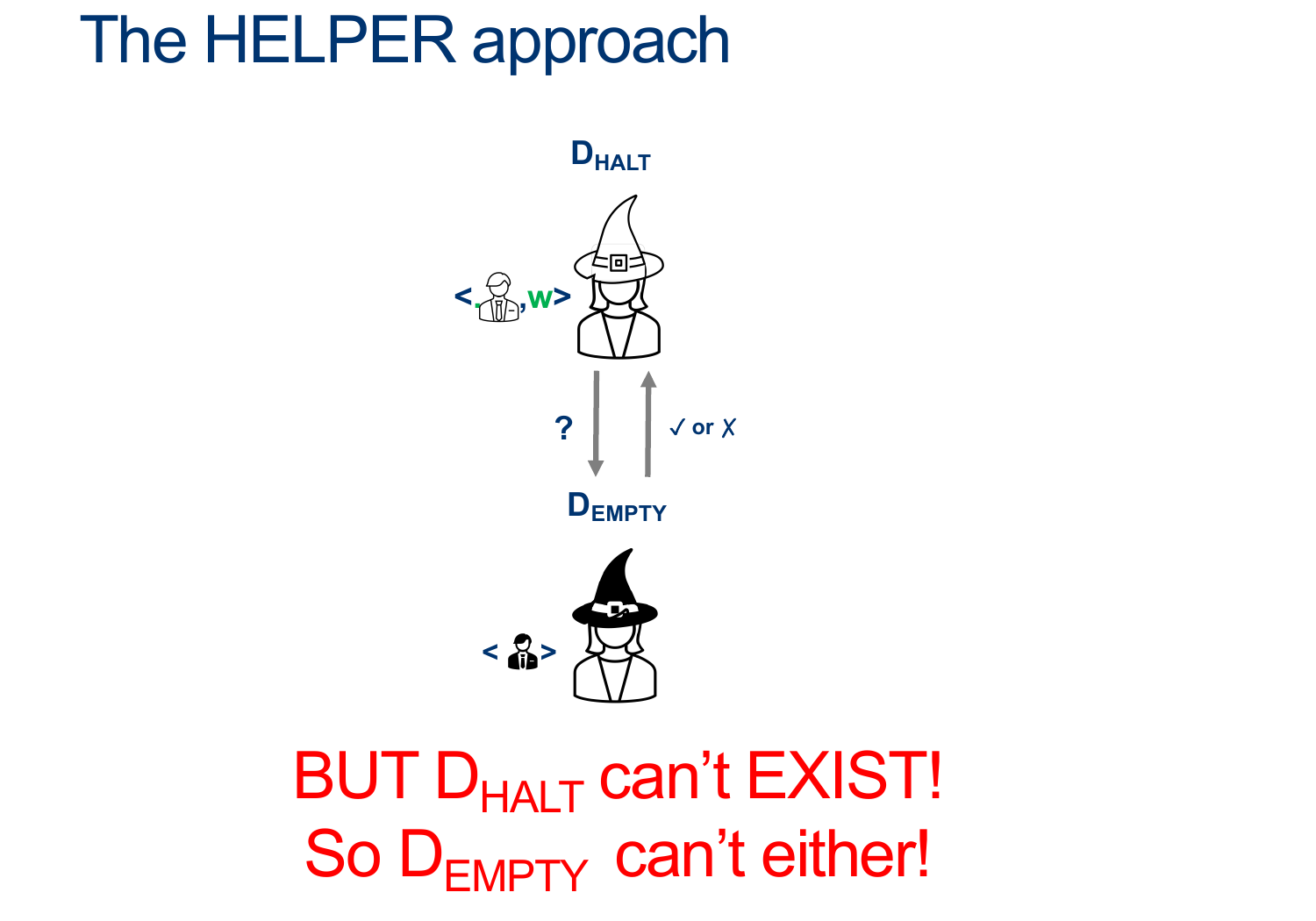
Activity 1 [2 minutes] How would you do this reduction?:
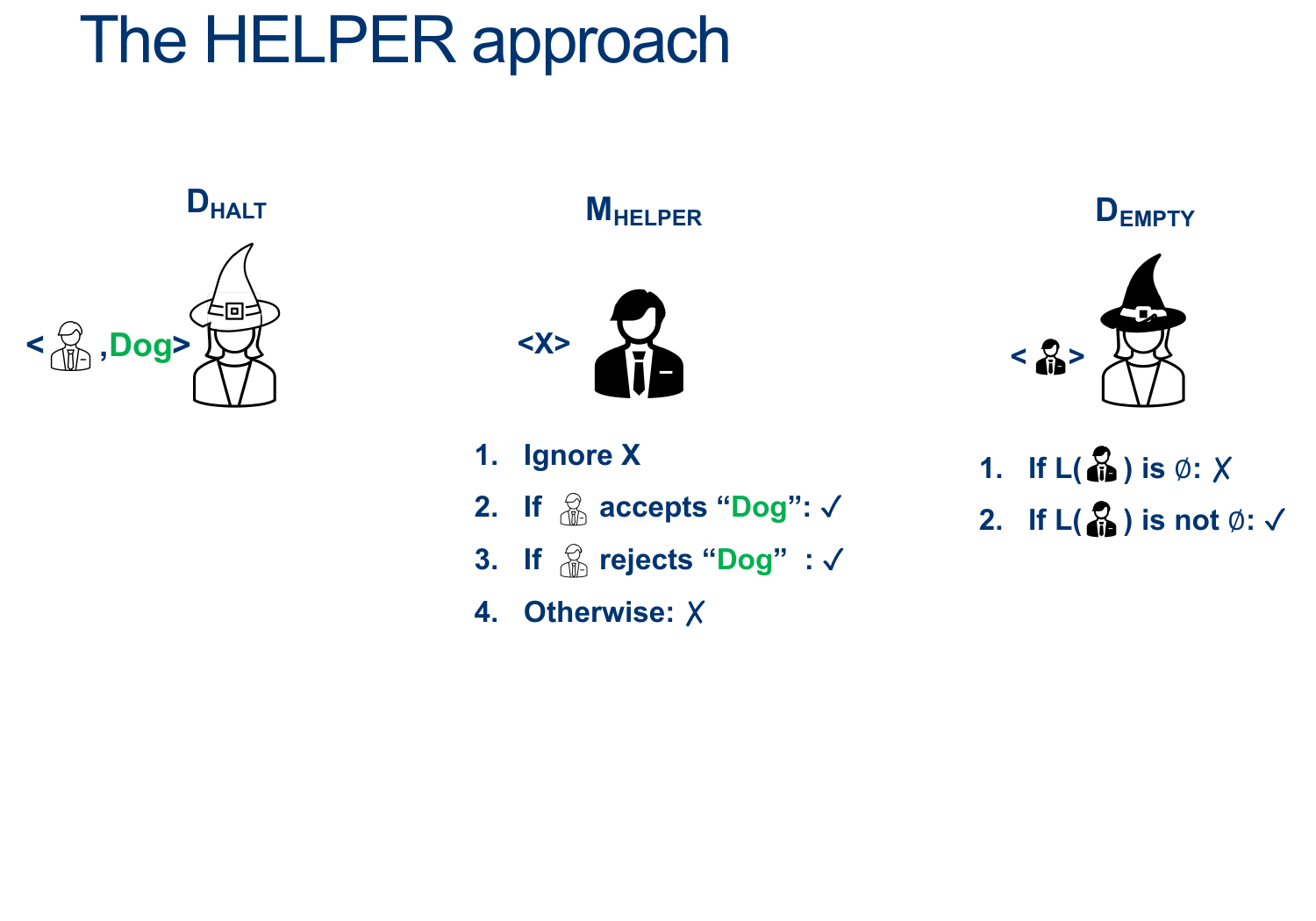
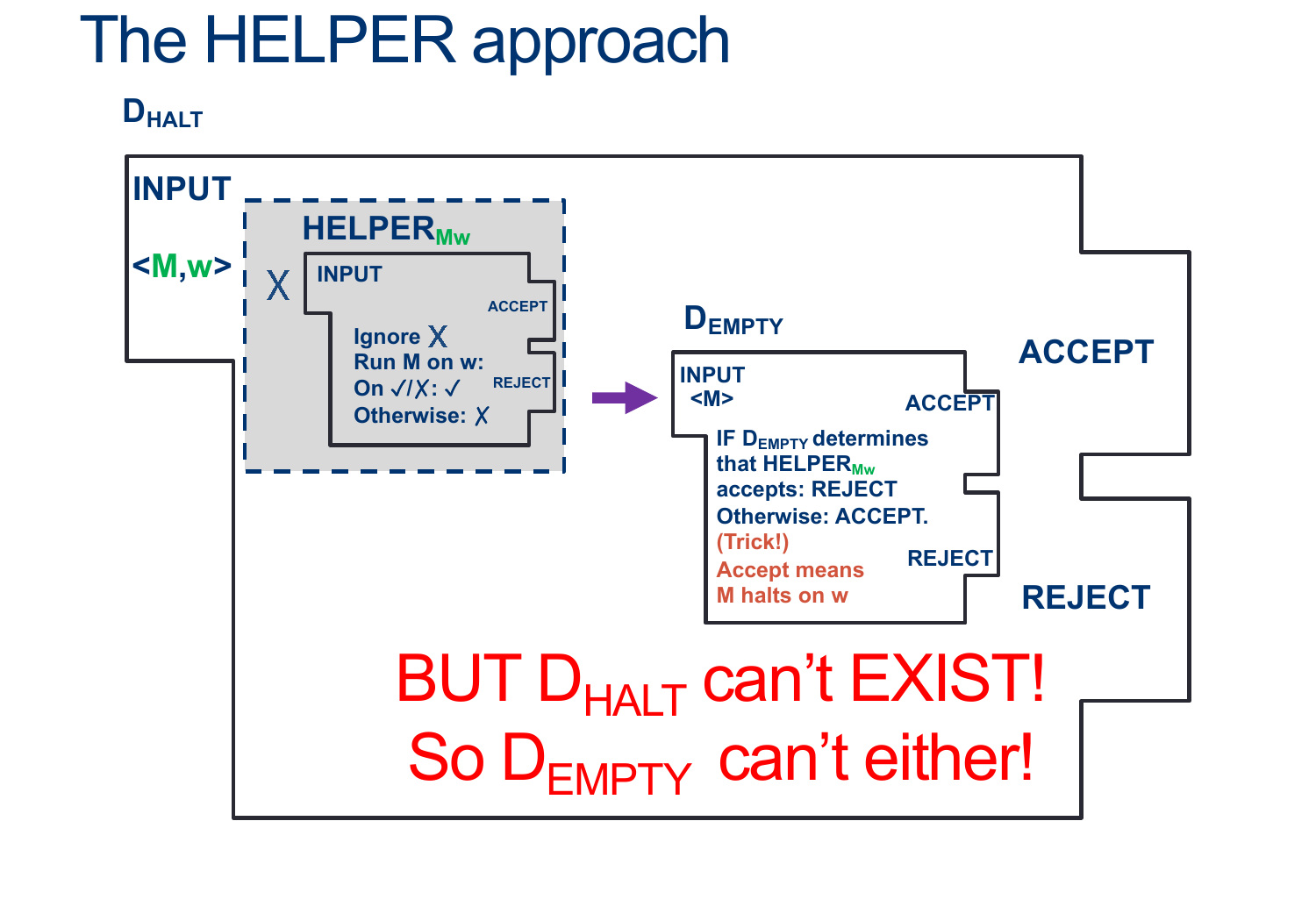
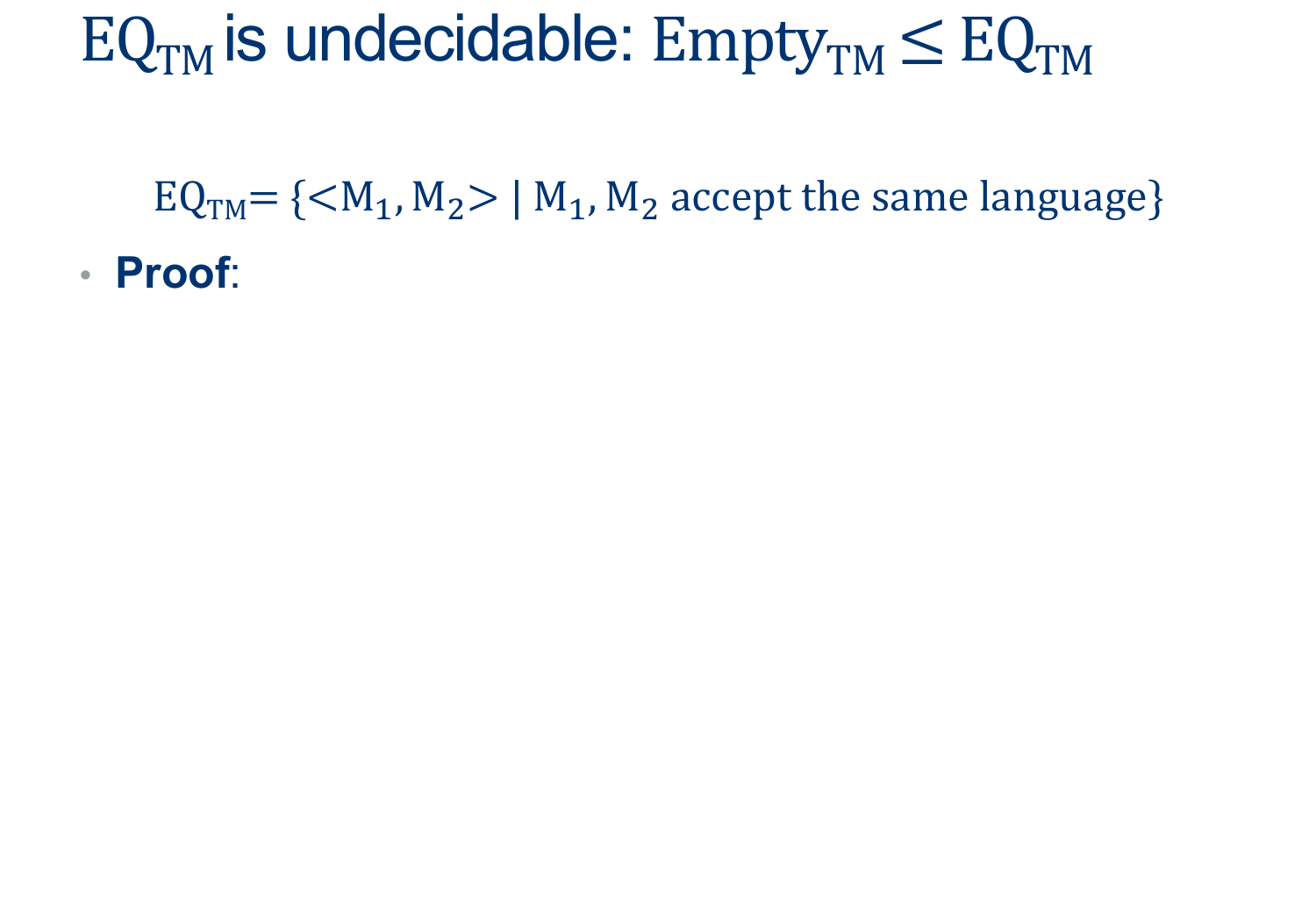
Activity 2 [2 minutes] How would you do this reduction?: (Wait; then Click)
Assume EQTM is decidable, and so there exists some $D_{EQTM}$ that decides, for any input $< M_1, M_2>$, whether $M_1$ Accepts the same language as $M_2$.
We’ll design the Machine $D_{EmptyTM} $ as follows:
\[\begin{align*} &D_{EmptyTM}:\\ & \text{ On input $ < M > $ }:\\ & \text{ Create (but don't run) $HELPER_{\emptyset}$ such that}\\ & \quad \text{ On input $ < X > $ }:\\ & \quad \quad \text{ Ignore $ < X > $ }\\ & \quad \quad \text{ Reject}\\ & \text{ Now Run $D_{EQTM}$ on input $ < M, HELPER_{\emptyset} $ ADWID}\\ & \text{ If $D_{EQTM}$ accepts, it is only because M accepts no words so our machine ACCEPTS}\\ & \text{ If $D_{EQTM}$ rejects, , it is only because M accepts some w so our machine REJECTS}\\ \end{align*}\]
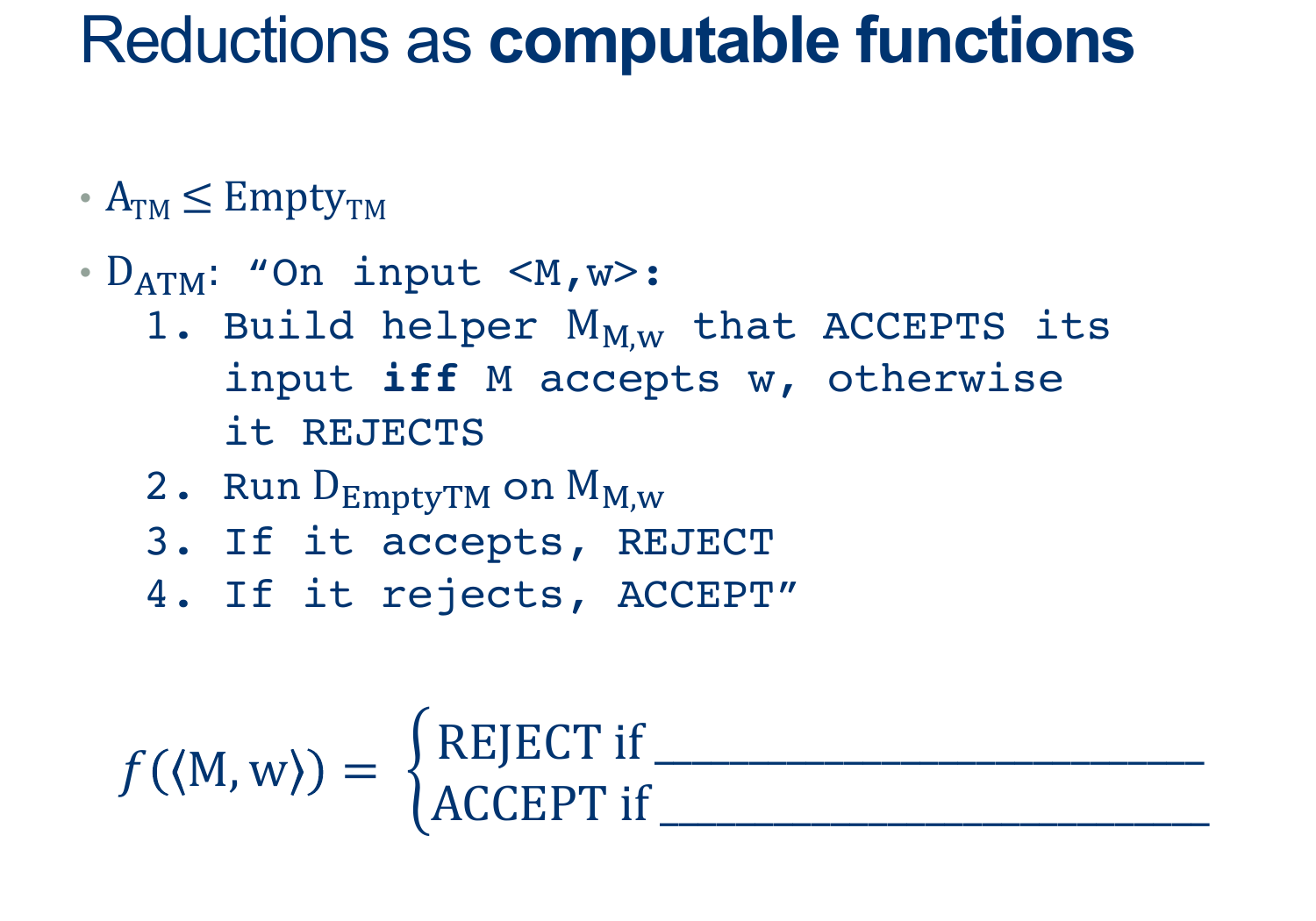
Activity 3 [2 minutes] How would you do this reduction?: (Wait; then Click)
- Reject if: $D_{EMPTY}$ accepts $M_{M,w}$
- Accept if: $D_{EMPTY}$ rejects $M_{M,w}$
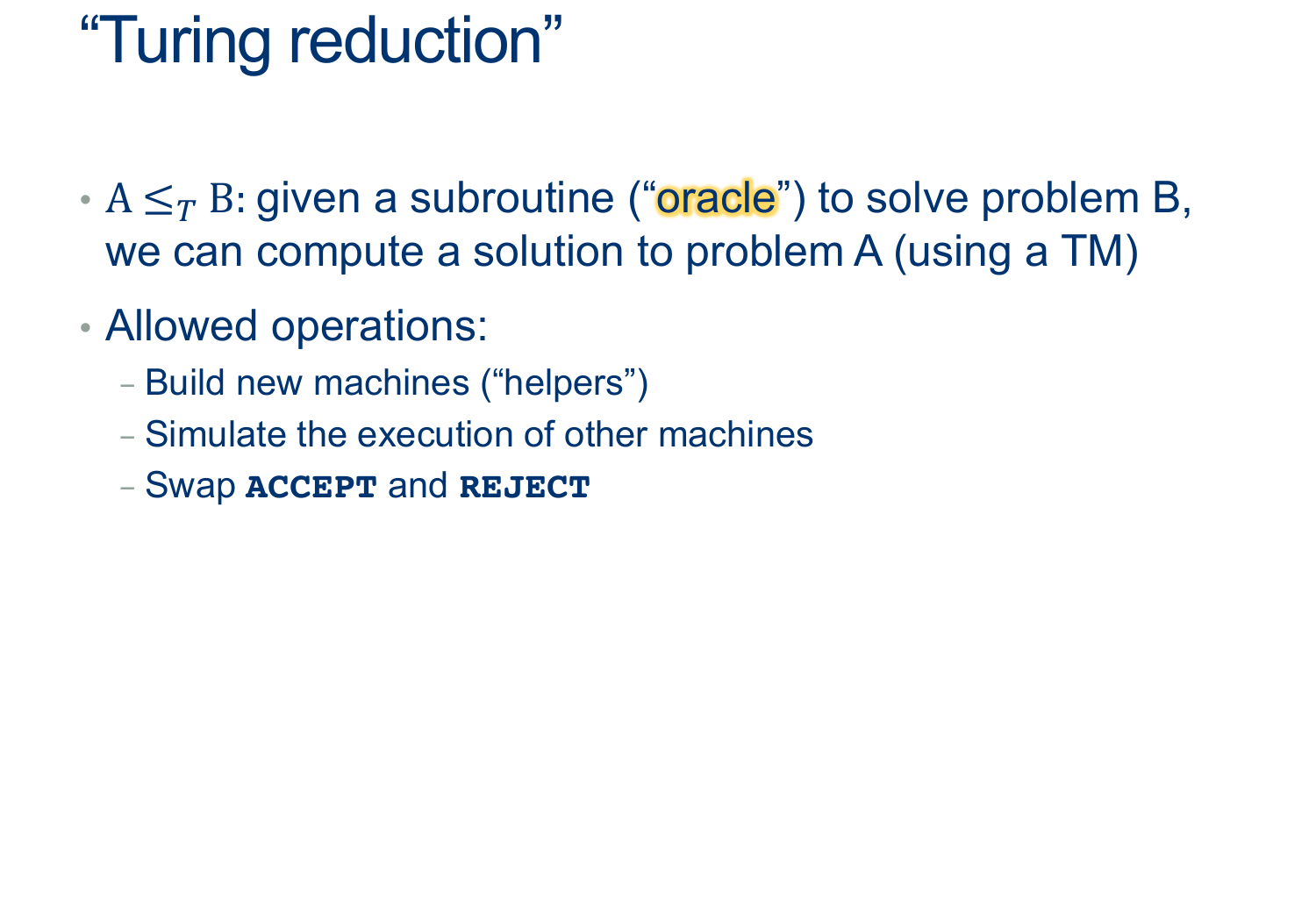
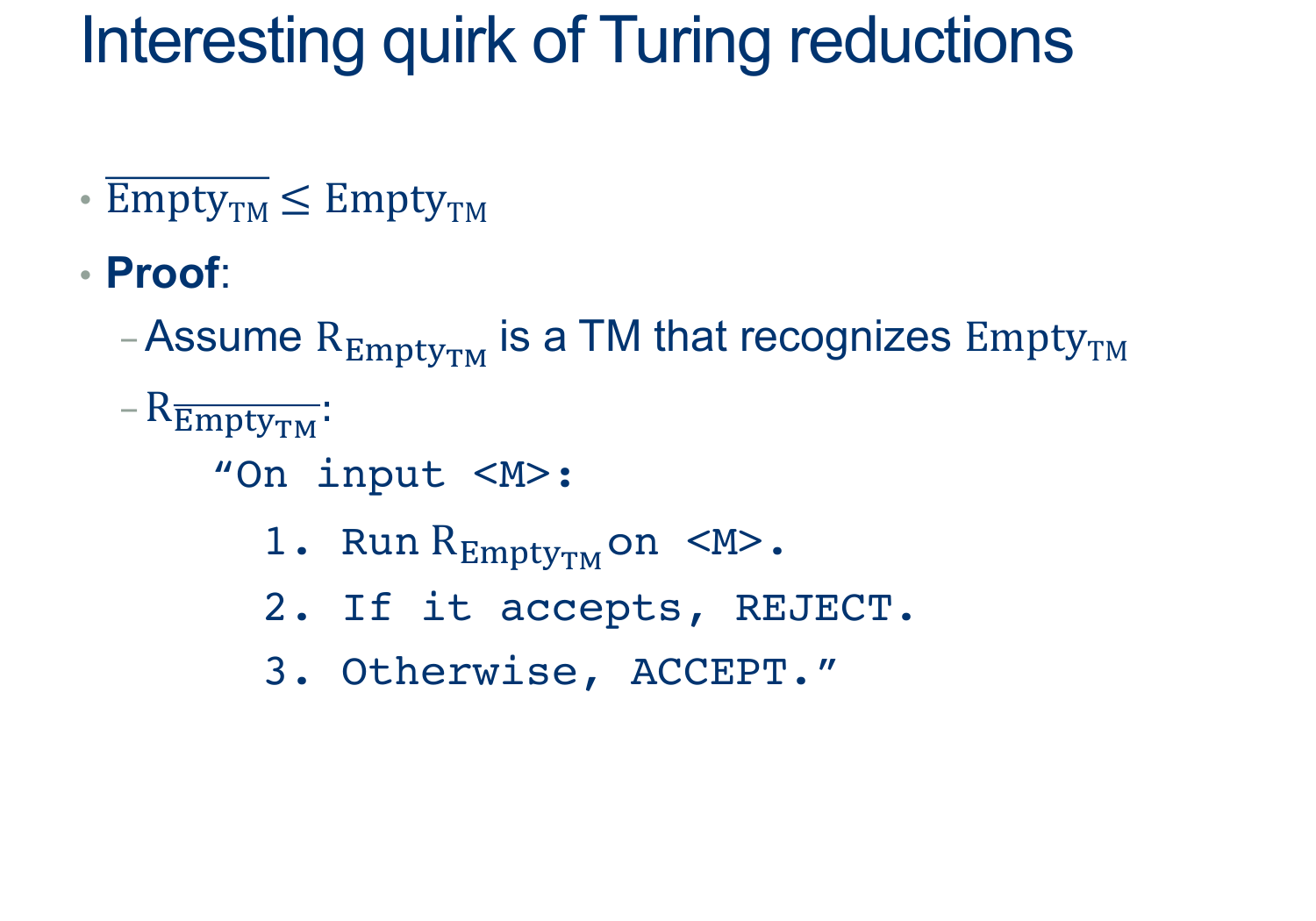
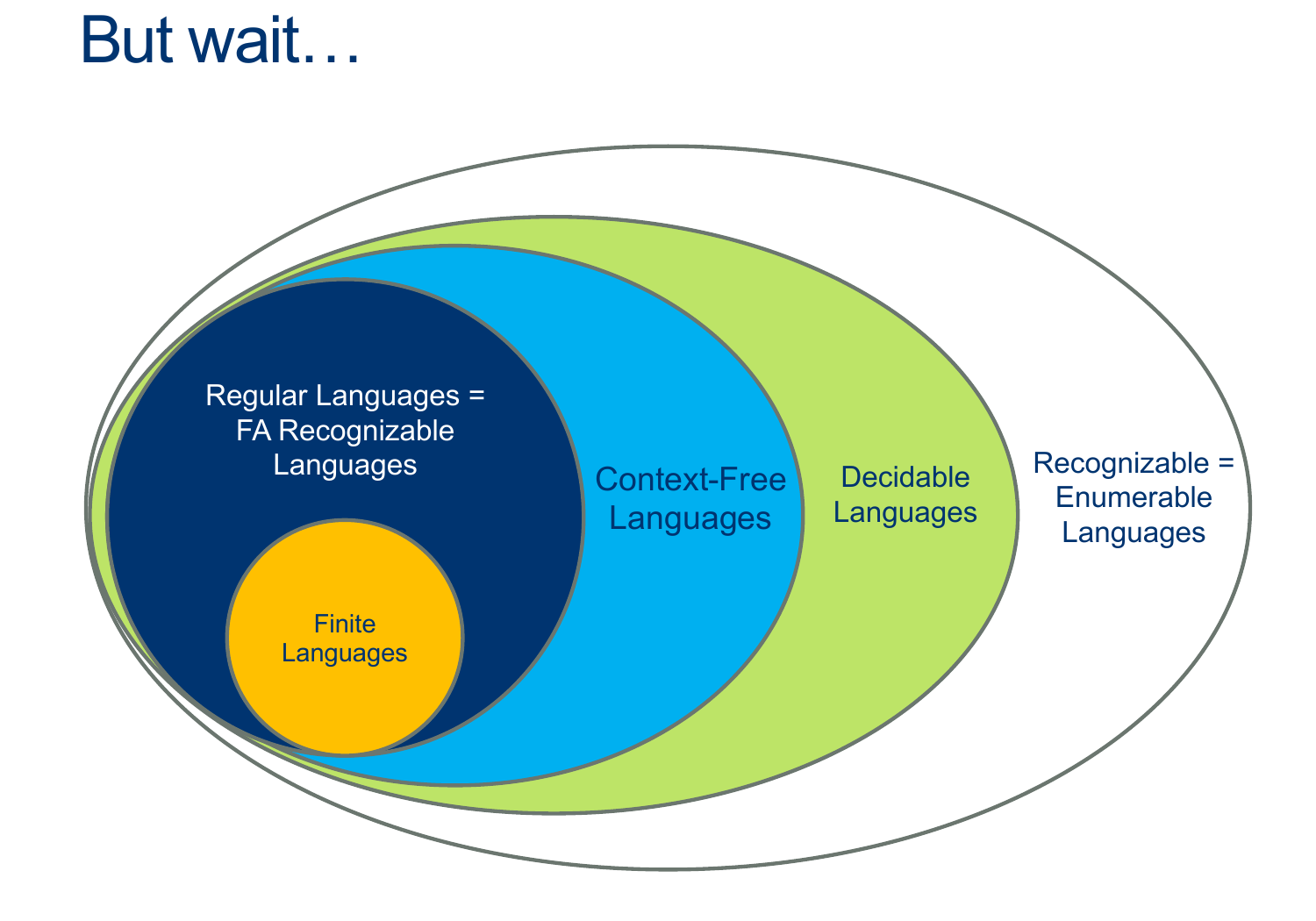
The Emptiness Problem
- Theorem: $\overline{EMPTY-TM}$ is recognizable
- Theorem: $EMPTY-TM$ is undecidable
- Corollary: $EMPTY-TM$is unrecognizable
- Proof: If $\overline{EMPTY-TM}$ and $EMPTY-TM$ recognizable,
- that would imply $EMPTY-TM$ is decidable
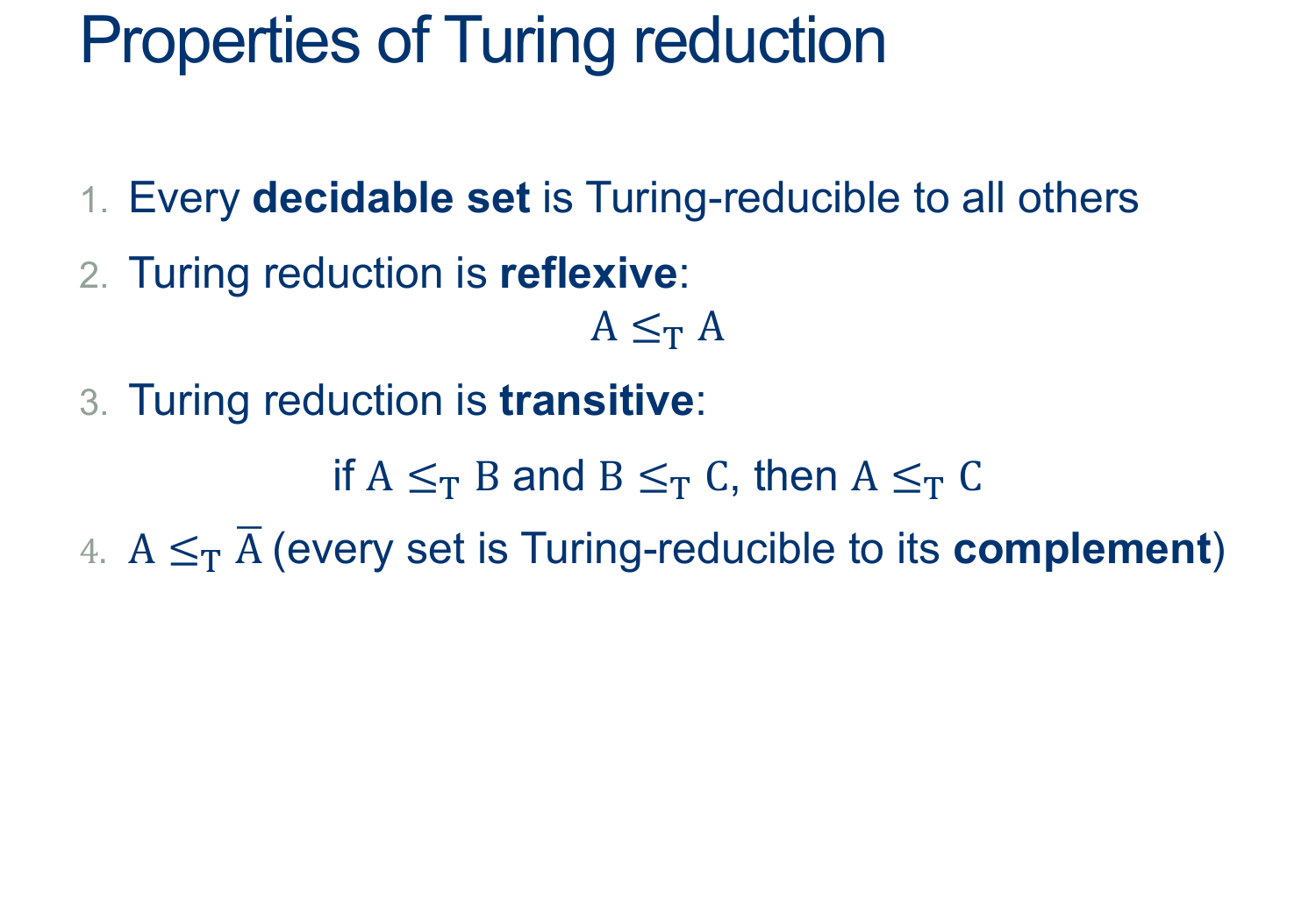
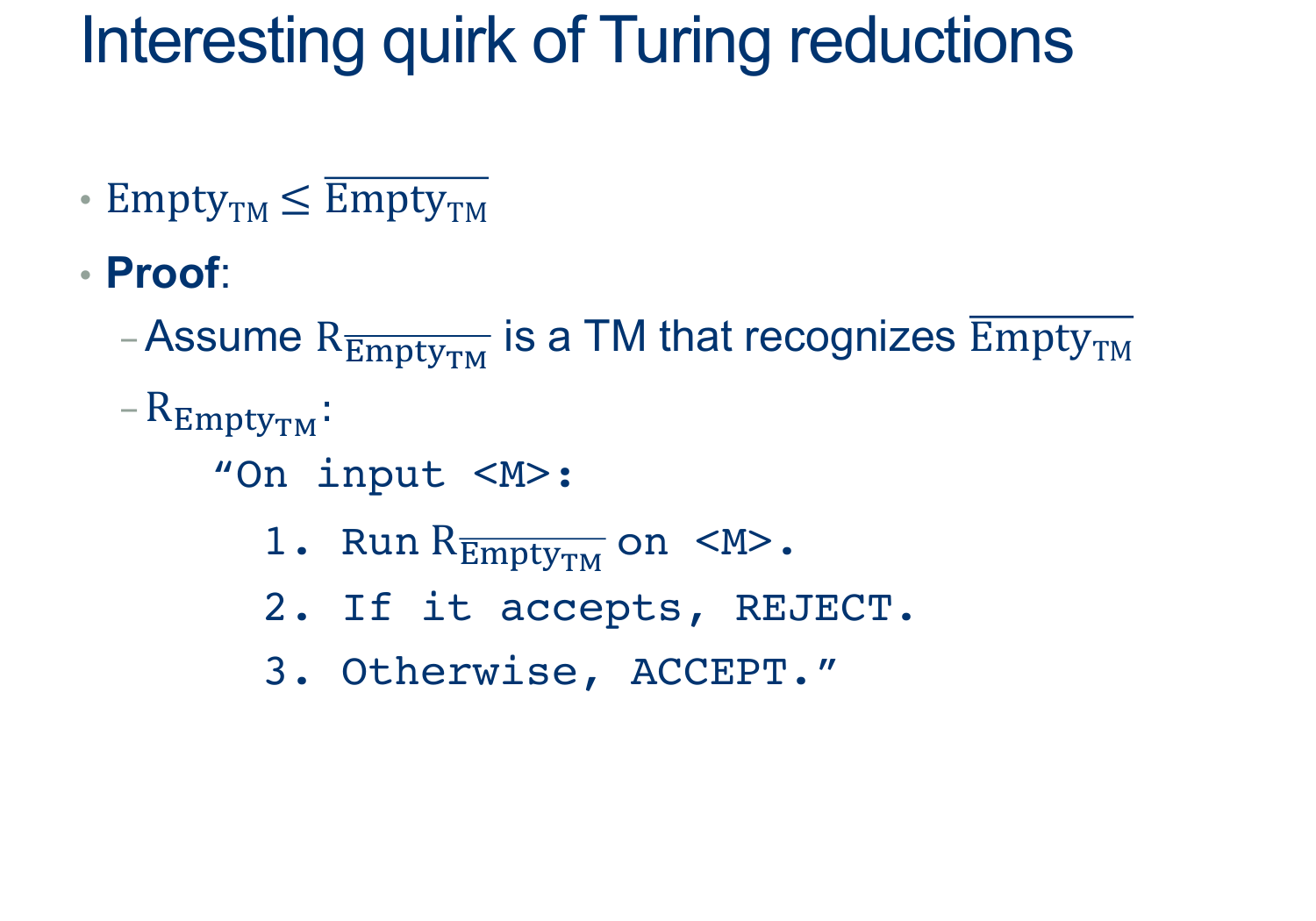
This means our Turing Reduction can’t catch the ordering between languages… nor can we really use it to establish, from its results a clear idea of the class of languages they belong to.
Issue with EMPTY ≤ ¬EMPTY is that the “Domain” of one is complement of the “Domain” of the other!
However, we’ve actually seen a STRONGER type of reduction
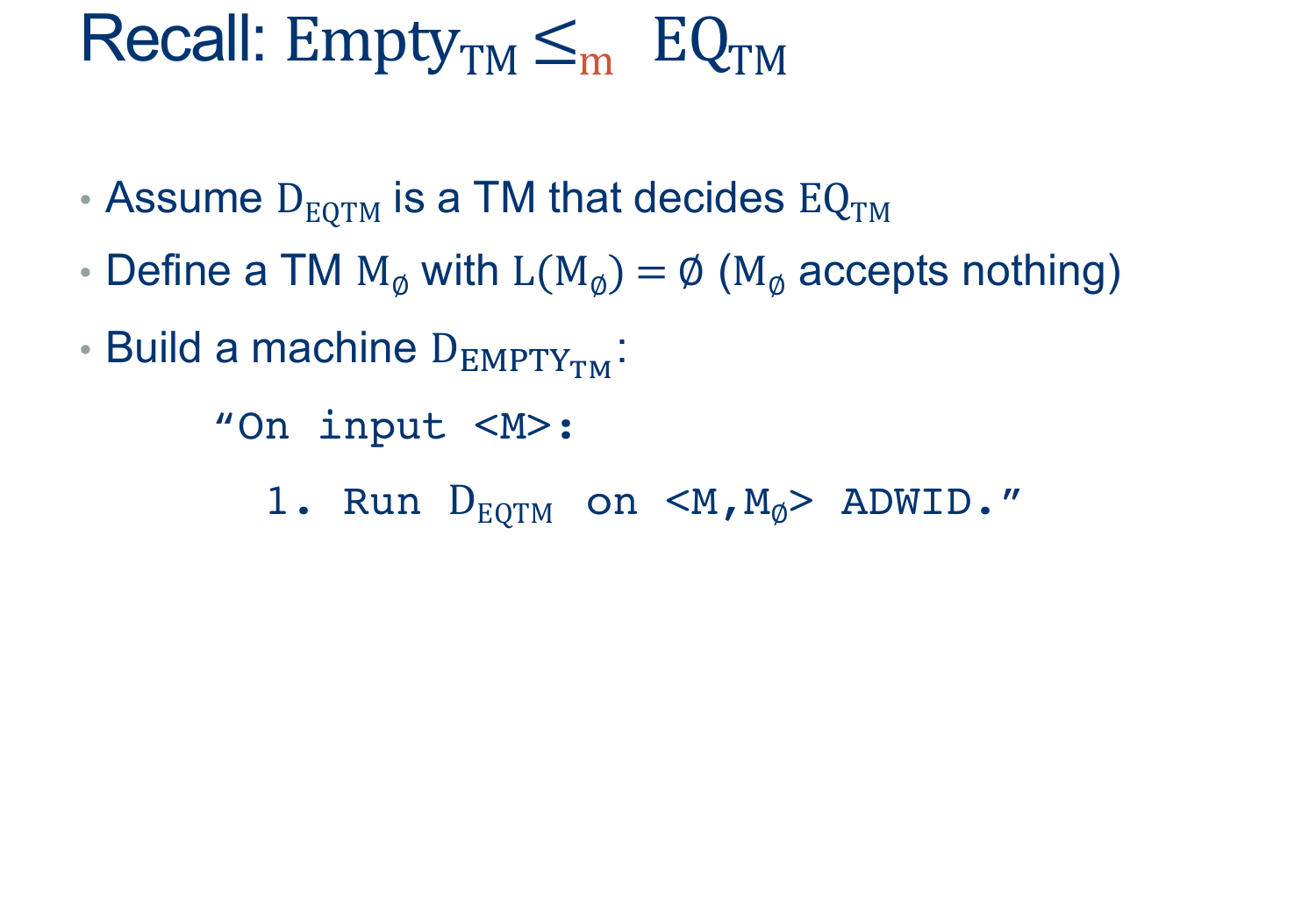
Here, The “Domain” of EMPTY corresponds to the “Domain” of EQ!
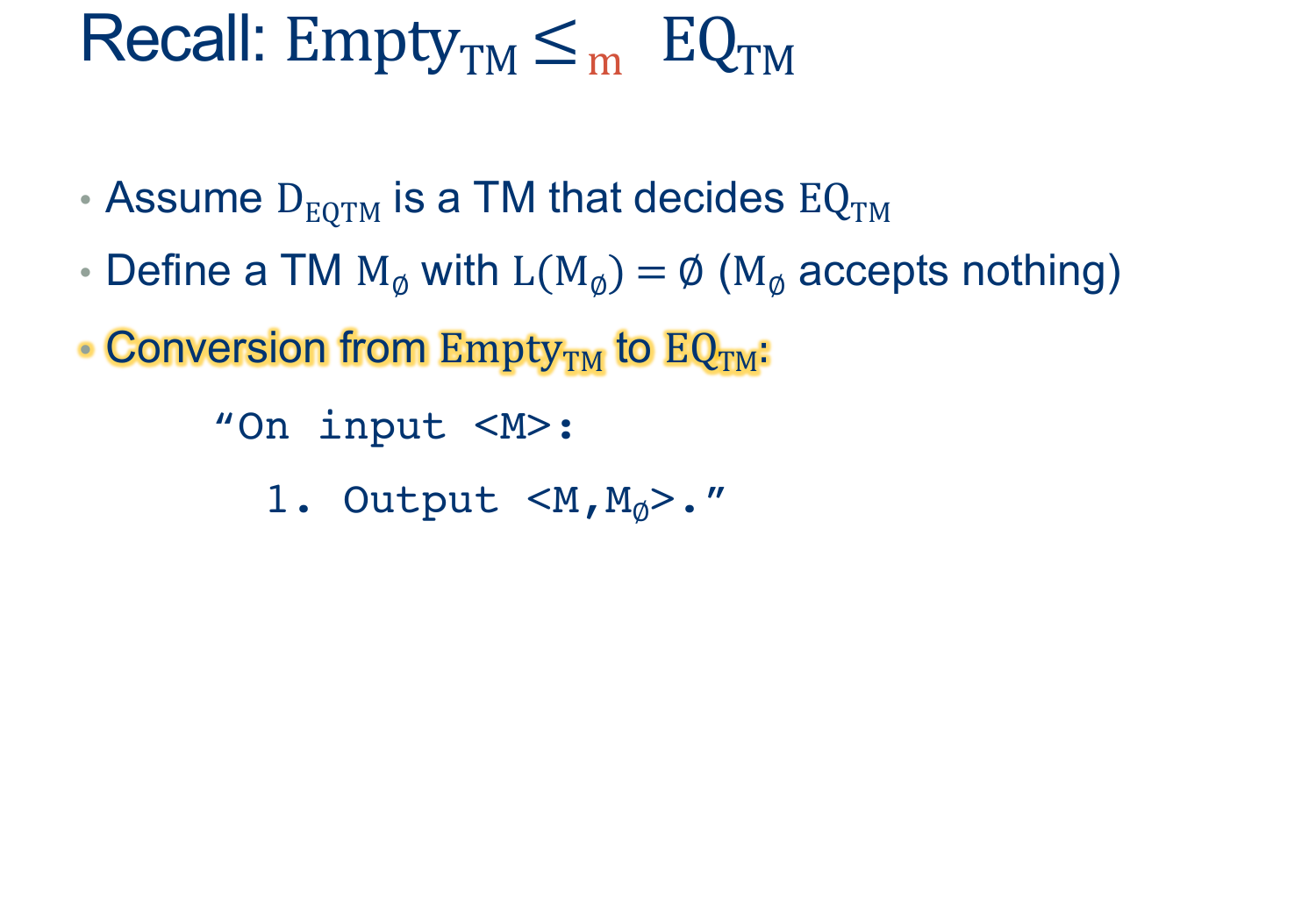
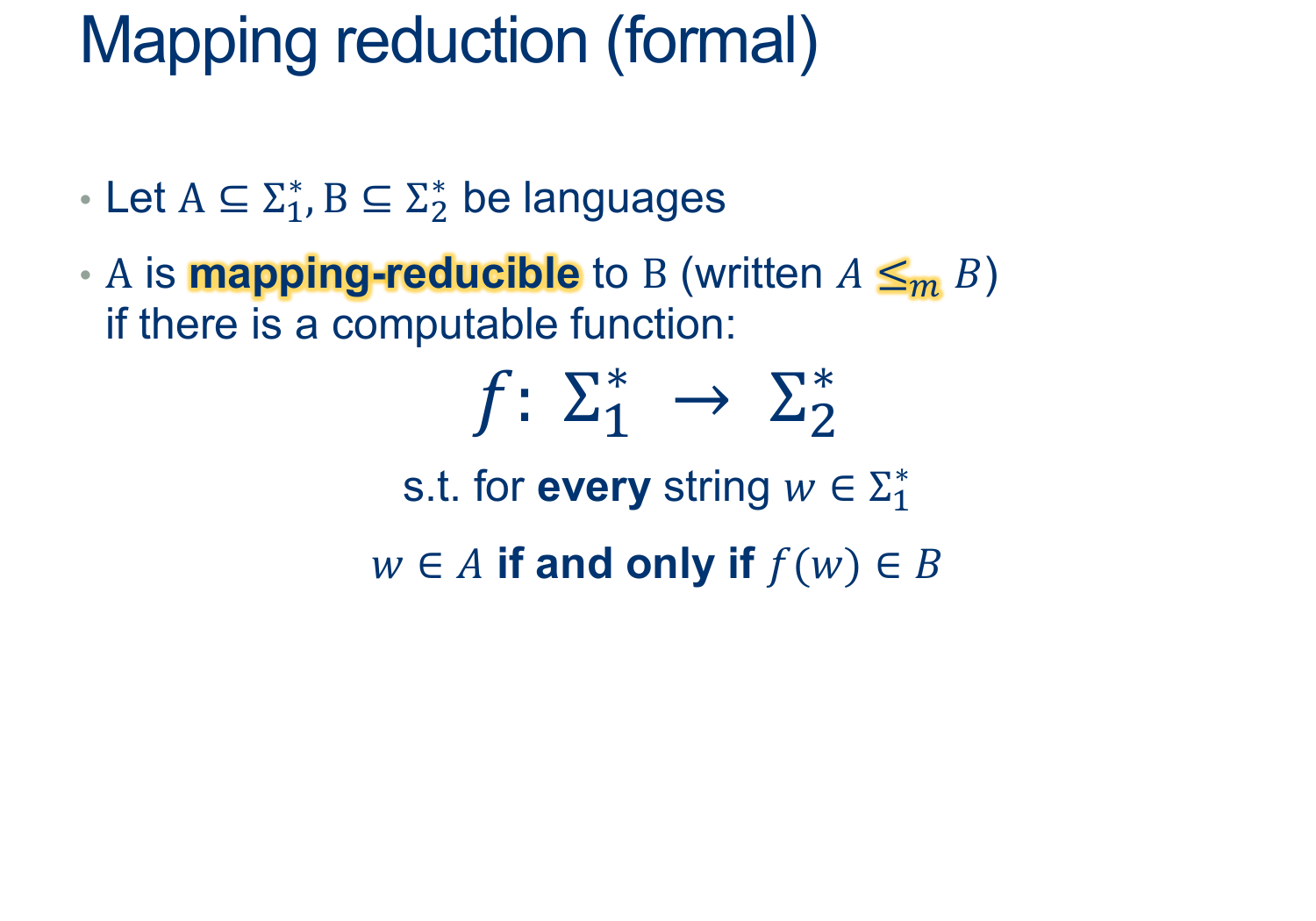
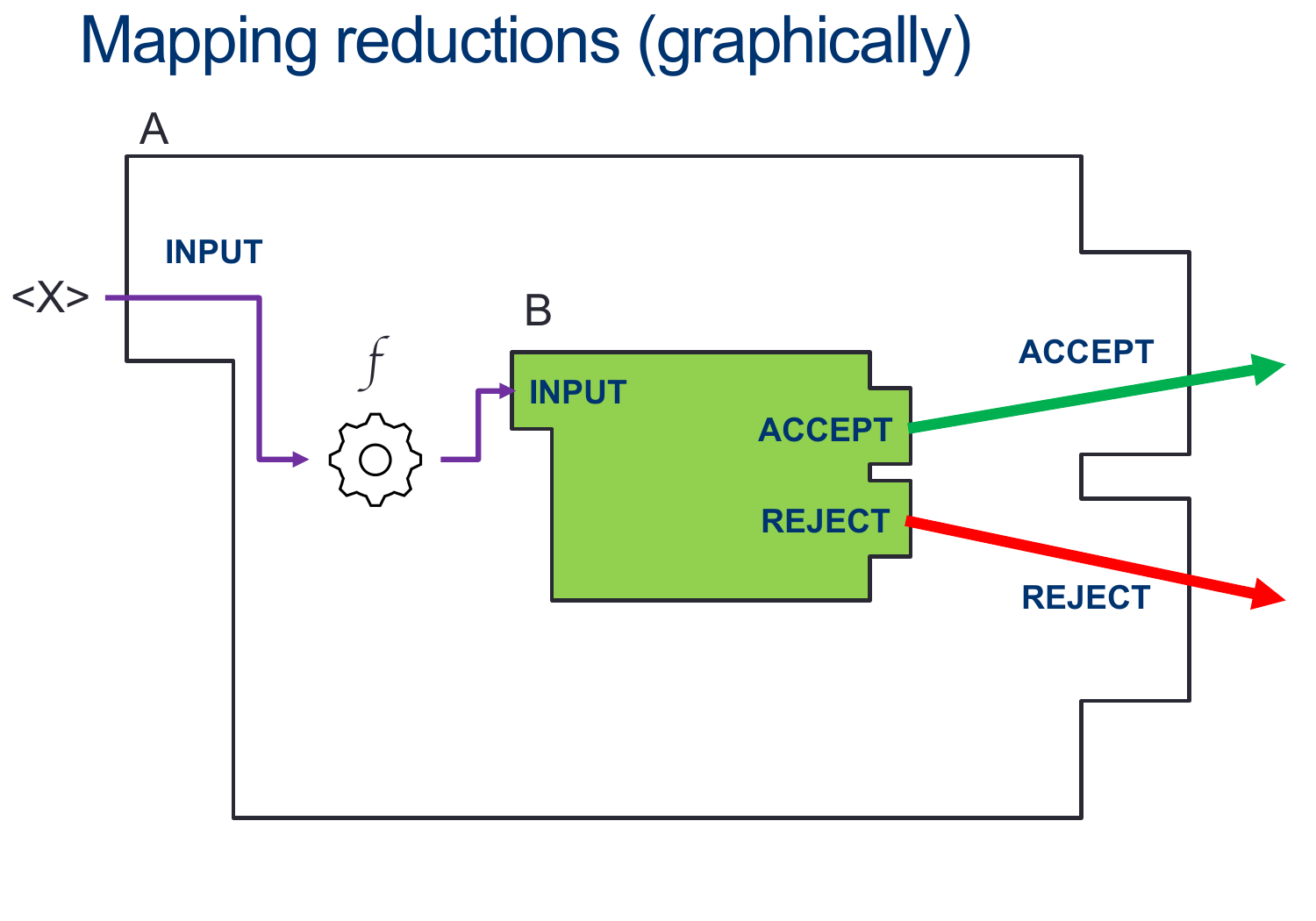
We could rewrite this as a simple conversion from any word in EmptyTM to a word in EQ_TM (and similarly a word not in EmptyTM to a word not in EQ_TM).
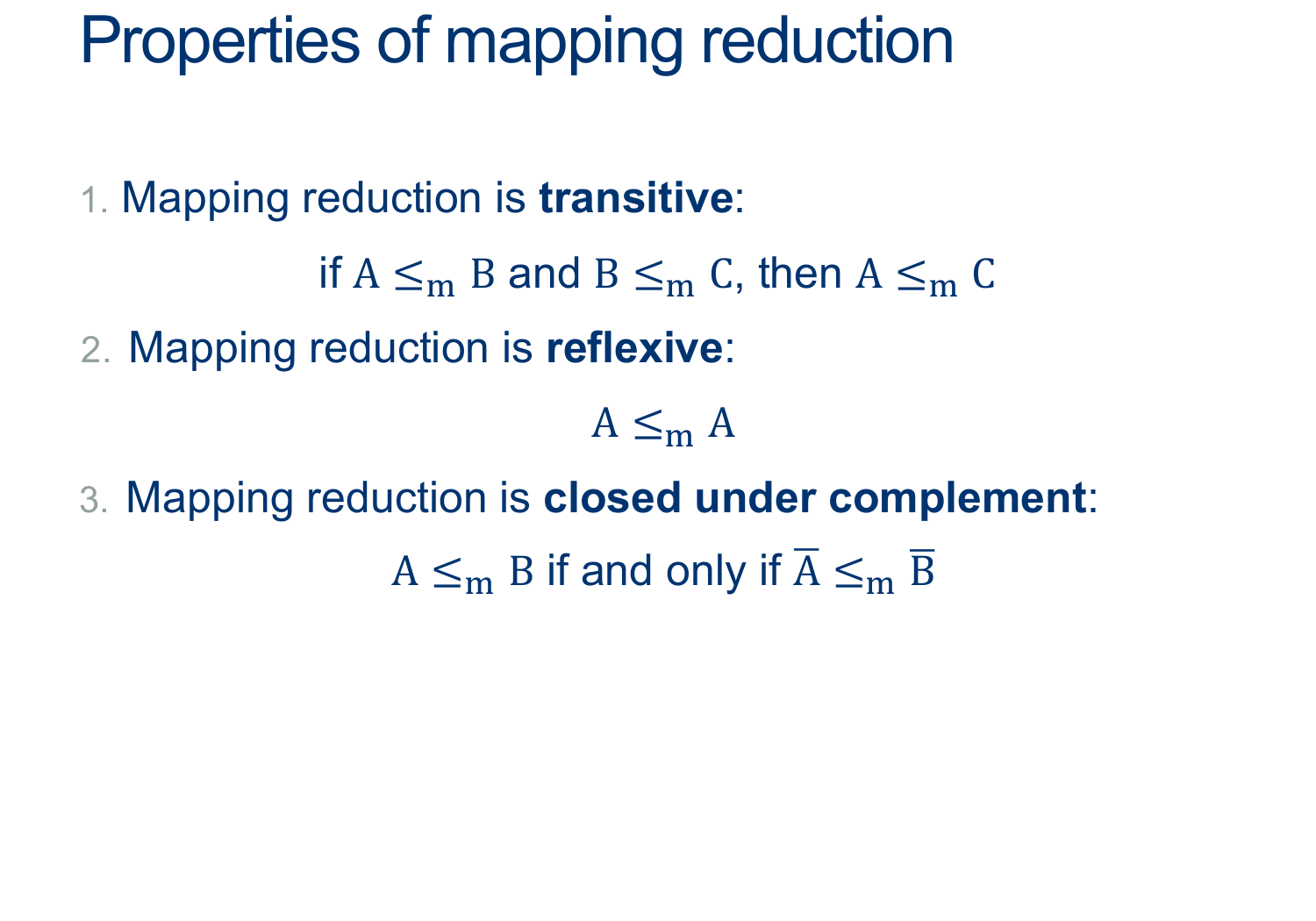
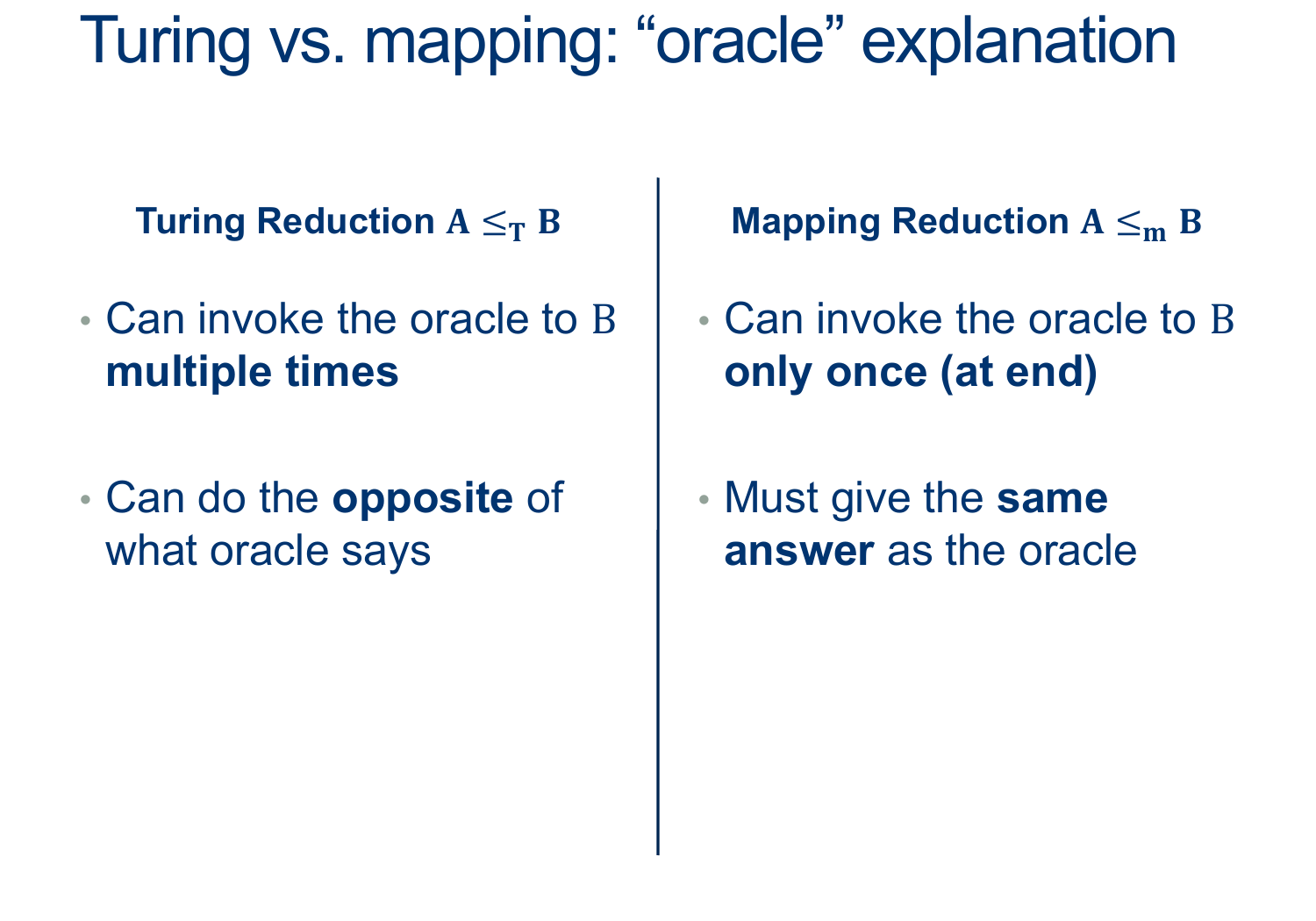
We call this a mapping reduction, and denote it $ \leq_m$
Mapping Reductions

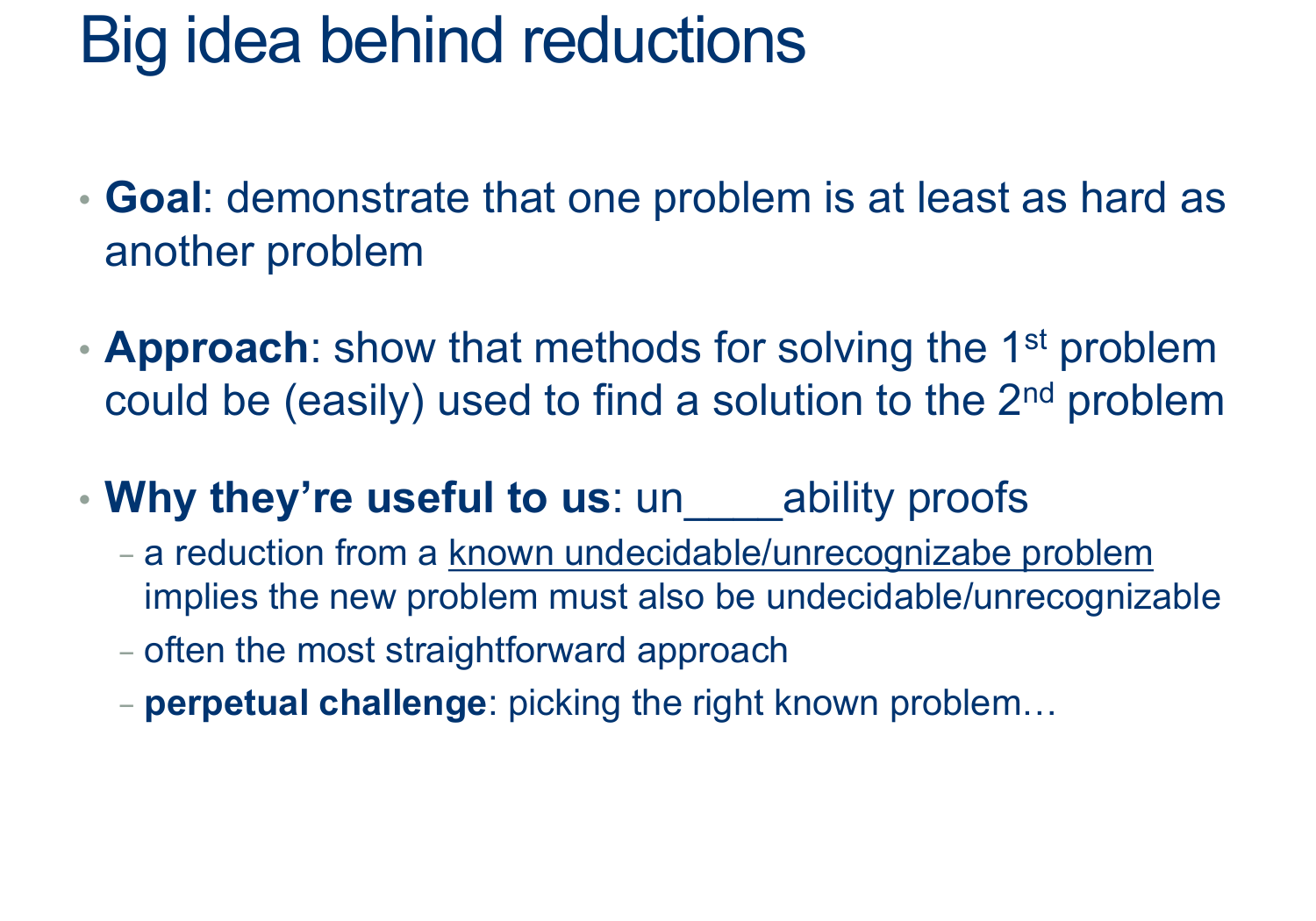
They’re a way for us to relate problems to one another
If A reduces to B and B is easy => A is easy too
More common: if A reduces to be and A is hard => B is hard too
We started with ATM (which we proved was undecidable using a big ugly contradiction )
Reduced ATM to HALT (ATM ≤ HALT): we showed that if we had a decider HALT, we could use that to decide ATM (so that means HALT must also be undecidable)
We did the same thing with ATM-01
And EmptyTM
Later, we also showed that if we had a decider for HALT, we could use that to decide EmptyTM
And that if we had a decider for EQ_TM, we could yet again decide EmptyTM (mapping)
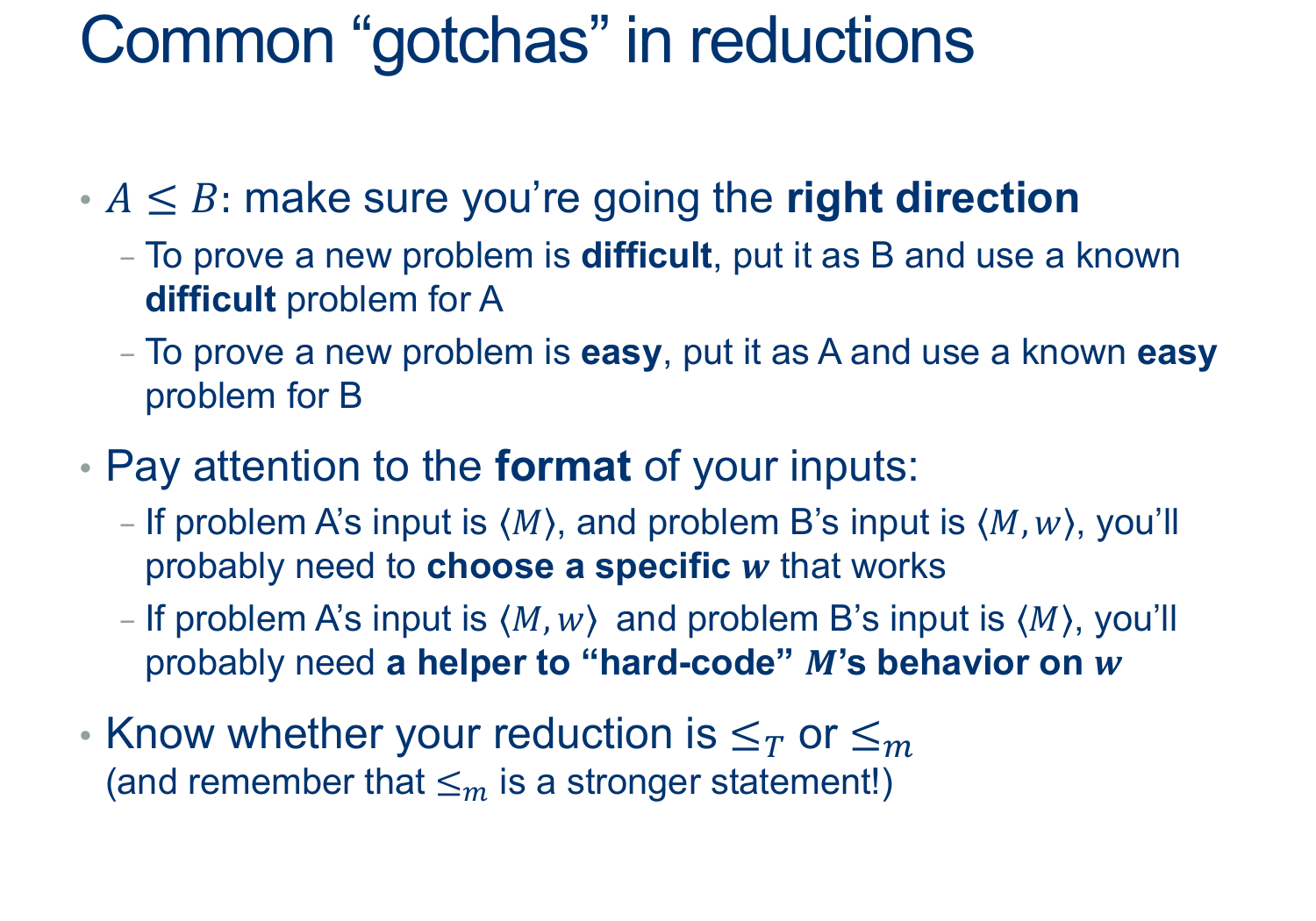
Mapping Reducibility and Reductions Conclussion
A Reduction Issuue
The Emptiness Problem
- Theorem: $\overline{EMPTY-TM}$ is recognizable
- Theorem: $EMPTY-TM$ is undecidable
- Corollary: $EMPTY-TM$is unrecognizable
- Proof: If $\overline{EMPTY-TM}$ and $EMPTY-TM$ recognizable,
- that would imply $EMPTY-TM$ is decidable
This means our Turing Reduction Can’t catch if the fact that we’re reducing outside the same class of languages
Issue with EMPTY ≤ ¬EMPTY is that the “Domain” of one is complement of the “Domain” of the other!
However, we’ve actually seen a STRONGER type of reduction
Here, The “Domain” of EMPTY corresponds to the “Domain” of EQ!
We could rewrite this as a simple conversion:
from any word in EmptyTM to a word in EQ_TM (and similarly a word not in EmptyTM to a word not in EQ_TM).
We call this a mapping reduction, and denote it $ \leq_m$
Mapping Reductions
They’re a way for us to relate problems to one another
If A reduces to B and B is easy => A is easy too
More common: if A reduces to be and A is hard => B is hard too
We started with ATM (which we proved was undecidable using a big ugly contradiction )
Reduced ATM to HALT (ATM ≤ HALT): we showed that if we had a decider HALT, we could use that to decide ATM
(so that means HALT must also be undecidable)
We did the same thing with ATM-01
And EmptyTM
Later, we also showed that if we had a decider for HALT, we could use that to decide EmptyTM
And that if we had a decider for EQ_TM, we could yet again decide EmptyTM (mapping)
Activity 1 [2 minutes] How would you do this reduction?: (Wait; then Click)
(Wait; then Click)
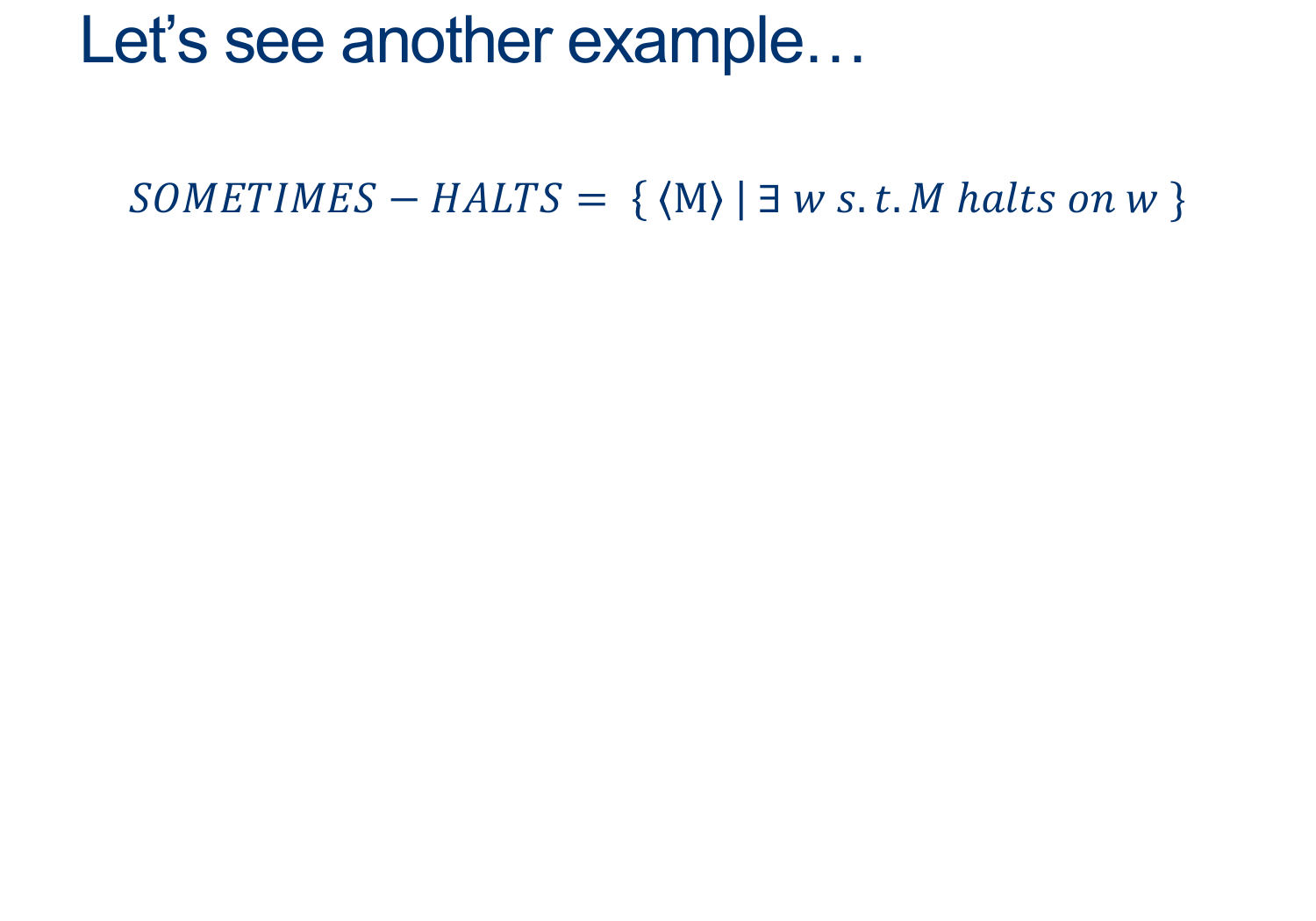
$$HALT \leq_m SOMETIMES-HALTS$$ We want to show that we can take any input and transform it such that: if the input was a word in HALT $(< M,w>)$, the output is a word $(< M>)$ in SOMETIMES-HALTS if the input was NOT a word in HALT, the output is NOT a word in SOMETIMES-HALTS This suggests that we want to build a helper machine that “amplifies” the behavior of M on w: $$ \begin{align*} &D_{HALT}:\\ & \text{ On input $ < M,w > $ }:\\ & \text{ Create (but don't run) $HELPER_{M,w}$ such that}\\ & \quad \text{ On input $ < X > $ }:\\ & \quad \quad \text{ Ignore $ < X > $ }\\ & \quad \quad \text{ Run M on w ADWID}\\ & \text{ Now Run $D_{S-H}$ on input $ < HELPER_{M,w} > $ ADWID}\\ \end{align*} $$ The only way the helper halts is if M halts on w (if this is the case, it halts on EVERY input). Otherwise, it loops. In other words, if $< M,w>$ was in HALT, then the helper will be in SOMETIMES-HALTS, and if $< M,w>$ is NOT in HALT, then the helper won’t be in SOMETIMES-HALT. Thus, we’ve defined a mapping that from problems in HALT to problems in SOMETIMES-HALTS, proving that SOMETIMES-HALTS is at least as difficult as HAL, and so must be undecidable.